


Cosmic Census Expands: Elusive Giant Emerges After Decade-Long Standoff with Starlight
POLICY WIRE — CAPE CANAVERAL, Fla. — For a cosmic detective story spanning more than a decade, the revelation arrives with the understated drama of a library turning over a forgotten book. Scientists...

POLICY WIRE — CAPE CANAVERAL, Fla. — For a cosmic detective story spanning more than a decade, the revelation arrives with the understated drama of a library turning over a forgotten book. Scientists have, at long last, directly observed a new gas giant planet—a dim, hulking adolescent orbiting a young star. And get this: it’s been lurking, largely unnoticed, in astronomical data all this time. You’d think after all those years, after all that light-travel, the universe might make it a little easier.
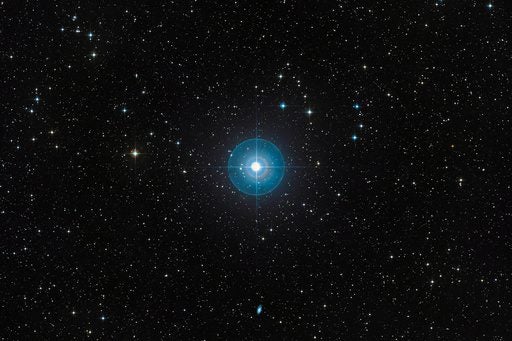
This isn’t your average planet-finding gig. We’re talking about an elusive world, roughly the size of Jupiter but a hundred times fainter, chilling out around Beta Pictoris—a star system barely 20 million years old, a mere infant in galactic terms. Our own sun, by comparison, is an ancient, weathered sage, having graced the cosmos for 4.5 billion years. What’s truly fascinating? Two distinct groups of stargazers, operating independently from opposite ends of the globe, stumbled upon the same faint signal just days apart late last year. It’s like discovering buried treasure simultaneously on different continents with different maps, and that’s saying something.
One team, spearheaded by Scottish and German researchers, deployed the European Southern Observatory’s Very Large Telescope in Chile. They peered into the celestial void, saw something, — and then painstakingly sifted through archival data. Lo and behold, the spectral smudge that would become Beta Pictoris c had been there all along, hiding in plain sight—eclipsed by its much brighter stellar parent and two known planetary siblings. “It was, if you will, playing hide-and-seek for over 11 years,” remarked Markus Bonse, a co-leader on the European team, capturing the long, silent struggle. And he’s not kidding; this kind of work takes immense patience, the sort only truly committed researchers possess.
The other squad, a California-led contingent, had NASA’s Webb Space Telescope do the heavy lifting. That powerhouse of a machine, the biggest — and baddest ever sent into space, only needed a couple of observations. The teams, famously (or perhaps notoriously) kept their findings under wraps from each other, keen to prevent any accidental biases tainting their painstaking conclusions. Imagine that level of competitive scientific restraint—you don’t see it every day, certainly not in most policy circles.
But what does this all mean for those of us tethered to Earth? Well, Beta Pictoris c takes a leisurely 91 years to complete one orbit around its star. It’s born into chaos, likely pummeled by asteroids and comets in a way our placid solar system hasn’t been in eons. Dr. Aidan Gibbs, who led the California group from the University of California San Diego, believes it’s “our most lucid glance at a planetary system fresh out of the cosmic oven, still finding its footing.” The sheer difficulty of the discovery is noteworthy, too. Fewer than 100 of the over 6,000 confirmed exoplanets we know about have been directly imaged this way; the vast majority are found when they’re just passing in front of their star, causing a brief, detectable dimming, according to NASA. That’s how scarce these direct observations are.
What This Means
This isn’t merely another astronomical tally; it’s a window. By catching a planetary system in its relative infancy, scientists gain an almost real-time laboratory to study how gas giants form and how planetary architectures stabilize. It helps us flesh out the evolutionary narratives of systems far from our own. Understanding these primordial conditions sheds light on our own cosmic origins—how our Earth, our Sun, our very selves, came to be.
Economically and politically, such grand scientific endeavors, while seemingly detached from immediate terrestrial concerns, represent massive investments in human ingenuity and global collaboration. These projects cost billions, require decades of planning, — and transcend national boundaries. Even in nations like Pakistan, where scientific infrastructure often grapples with more pressing societal demands, the allure of the cosmos remains a powerful, unifying force. Ancient Muslim scholars made indelible contributions to astronomy, a legacy that continues to inspire. Funding these ventures means placing a tangible value on fundamental discovery—a policy choice that often faces stiff competition from defense spending, climate mitigation, or even efforts like monitoring Iran’s “Ghost Fleet” in the Arabian Sea, as described by Policy Wire earlier this year. Because these investments are in humanity’s collective intellectual capital, that’s why they matter beyond the lab.
The next frontier, say University of Edinburgh’s Dr. Ben Sutlieff, is “building a more comprehensive picture.” But what exactly does that “picture” tell us? It reminds us that our own relatively tranquil corner of the Milky Way isn’t the universe’s default setting. Young planetary systems are violent, chaotic cauldrons where planets are still finding their gravitational rhythm. And perhaps most importantly, it reinforces the sheer scope of what we still don’t know, even after decades of probing the blackness. Sometimes, the universe just makes you wait.