


USMNT World Cup: 10 Men, Epic Win, Round of 16
Relive the USMNT's dramatic World Cup triumph! See how they overcame a red card & scored a stunning free-kick to secure a 2-0 victory, advancing to the Round of 16.

POLICY WIRE — Santa Clara, Calif. — It was the sort of night where narratives, usually so tidily packaged, simply evaporated. Logic fled the field, replaced by a raw, messy spectacle of guts, pain, — and a bit of unadulterated madness. Picture this: America’s World Cup dream—frail, flickering—hanging by a thread. They were down a man, battered, bruised. And then, from the crucible of an eight-year-old’s dream, emerged Malik Tillman.
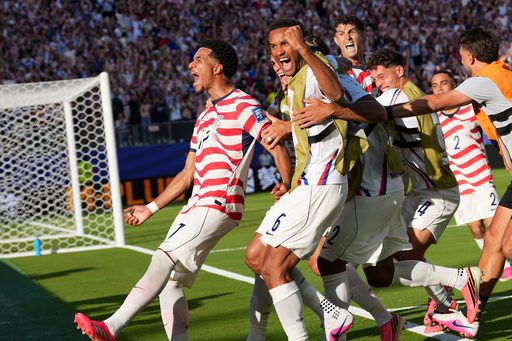
His sock, an undeniable crimson testament to a brutal stamp. His right boot, freshly swapped. But the free kick? It was pure, unadulterated artistry, a curling missile that sealed a 2-0 victory against a valiant Bosnia-Herzegovina side. This wasn’t just a goal; it was a defiant, bloody roar into the Californian night, catapulting the U.S. into the round of 16. It wasn’t the opening salvo one expected—that belonged to Folarin Balogun’s crisp strike just before halftime. But it was the exclamation point, the undeniable, emphatic closer.
Because the story of this match isn’t really about neat goals or flawless execution. It’s about a scramble, a defiant stand. Balogun had put the Yanks up in the 45th minute, his third World Cup goal, but then came the ugly twist. In the 64th minute, an awkward challenge, a slow-motion video review, — and suddenly, a red card. Gone. Poof. Ten men against eleven, with the entire trajectory of the tournament resting on whether they could hold the line. Manager Mauricio Pochettino, a man who knows a thing or two about belief, simply urged them to keep dreaming. After the final whistle, he reportedly belted out “Take Me Home, Country Roads.” One imagines his voice was hoarse—ours were too.
It was a proper nail-biter, a game designed to give cardiologists a run for their money. For Bosnia-Herzegovina, a nation with its own complex history and a passionate fanbase reaching across the globe to the Muslim world, this loss felt particularly sharp. They’d fought tooth and nail, holding their own against a perceived heavyweight, and had their moments after the American red card. “We had our moments after the red card,” Bosnian goalkeeper Nikola Vasilj admitted later, his voice heavy with resignation. “You could feel that there was something. The only thing that was missing was a goal.” And then, Tillman’s free-kick—an unwelcome reminder that football, like life, can be brutally unfair.
Star Christian Pulisic, who had an earlier goal disallowed, watched as Tillman—nursing that injured foot—stepped up. The ball arced, defied gravity, kissed the fingertips of a diving Vasilj, — and found its home. Just like he’d envisioned it. “I’ve been dreaming about maybe taking a free kick and scoring a free kick,” Tillman said post-match, still catching his breath, still absorbing the moment. Sometimes, kids, dreams do come true, even when your foot’s practically falling off.
And let’s not forget the sheer weight of history here. Before this victory, the United States had logged just two knockout-stage wins in World Cup history: one during their semifinal run way back in 1930, and then again against Mexico in the 2002 round of 16. This latest triumph breaks a nearly unbroken chain of early exits for a program constantly yearning for sustained global relevance. The win also snapped a 10-game losing streak against European teams, a statistic cited by the Associated Press, underlining the uphill battle they’d consistently faced. But this time, they weren’t just fighting Europe; they were fighting themselves, the clock, and that dreaded numerical disadvantage.
📄 POLICY WIRE WHITEPAPER PUBLISHED: PAKISTAN'S NATIONAL SECURITY POLICY PRIORITIES
👉 READ BY CLICKING HEREThe euphoria, palpable throughout the stadium, also highlighted a glaring tactical question. Balogun, their leading scorer, now sits out the Belgium match due to the red card. “Obviously the ref made a decision that he made, but I think it’s questionable,” midfielder Weston McKennie observed, articulating the frustration of a team suddenly missing its sharpest attacking edge. Still, Tillman, with that bloody boot — and steely resolve, offers a glimpse of resilience. “We have great players who can replace him,” Tillman assured the press, perhaps trying to convince himself as much as the reporters.
What This Means
The geopolitical resonance of a win like this, particularly for American football, is hard to overstate. It’s not merely a game; it’s a policy statement—an affirmation of burgeoning athletic investment meeting a global stage. The US market remains arguably the holy grail for FIFA, and deep runs galvanize that commercial interest, leading to more money flowing into infrastructure, youth development, and, inevitably, political lobbying power within sports federations. For Bosnia, their departure highlights the enduring challenge for smaller footballing nations, who often rely on individual moments of brilliance rather than the deep benches of larger states. The passion, however, remains, mirroring the fervent support for clubs across South Asia or the Middle East—a binding agent for communities fractured by other forces. And this performance, ragged and spectacular, actually boosts their image, because it showed the capacity to overcome adversity in a way few pundits predicted. This team, for better or worse, just gained a reputation for grit.
Up next: Belgium. The team that knocked them out in extra time in 2014’s Round of 16. Talk about history repeating, or maybe, this time, diverging. It’s not just a rematch; it’s another chance for this scrappy U.S. squad to redefine itself, to continue writing a fairytale in smudged boots — and bloodied socks. The stakes couldn’t be higher, both on the pitch — and in the ongoing PR battle for America’s sporting soul. And let’s be real, after a performance like that, who isn’t curious to see what these guys do next? Find more about sports narratives here: Red Card, Raucous Win: US Stages Shock World Cup Comeback Against Bosnia or Wimbledon’s Grind: Day 4 Reveals More Than Just Serve and Volley.