

The study of contemporary electoral politics in South Asia reveals how democratic institutions can be reshaped by underlying ideological currents. Across the region, elections increasingly serve not only as mechanisms of representation but also as indicators of broader social transformations. India, often cited as the world’s largest democracy, provides a critical case for examining how political narratives, identity-based mobilization and institutional change interact to influence national direction. Against this backdrop, the 2025 Bihar election represents more than a routine political event. It illuminates the deep ideological shifts that have been unfolding across the country. While the Bharatiya Janata Party’s (BJP) victory is celebrated by its cultist followers, scholars and minority communities view the outcome as another step in India’s movement away from its secular, pluralistic foundations toward an entrenched majoritarian order rooted in Hindutva ideology.
Hindutva’s Expansion Into the Heartland
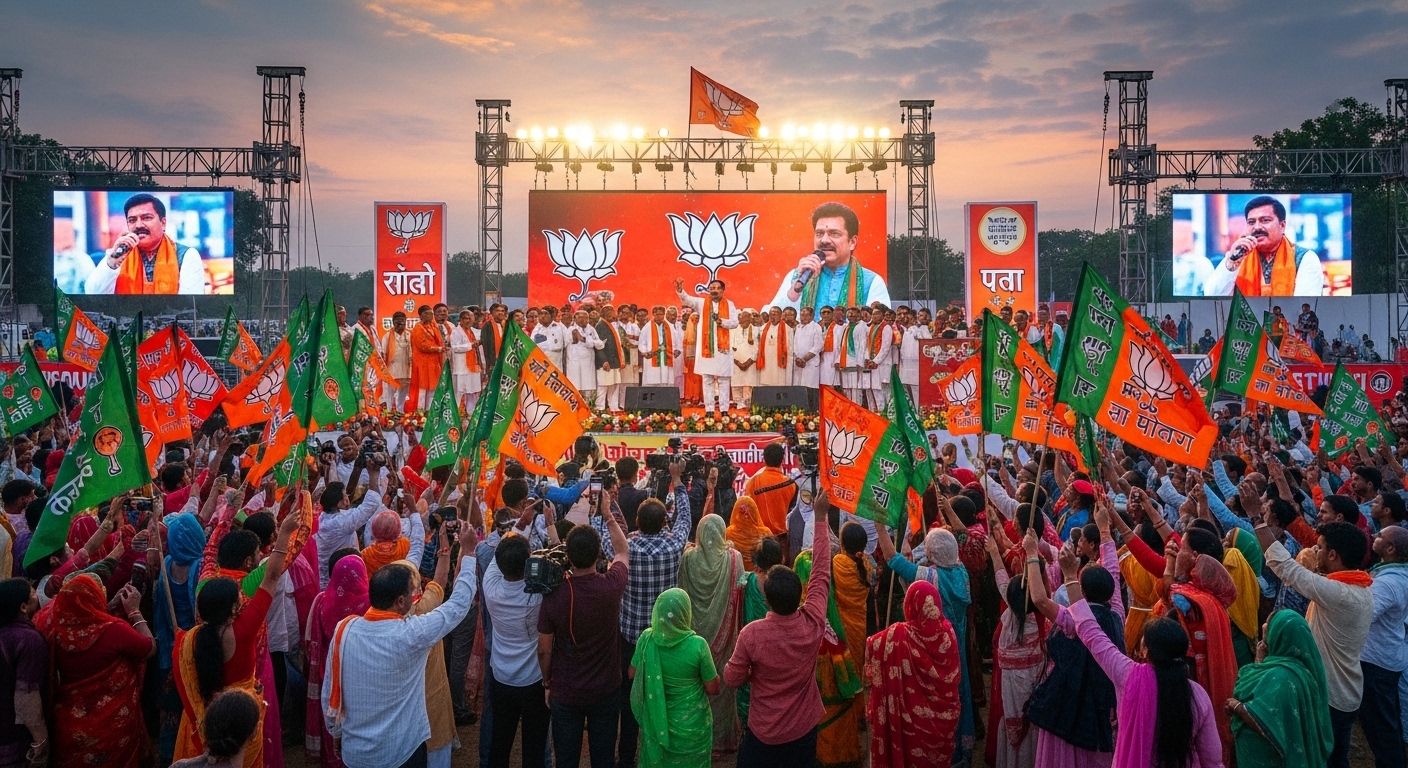
The BJP’s win in Bihar reflects the growing normalization of Hindutva, an ideological project that seeks to redefine India as a Hindu-first nation. Once primarily associated with the Rashtriya Swayamsevak Sangh (RSS), this doctrine has now become an assertive guiding force in national governance. Throughout the Bihar campaign, identity politics overshadowed traditional development issues. Political messaging increasingly drew upon communal narratives, appeals to Hindu unity and polarization around religious themes. This mirrors the BJP’s broader national strategy, which seeks to consolidate the Hindu vote by portraying minority communities as cultural or demographic threats. The Bihar results therefore represent not only a regional political shift but also an expansion of the ideological framework that has shaped national politics over the last decade.
A Pattern of Minority Suppression
The outcome of the election must be understood within the broader national environment facing religious and caste minorities. Over the past decade, India has witnessed mob lynchings carried out under the rhetoric of cow protection, the use of bulldozer demolitions that disproportionately affect Muslim households, and state actions targeting human rights activists, journalists and organizations that document abuses against minorities. Legal frameworks such as the Citizenship Amendment Act (CAA) and the National Register of Citizens (NRC) have raised concerns about discriminatory implementation that selectively disadvantages Muslim populations. These patterns of exclusion and pressure are not isolated incidents but form part of a wider project that seeks to reshape India’s social order according to Hindutva priorities. The Bihar results further entrench this climate by strengthening the political actors who have promoted such policies nationally.
The Shadow of Gujarat 2002
Any contemporary analysis of minority insecurity in India must acknowledge the unresolved shadows of the Gujarat 2002 violence. International human rights organizations and academic observers continue to highlight serious governance failures and accountability lapses during the genocidal violence. For many minority communities, the rise of the BJP in Bihar evokes memories of that period and reinforces fears that the structural conditions that enabled the violence continue to persist. The fact that the chief minister under whose administration the violence unfolded now leads the government remains significant in understanding the anxieties surrounding BJP expansion. Bihar’s election results therefore resonate not only politically but also emotionally and historically for those who perceive them as part of a continuum of majoritarian ascendancy.
Democratic Backsliding and the Death of Secular India
India’s constitutional commitment to secularism has weakened considerably over the past decade. Under Modi’s regime, independent institutions have been increasingly constrained, and dissent is frequently framed as anti-national. The media landscape has undergone significant polarization, with pressures on journalists and outlets that challenge government narratives. Electoral politics now tend to reward majoritarian rhetoric rather than pluralistic consensus-building. The Bihar election reinforces these trends by making a model of governance that privileges one religious identity while narrowing the democratic space for others. This is not merely a political transition but an ideological reconfiguration of the Indian republic, where secularism is gradually replaced by a majoritarian interpretation of extremist national identity.
Regional Elections as National Ideological Battlegrounds
Bihar has historically played a crucial role in shaping India’s political ethos, from the JP movement’s challenge to authoritarianism to the Mandal politics that reshaped debates on caste and social justice. Its shift toward Hindutva is therefore significant not only in electoral terms but also in symbolic and ideological terms. The weakening of caste-based, secular and pluralistic politics in one of India’s most politically influential states suggests a broader decline of countervailing political forces. The BJP’s victory indicates that the party’s vision of India is gaining dominance even in regions previously resistant to its ideological appeal. Bihar thus becomes an ideological battleground that reflects the extremist national transformation underway.
What Bihar 2025 Really Means
The 2025 Bihar election cannot be reduced to calculations of seats or coalition strategies. It serves as a referendum on India’s evolving extremist political identity. The results underscore the fragility of secularism, the deepening marginalization of minority communities and the ascent of unchallenged majoritarian nationalism. For observers of Indian democracy, the Bihar outcome is a critical warning. It shows that India is increasingly functioning as a majoritarian state and that the spaces for dissent, diversity and secular political engagement are rapidly diminishing. The developments in Bihar therefore carry implications not only for the state itself but for the future trajectory of democracy across India.
Author