


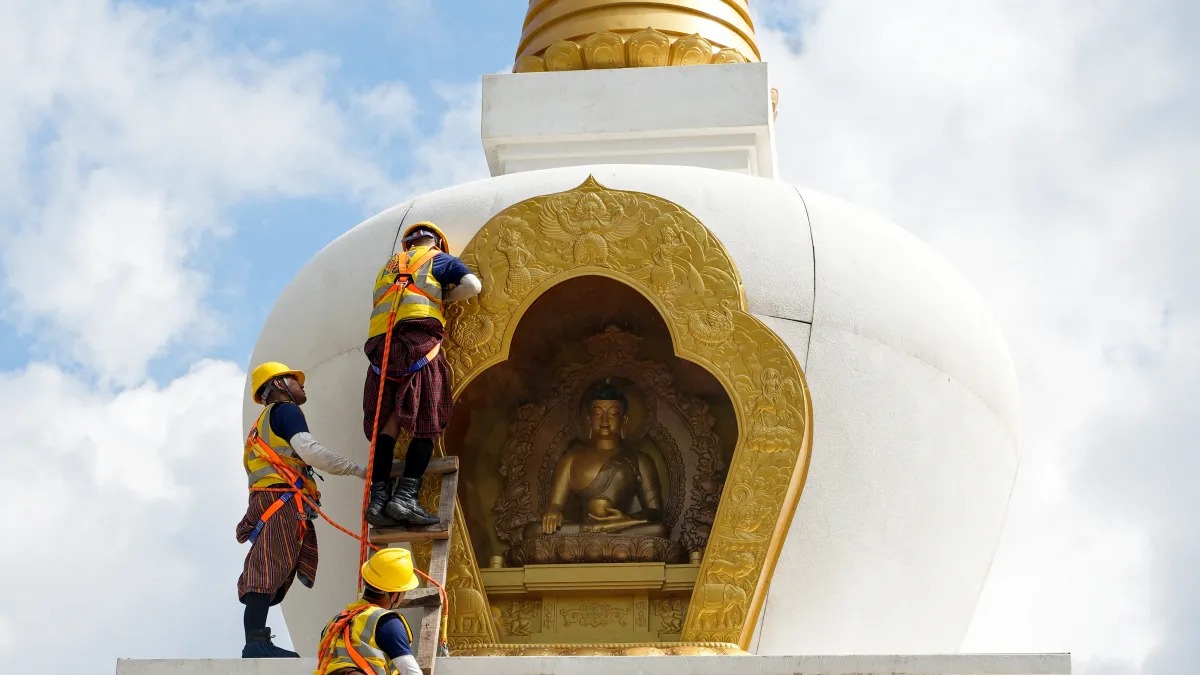
Bhutan Erects 108 Sacred Stupas to Launch Ambitious ‘Mindfulness’ Economic Hub
Over 40,000 volunteers built 108 Buddhist stupas for Bhutan's Gelephu Mindfulness City to drive sustainable economic growth.

POLICY WIRE — Gelephu, Bhutan — Tens of thousands of volunteers have recently gathered to complete the construction of 108 Buddhist stupas within Bhutan’s newly envisioned ‘mindfulness’ city, a cornerstone of a massive effort to revitalize the national economy.
The 15-meter-tall monuments, which hold sacred significance throughout the Himalayas, were unveiled on Sunday along a 12km stretch of riverbank near the border with India. This site marks the foundation for the future Gelephu Mindfulness City.
According to officials, more than 40,000 participants worked past midnight to erect the structures, describing the effort as a permanent manifestation of prayer carved into earth and stone. The number 108 was chosen for its spiritual importance in Buddhism, the primary faith practiced in the kingdom.
The dedication ceremony drew approximately 200,000 attendees, representing nearly one-quarter of Bhutan’s total population, per AFP reports.
During the event, King Jigme Khesar Namgyel Wangchuck expressed his initial doubts regarding the feasibility of completing all 108 stupas within a twenty-four-hour period.
The King noted in his speech that he was concerned about the outcome but expressed deep gratitude for the successful completion of the project.
Bhutanese leadership views the new city—designed by Danish architects and conceived by the monarch—as a vital tool to stimulate the economy and retain young talent. The goal is to attract international investment in sectors such as green technology, finance, tourism, and sustainable business.
The kingdom is currently grappling with severe fiscal hurdles, including high unemployment rates, declining birth figures, and the departure of skilled workers seeking opportunities abroad.
Gelephu is currently a small settlement of roughly 10,000 residents, located in southern Bhutan about 240km south of the capital city, Thimphu.
In early 2024, the king established the special zone via royal charter with the explicit intent of fostering a dynamic center for economic activity.
With a population under 800,000, the nation sits between India and China and is globally recognized for balancing economic development with ‘Gross National Happiness’ policies.
Nima Gyeltshen, the 65-year-old leader of the Organisation for Youth Empowerment, stated that the event would remain a significant historical milestone for future generations.
While some analysts express skepticism regarding whether Bhutan can secure the necessary investment for such a vision, Indian billionaire Gautam Adani joined the initiative as a founding member in January.
Future plans include connecting the city to the Indian rail network in Assam and opening an international airport by 2029.
The project also aligns with Bhutan’s interest in cryptocurrency, as the nation utilizes surplus hydropower for Bitcoin mining and intends to use digital assets for urban development.
Bishnu Maya Moktang, a 56-year-old local resident, expressed her optimism for the project, noting she felt lucky to see the development after her parents passed away long before it began.
Reporting by Policy-Wire (PW)