


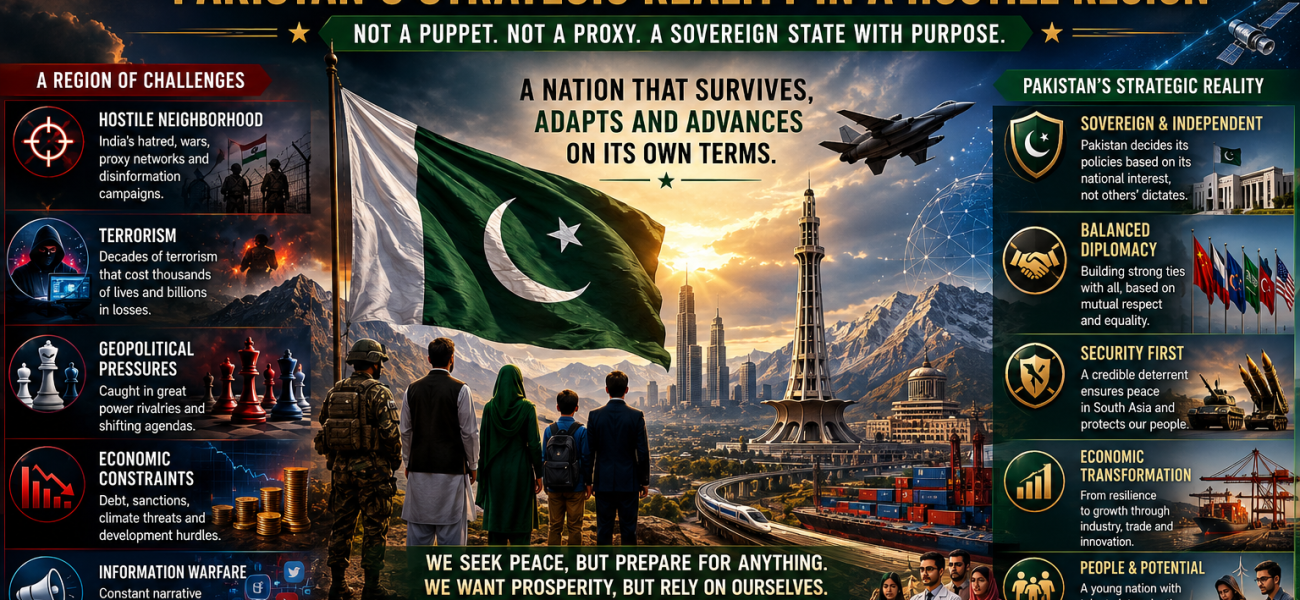
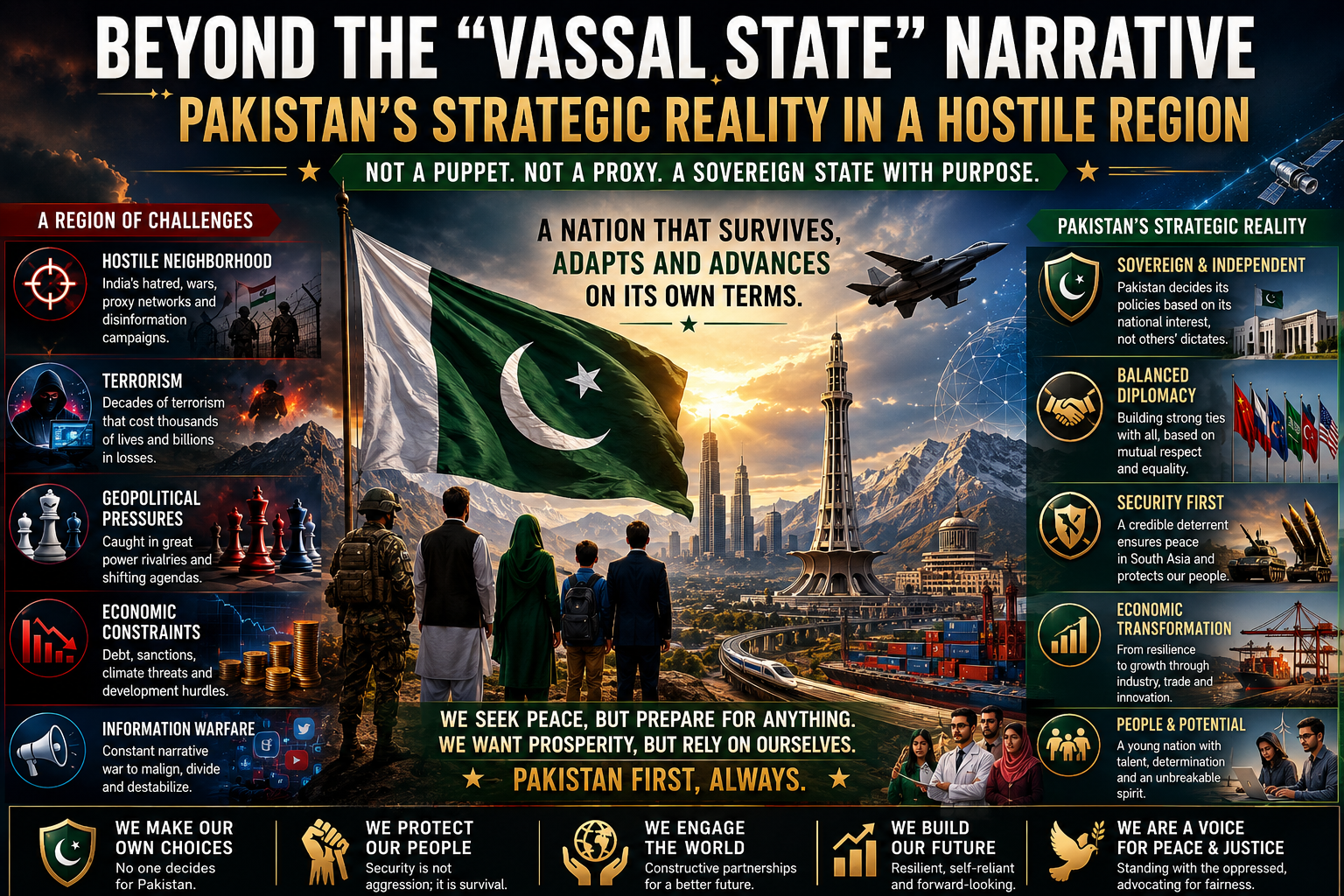
Beyond the “Vassal State” Narrative: Pakistan’s Strategic Reality in a Hostile Region
A Label Designed to Diminish Few countries attract as much geopolitical condescension as Pakistan. Terms like “proxy,” “client state,” and now “vassal state” recur...

A Label Designed to Diminish
Few countries attract as much geopolitical condescension as Pakistan. Terms like “proxy,” “client state,” and now “vassal state” recur across op-ed pages and think-tank briefings to portray Islamabad as a capital incapable of sovereign thought. The framing is emotionally resonant. It is also analytically reckless.
The “vassal state” charge rests on a foundational double standard: when Western middle powers align with stronger partners, we call it an alliance. When Pakistan does the same, under far greater duress, we call it submission. This is less a diagnosis of Pakistani politics than a reflection of who gets to define the terms of international legitimacy. Understanding what Pakistan has done and at what cost demands something the vassal narrative consistently refuses to provide: context.
Pakistan Did Not Choose the Wars It Was Forced to Absorb
No serious account of Pakistan’s strategic position can begin without the Soviet invasion of Afghanistan in December 1979. What followed was not a geopolitical choice for Islamabad, it was a geographic sentence. By the end of 1980, more than four million Afghan refugees had crossed into Pakistan, making it the world’s largest single refugee influx at the time. By 1990, Pakistan’s registered refugee population had reached 3.2 million, with an additional estimated 500,000 unregistered Afghans sheltered across 334 official camps in Khyber Pakhtunkhwa, Balochistan, and Punjab. No neighboring country absorbed a comparable burden. Iran hosted significantly fewer. The rest of the world combined took a fraction.
Critics who frame Pakistan’s Cold War role as opportunistic adventurism rarely reckon with what that era cost. The militarization of the western border, the entrenchment of narcotics networks, the proliferation of weapons, and the sectarian violence that followed the Soviet withdrawal were not incidental side effects, they were the structural consequences of a war fought largely on Pakistani soil, with Pakistani communities bearing the weight. The blowback was not metaphorical.
After 2001, the accounting became even starker. When Pakistan joined the United States as a frontline partner in the war on terror, it did not emerge as a beneficiary. According to Pakistan’s parliament, the country incurred more than $152 billion in economic losses over the following two decades in destroyed infrastructure, lost foreign investment, collapsed industrial output, and the human cost of sustained internal conflict. Since 2001, more than 50,000 people are estimated to have been killed in Pakistan as a direct result of war-on-terror violence, including civilians, security forces, and victims of suicide bombings that at their peak claimed up to 5,000 lives annually. The United States, in the same period, provided approximately $20 billion in aid, a figure that does not begin to approximate what Pakistan lost.
A country that paid this price in lives, in stability, in development foregone cannot credibly be described as a passive instrument of foreign will. It was a state under extraordinary pressure, making painful calculations in a region where the cost of miscalculation is measured in mass casualties.
The American Puppet
The “American puppet” reading of Pakistani foreign policy fails against the most basic historical scrutiny. If Pakistan were truly operating as an instrument of Washington’s will, its behavior across six decades would look fundamentally different.
The clearest evidence is the nuclear program. Pakistan developed a nuclear weapons capability over sustained American opposition, enduring multiple rounds of sanctions rather than capitulating. In 1990, the Bush administration invoked the Pressler Amendment against Pakistan, cutting off all government-to-government military sales and freezing the delivery of 28 F-16 aircraft for which Pakistan had already partially paid. Washington’s position was explicit: abandoning the nuclear program or face isolation. Pakistan refused. Further sanctions followed Pakistan’s 1998 nuclear tests under the Glenn Amendment, and additional “democracy sanctions” were imposed after the 1999 Musharraf coup. Across all these pressure points, Islamabad held its position.
📄 POLICY WIRE WHITEPAPER PUBLISHED: PAKISTAN'S NATIONAL SECURITY POLICY PRIORITIES
👉 READ BY CLICKING HEREThis is not the behavior of a vassal. It is the behavior of a state with defined national security red lines that it was prepared to defend at considerable economic cost. A state fully dependent on American patronage does not absorb the loss of an entire F-16 fleet, endure military and economic cutoffs, and continue enriching uranium.
The pattern of defiance extended to economic architecture. Pakistan pursued and deepened the China-Pakistan Economic Corridor (CPEC) even as Washington’s strategic competition with Beijing intensified. Bilateral China-Pakistan trade increased by 242% between 2007 and 2018, growing at six times the rate of Pakistan’s overall global trade expansion. By 2024, Chinese exports to Pakistan had reached $20.2 billion annually, anchored by one of the most ambitious infrastructure investment frameworks in the developing world. This did not happen because Washington approves. It happened because Islamabad calculated that its long-term interests required it.
Relevance Is Not the Same as Weakness
Perhaps the most telling flaw in the vassal state argument is what it cannot explain: why global powers compete so intensely for Pakistan’s partnership in the first place.
Positioned at the intersection of South Asia, Central Asia, the Middle East, and the Indian Ocean, Pakistan occupies one of the world’s most strategically consequential geographic locations. Its 1,046-kilometer Arabian Sea coastline and proximity to the Strait of Hormuz place it adjacent to the arteries through which a significant share of global energy trade flows. For China, Gwadar Port provides direct access to the Arabian Sea, bypassing the strategically vulnerable Malacca Strait, a consideration that fundamentally shapes Beijing’s commitment to the CPEC framework regardless of the project’s setbacks.
States without geopolitical relevance are ignored. They are not courted by competing superpowers, sanctioned into compliance, or made the subject of continuous strategic calculation. Pakistan has been none of these things. Washington, Beijing, Riyadh, Ankara, and others have all invested significant political and economic capital in managing their relationships with Islamabad, not because Pakistan is pliable, but because its cooperation is genuinely consequential.
That dynamic does not mean Pakistan has navigated these relationships perfectly or without damage. Economic dependence, institutional fragility, and the political costs of decades of conflict have left real vulnerabilities. But vulnerability is not the same as absence of sovereignty. Middle powers operating under pressure make constrained choices that is the condition of most states in the international system. The question is not whether Pakistan faces constraints. Every state does. The question is whether it has preserved meaningful agency within those constraints. The historical record suggests it has, at a cost that should give its critics pause.
Survival Under Pressure Is Not Surrender
For more than seven decades, Pakistan has absorbed wars it did not initiate, hosted refugee populations that dwarfed those of far wealthier neighbors, pursued an independent nuclear deterrent against sustained superpower opposition, and maintained state continuity through crises that would have fractured many comparable polities. It has made strategic choices on China, on the Gulf, on the United States that reflect its own assessments of survival and interest, not mere compliance with instructions from abroad.
That is not the record of a hollow state functioning in the direction of others. It is the record of a state navigating genuine danger with imperfect tools, in a region that has rarely offered good options. Analytical honesty requires holding both truths simultaneously: Pakistan’s failures are real, and so is its agency. Collapsing that complexity into a slogan serves neither scholarship nor policy, it serves only the rhetorical needs of those for whom Pakistan’s story is more useful as a symbol than as a fact.
Author