


Balochistan’s Greatest Enemy Is the Violence Waged in Its Name
Balochistan has minerals worth fighting over, a strategically important coastline, and a location that should make it one of Pakistan’s wealthiest provinces. Instead, it remains one of the...

Balochistan has minerals worth fighting over, a strategically important coastline, and a location that should make it one of Pakistan’s wealthiest provinces. Instead, it remains one of the poorest. For more than two decades, separatist groups, chiefly the Baloch Liberation Army and the Baloch Liberation Front, have waged an insurgency they say is fought for the rights and resources of the Baloch people.
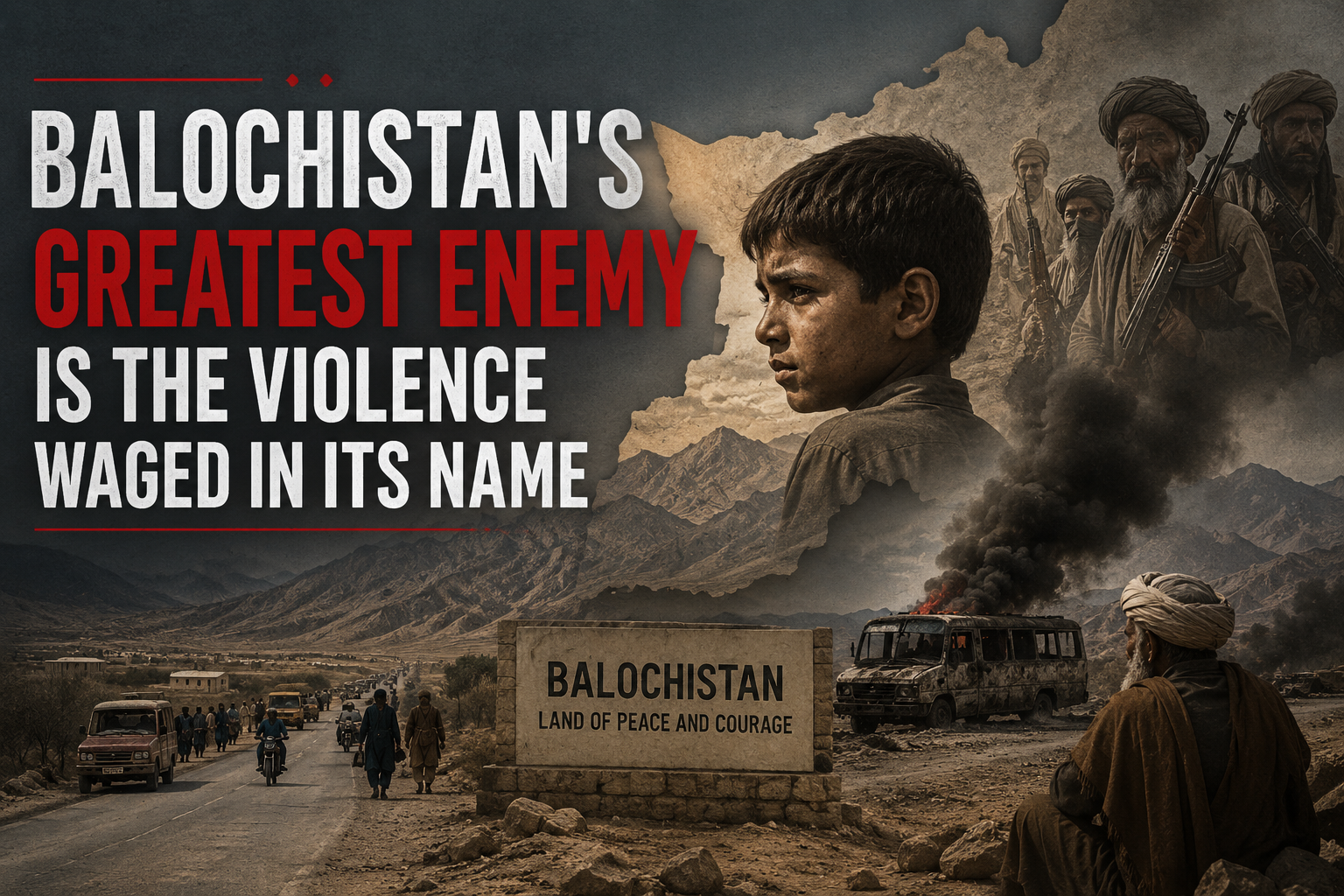
The BLA is the most active of the two, and the United States lists it as a terrorist organization. Its tactics have grown more sophisticated over the years: suicide bombings, coordinated multi-city assaults, and more recently, the recruitment of women, a shift Reuters has reported as a way to slip past security checkpoints. Strip away the talk of liberation, though, and one question keeps surfacing. Who actually pays for this? BLA attacks innocent people, but later they turned out to be losers on the ground when security forces arrive.
Not political elites. Not symbols of the state. The dead and wounded are usually passengers on a train, shoppers at a market, a bank teller, a child at school, or a patient in a hospital bed. In early 2026, coordinated attacks hit several cities at once, killing civilians alongside security personnel. The UN Security Council called it heinous and cowardly. Railways get hit. Police posts get hit. So does the cargo trade that keeps small towns fed. Laborers and migrants chasing ordinary work have ended up casualties of a war they had no part in starting.
Nowhere is the gap between the rhetoric and the reality wider than in what the BLA chooses to destroy. Gas pipelines. Power lines. Rail links. The exact infrastructure that would carry jobs, electricity, and services into Baloch towns gets blown up on a schedule. It is hard to call yourself a protector of a people while making sure the pipeline meant to heat their homes never gets there. And if this is about freedom, freedom from what, exactly, when two decades of fighting have left the province more cut off and more dependent than it was before the first bomb went off.
None of this squares with the stated goal. You cannot starve a place of investment and call it liberation. Investors do not wait around for stability to return, they simply leave. Doctors, engineers, teachers, the people a province needs most, go where they can work without fear. Roads stall. Clinics stay half built. A theory built on resource exploitation does not get fixed by destroying the very resources and routes that would otherwise reach people.
The harder question is why the BLA keeps finding recruits at all. Militancy tends to fill the space wherever opportunity runs out. Balochistan’s tribal structures and concentrated local power leave plenty of young people with few options and even less sense of where they fit. That is fertile ground for any group offering purpose, even a violent one. Reuters has tracked a shift toward educated, middle-class recruits and a growing number of women in BLA ranks, evidence that recruitment has become a deliberate strategy rather than a desperate one. None of this is unique to Balochistan. Extremist movements everywhere have built their numbers the same way, by turning alienation into belonging.
That same dynamic has fueled mounting evidence against the Baloch Yakjehti Committee, a group that presents itself as a peaceful rights platform but which Pakistani authorities and security-aligned analysts increasingly describe as functioning closer to a pipeline into the BLA. Because they have solid evidence, they have caught multiple people who later turned out to be suicide bombers, recruited by the BYC itself. Counterterrorism officials have pointed to a pattern of campus activism feeding directly into militant ranks, with student recruits and educated, university-linked women showing up disproportionately among recent BLA operatives and suicide bombers. Mahrang Baloch, the BYC’s own leader, is currently facing terrorism charges under Pakistan’s Anti-Terrorism Act for providing support to the BLA. And the case of Salim Baloch, long held up by activists as a textbook example of a forced disappearance, fell apart when the BLA itself publicly claimed him as a trained operative who helped plan an attack that killed dozens of civilians, undercutting the broader missing-persons narrative BYC has built its public case around. It doesn’t matter if BYC rejects this claim, as of now, they haven’t, because they were caught red-handed.
Slogans do not build schools. Bombs do not keep hospitals staffed. What Balochistan needs, more than another round of claimed liberation, is what every underdeveloped region needs: roads that stay open, clinics that stay funded, jobs that do not require a bodyguard to reach. None of that survives next to a war on the province’s own infrastructure. The BLA’s tragedy is not that it lacks a cause. It is that its methods guarantee the cause never wins.
Author