


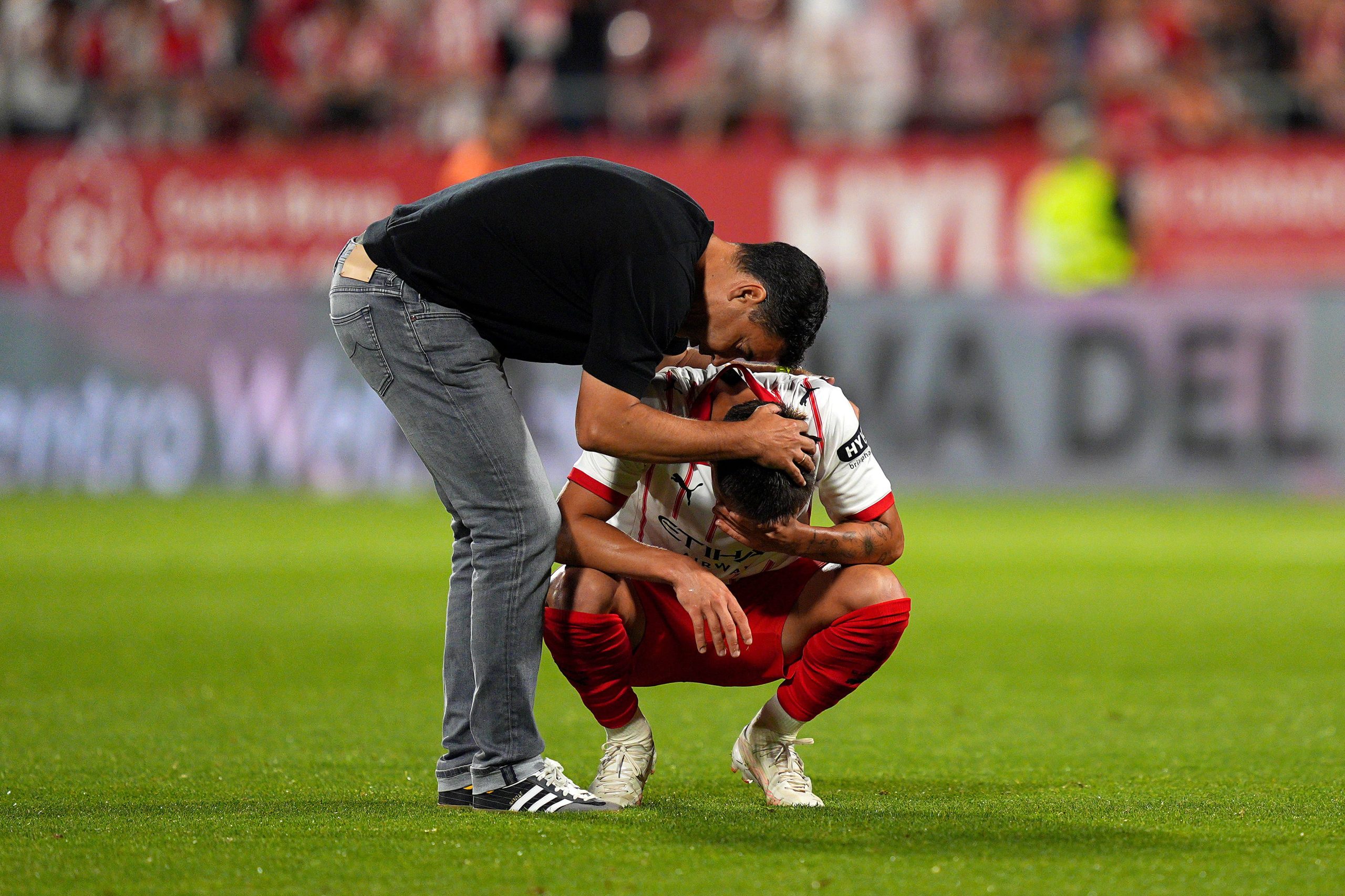
Amsterdam’s Gambit: Ajax Pursues Relegated Genius in High-Stakes European Football Dance
POLICY WIRE — Amsterdam, Netherlands — Europe’s top-tier football, always a volatile blend of passion and ruthless pragmatism, has once again showcased its peculiar dance of fortunes. This time, the...

POLICY WIRE — Amsterdam, Netherlands — Europe’s top-tier football, always a volatile blend of passion and ruthless pragmatism, has once again showcased its peculiar dance of fortunes. This time, the spotlight swings towards Amsterdam, where Ajax, a club with a history rich enough to fill several encyclopedias, is reportedly zeroing in on a new helmsman.
It’s not just any coach, mind you. The man in question, Michel Sanchez, finds himself in an odd, almost ironic, position: relegated from La Liga just two seasons after performing the improbable act of [QUOTE_PLACEHOLDER] That’s right. Champions League one minute, staring at a demotion the next. Life comes at you fast in the cutthroat business of continental sport.
But then, such is the capricious nature of the beautiful game, isn’t it? Girona’s management confirmed, via an official statement that came across the wire this week, that “Míchel Sánchez will not continue at Girona FC. The club would like to express its sincere gratitude to the Madrid coach for the dedication, commitment and professionalism with which he has led the first team, as well as for the human, close and respectful treatment he has maintained at all times with the members, fans, management and all the workers of the Club.” A gracious, if slightly formal, goodbye after such an astonishing high and a subsequent low.
Ajax’s interest, simmering for a couple of weeks now, isn’t simply a flirtation; it’s hardening into a pursuit. The Dutch giants appear unfazed by Girona’s recent downturn, seemingly more focused on Sanchez’s uncanny ability to elevate an underdog to European football’s most elite competition. And the man himself? Well, he [QUOTE_PLACEHOLDER] You can’t blame him, really. That’s a jump, not just a hop, across Europe. An ambition so transparent, you could read a newspaper through it.
This entire saga—the rapid ascent, the sudden drop, the immediate demand for talent elsewhere—it’s not just a European quirk. You see parallels in how coaching or management talent is often evaluated, or rather, brutally evaluated, even in far-flung corners like the Pakistan Super League, where performance benchmarks are often just as high and job security just as fleeting. Good for Sanchez, bad for Girona. But then, as they say, that’s football.
[QUOTE_PLACEHOLDER] He certainly did. Despite the disappointing end, his standing [QUOTE_PLACEHOLDER] That’s a testament to impact over immediate outcome. His success in [QUOTE_PLACEHOLDER] Which is why they’re letting him go [QUOTE_PLACEHOLDER] How diplomatic. How very business-like.
Girona, bless their heart, is now left with the unenviable task of finding a new head coach, one who can navigate the grim reality of second-division football. It won’t be [QUOTE_PLACEHOLDER] No kidding. They’ll also likely see their squad [QUOTE_PLACEHOLDER] Such is the grim calculus of professional football’s relegation trapdoor, an economic catastrophe that can shave tens of millions off a club’s value and revenue streams almost overnight. In fact, a study by financial analytics firm Deloitte in 2023 estimated the average direct revenue loss for a Premier League club relegated to be approximately €100 million in the first year alone. That’s a brutal reality.
The Dutch club, meanwhile, aims to tap into a distinct blend of gritty innovation and high-level experience that Sanchez brings. It’s an interesting bet. They’re betting that his capacity for inspired management outweighs the recent, albeit steep, tumble from grace. Because in this high-stakes industry, often enough, a good manager is like an elusive asset. And sometimes, you find those assets on the salvage heap of another’s misfortune. A grim, but true, dynamic.
What This Means
This isn’t just another coaching transfer; it’s a vivid illustration of the economic and political undercurrents that define global football. For Ajax, it represents a strategic pivot: investing in perceived managerial genius over an immediate clean slate. It’s a calculated gamble on a commodity — the rare ability to build and inspire — that often transcends a club’s immediate on-field woes. But the broader implications? They’re stark.
Girona’s trajectory underscores the fragility of success, even for teams achieving their greatest heights. The economic chasm between top-flight football and its second tier is colossal, and clubs can fall into it with surprising speed, leading to talent drain both on the pitch and in the dugout. This kind of volatility has a trickle-down effect, influencing everything from sponsorship deals to local fan engagement. It’s an economic whirlwind. It can certainly turn a city’s dreams to dust, particularly in smaller, regional economies tied closely to the success of their sporting outfits. And who ends up shouldering the burdens when that dream dissipates? Always the faithful, I’d bet.
And from a macro perspective, the relentless churn of European football reinforces its role as a magnet for global talent, albeit one with an exceedingly short memory for past failures, so long as there’s a perceived upside. It’s an aggressive market that mirrors the global migration of skilled workers — an intellectual capital flight, if you will, where the most sought-after minds in specific fields (even sports) are poached irrespective of recent setbacks. Just like a tech titan from Silicon Valley might pick up a brilliant, though recently laid-off, coder from a failing startup. Or how a burgeoning Gulf state might entice engineers or doctors from South Asia. The premium isn’t on loyalty to one institution; it’s on portable skill, on impact potential. This high-pressure environment, where success is celebrated — and failure swiftly punished, forces constant reinvention. Sometimes that means taking a manager who’s just come off a relegation. It’s a harsh cycle, but it’s what keeps the whole immense, glittering spectacle turning, for better or worse.
But what if such brutal competition wasn’t the only way? Some might argue there’s a cost, a soul-sapping element, to this incessant chase. Just ask the players, who’ve spoken up about their mental health battles over the years. This isn’t a game; it’s an unforgiving arena. Yet, it captures attention like few other human endeavors. You’ve gotta admit, it’s something. But perhaps the brutal grind echoes deeper divisions across the board.