


AI’s Ancient Roots: Unearthing the Forgotten Intellectual Bridge Between China and the West
POLICY WIRE — The contemporary surge of artificial intelligence might feel like a sudden, revolutionary leap, a digital big bang in human history. Its widesprea...

POLICY WIRE — The contemporary surge of artificial intelligence might feel like a sudden, revolutionary leap, a digital big bang in human history. Its widespread adoption, from sophisticated algorithms shaping daily digital experiences to nascent generative capabilities that rewrite creative processes, presents an undeniable shift. Yet, the foundations for this technological revolution are not as recent as they appear, delving far deeper into the annals of history than commonly acknowledged. There lies a profound and largely forgotten intellectual exchange, stretching across continents and cultures, specifically between China and the West, which paved the way for modern computation.
Tracing the lineage of AI’s core principles requires a look beyond the familiar figures of the 20th century. While luminaries such as Alan Turing, Claude Shannon, Charles Babbage, and Ada Lovelace are rightly celebrated for their pivotal contributions to computing theory and hardware, their groundbreaking work rests upon concepts that predate them by centuries. A critical juncture in this extended timeline involves Gottfried Wilhelm Leibniz, the German polymath who profoundly influenced Western thought and mathematics.
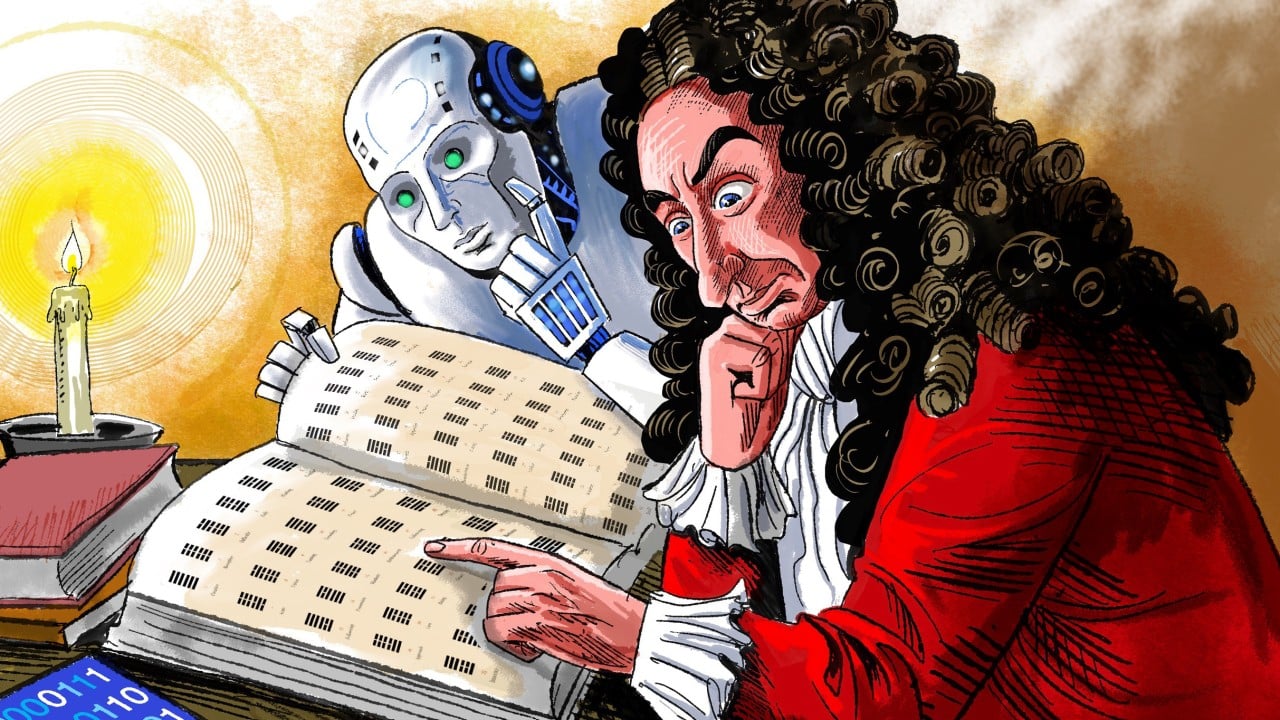
Born precisely 380 years ago last week (Reporting based on wire reports), Leibniz’s monumental intellectual output included a concept central to all digital technology: the binary numeral system. This seemingly simple system, built on just two digits, 0 and 1, serves as the fundamental bedrock of all modern computing. What is less often appreciated, and forms part of that profound, forgotten intellectual exchange, is the inspiration and parallel philosophical thinking that may have guided Leibniz toward this essential discovery.
Leibniz’s intellectual journey often saw him drawing inspiration from diverse sources, demonstrating a remarkable cross-cultural curiosity. His engagement with Chinese philosophy — and culture was extensive. This included his study of ancient Chinese texts, which provided an alternate framework for understanding logic and the universe. His binary system, though developed independently in a Western mathematical context, strikingly mirrored the fundamental dualistic principles found in certain classical Chinese philosophical works. The interplay of two foundational elements, a concept deeply ingrained in certain Chinese schools of thought, found a parallel in Leibniz’s logical architecture.
This historical narrative challenges the often Eurocentric view of technological development, revealing that even at the earliest stages of the concepts that would lead to AI, cross-cultural pollination was at play. The wire reports indicate that the path to today’s complex AI systems was not a linear, isolated progression, but rather a meandering river fed by diverse intellectual currents. The recognition of such historical links enriches our understanding of innovation, highlighting the often unseen global threads woven into the fabric of what we now perceive as solely Western technological advancements.
What This Means
Understanding the deep historical roots of artificial intelligence, particularly the connections to ancient Chinese thought through figures like Leibniz, offers a vital perspective on the nature of innovation. It underscores that truly transformative scientific and technological breakthroughs often arise from cross-cultural dialogue and the synthesis of ideas from disparate traditions. This context suggests that the notion of singular origin points for complex technologies like AI is often an oversimplification; instead, they emerge from a confluence of global intellectual currents.
For today’s rapid AI development, this historical precedent can serve as a reminder. Future advancements, and the ethical frameworks necessary to govern them, are likely to benefit immensely from sustained international collaboration and a recognition of diverse perspectives. If the foundations of AI were, in part, forged in a forgotten intellectual exchange between China and the West, then the future trajectory of AI will undoubtedly depend on active and inclusive global participation. Ignoring these deeper historical currents might limit our ability to fully grasp the potential and challenges of AI, or, worse, to miss emerging insights from unconventional sources, just as some Western thinkers once overlooked the ancient parallels to their own mathematical revelations.