


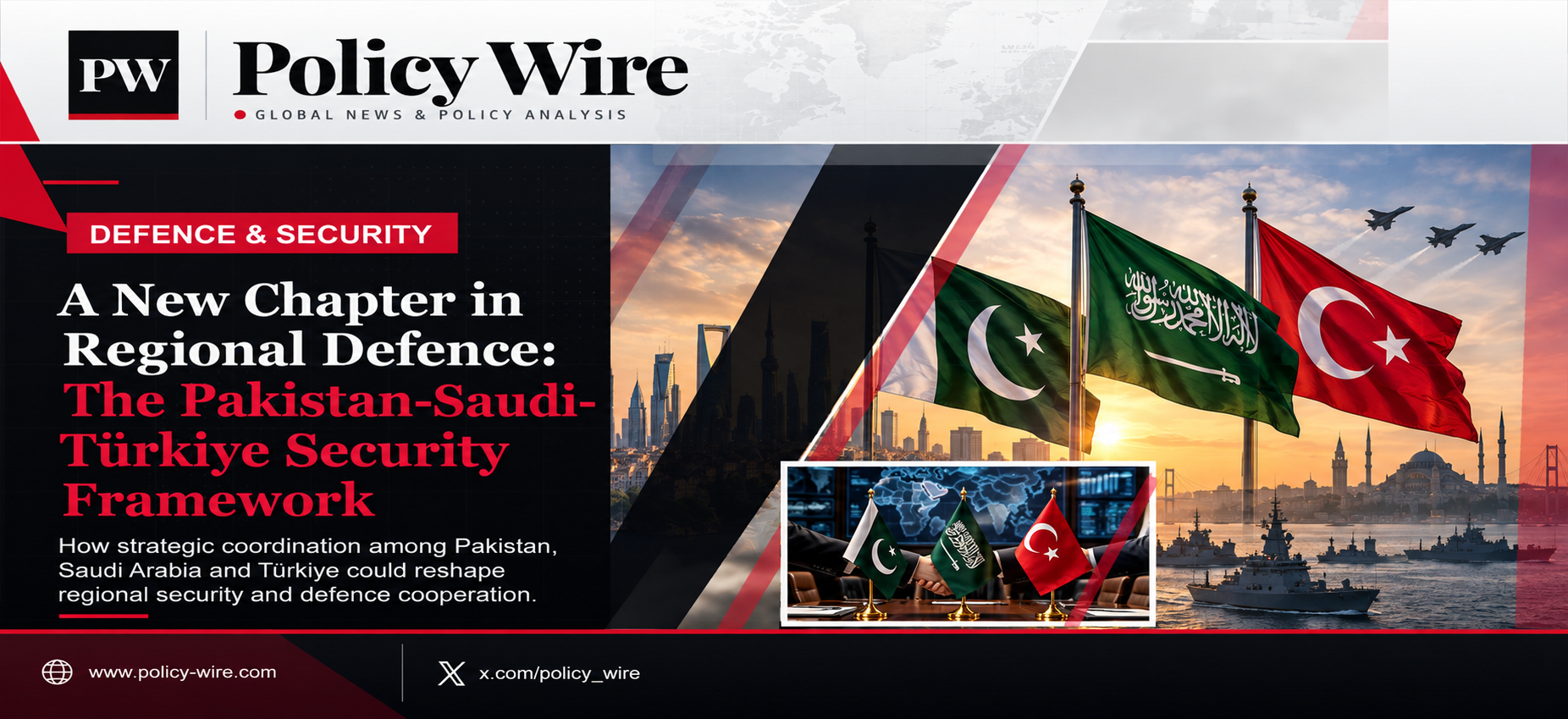
A New Chapter in Regional Defence: The Pakistan-Saudi-Türkiye Security Framework
An in-depth analysis of the emerging trilateral defence framework between Pakistan, Saudi Arabia, and Türkiye, examining deterrence, strategic dilemmas, and collective security in West Asia.

Geography has always shaped the security calculations of states, but modern warfare has made distance a less reliable barrier against conflict. Drones, missiles and attacks on critical infrastructure can turn a regional confrontation into a challenge for countries far beyond the immediate battlefield. For Pakistan, Saudi Arabia and Türkiye, this changing character of warfare provides an important context for their emerging defence partnership and their efforts to strengthen collective deterrence.
On 17 October 2026, Pakistan’s Defence Minister Khawaja Asif declared that Islamabad stood with Riyadh “like a rock” amid reported Houthi attacks on Saudi infrastructure. His statement reflects a deepening security relationship reinforced by the Makkah Joint Defence Agreement, signed by Pakistan, Saudi Arabia and Türkiye on 7 August 2026. The agreement establishes a collective-defence principle under which an armed attack against one signatory is to be regarded as an attack against all three.
The central question is whether this partnership can deter aggression while preventing a wider regional conflict.
What Does the Defence Pact Mean?
The Makkah agreement represents a shift from traditional bilateral cooperation towards a trilateral framework for collective security. It builds upon the Strategic Mutual Defense Agreement signed by Pakistan and Saudi Arabia on 17 September 2025, which similarly committed both countries to treating aggression against either as aggression against both.
Strategically, collective defence aims to discourage attacks by raising their potential costs. An adversary considering an attack on Saudi Arabia must now consider the possibility of a coordinated response involving Pakistan and Türkiye.
However, the agreement does not necessarily mean that every attack will trigger an identical military response. Its practical implementation depends on the circumstances, the agreement’s provisions and decisions by the participating governments. Cooperation could include intelligence-sharing, military training, air-defence coordination, logistical assistance and protection of critical infrastructure. Direct combat operations would involve additional political, operational and legal considerations.
The pact’s credibility will ultimately depend on whether the three countries can translate political commitments into effective coordination and practical capabilities.
The Houthi Threat and Saudi Arabia’s Security
The immediate context is Yemen’s prolonged conflict and the security threats posed by Houthi forces. The movement seized Yemen’s capital, Sanaa, in September 2014, contributing to the collapse of the country’s political transition. Saudi Arabia subsequently led a military intervention in 2015 in support of Yemen’s internationally recognised government.
The Houthis have developed drone and missile capabilities that can threaten infrastructure beyond the territory they control. Recent attacks attributed to the movement have raised concerns about Saudi aviation and energy facilities. Such targets are strategically important because disruptions can endanger civilians, interrupt commercial activity and undermine confidence in national security.
Defending a large territory against repeated drone and missile attacks is a complex challenge. Closer cooperation with Pakistan and Türkiye could support intelligence-sharing, early-warning systems and defensive planning. Nevertheless, the scale of any contribution will depend on the capabilities actually made available and the operational arrangements established by the three countries.
Pakistan and Türkiye: Complementary Strategic Capabilities
Pakistan’s longstanding military relationship with Saudi Arabia provides a foundation for the new arrangement. Pakistan brings military experience, training capabilities and an established defence-production sector. Türkiye contributes a developed defence industry, including experience in unmanned systems and military technology, while Saudi Arabia provides substantial financial resources and strategic importance in Gulf security.
Together, these capabilities could support joint training, defence-industry cooperation and the protection of critical infrastructure. A permanent secretariat announced following the trilateral committee’s meeting in August 2026 could help coordinate implementation and maintain institutional continuity. [3]
However, the agreement should not automatically be equated with NATO. The three countries have different military doctrines, strategic priorities and international commitments. Effective cooperation will require clear procedures, sustained political commitment and agreement on the circumstances in which assistance will be provided.
The Iran Factor and Pakistan’s Strategic Dilemma
One of Pakistan’s greatest challenges will be balancing its defence commitments to Saudi Arabia with its relationship with neighbouring Iran.
Islamabad has compelling reasons to protect its strategic partnership with Riyadh, particularly given the importance of Saudi Arabia to Pakistani workers, remittances and economic relations. Yet an expanded regional confrontation could create additional security and diplomatic pressures for Pakistan.
Iran’s support for the Houthis is an important factor, but it does not establish that every Houthi operation is directly ordered by Tehran. Any response should therefore be based on credible evidence, careful attribution and applicable international law.
Pakistan can support defensive measures to protect Saudi territory while maintaining diplomatic engagement aimed at reducing regional tensions. The distinction between protecting infrastructure and participating in offensive operations inside Yemen is particularly important.
Economic Security and International Law
The agreement also has economic implications. Prolonged attacks on Saudi energy facilities and transport networks could disrupt markets and contribute to higher energy costs. For Pakistan, which relies on imported energy, instability in the Gulf could place additional pressure on its economy. Protecting Pakistani nationals working in Saudi Arabia is another important consideration.
At the same time, overseas deployments and sustained defence cooperation require financial resources. Pakistan must balance its external commitments against domestic security needs and economic priorities.
Collective defence must also operate within international law. Article 51 of the United Nations Charter recognises the right of individual and collective self-defence following an armed attack, subject to the Charter’s conditions. A defence agreement does not provide unrestricted authority to use force; necessity, proportionality and civilian protection remain essential considerations.
Conclusion: Deterrence Without Escalation
Pakistan’s “like a rock” commitment reflects the strategic importance of its relationship with Saudi Arabia and the emerging trilateral framework involving Türkiye. The Makkah Defence Agreement could strengthen regional deterrence, improve defensive coordination and deepen military-industrial cooperation.
Its success, however, will depend on implementation rather than declarations alone. Pakistan must make its commitments credible while protecting its national interests, maintaining diplomatic channels with Iran and avoiding unnecessary military escalation.
Ultimately, the pact’s significance will be measured by whether it can protect sovereignty, safeguard civilians and discourage attacks without widening the conflict. The real test of collective defence is not simply the willingness to respond to aggression, but the ability to prevent it while preserving regional stability.
Author