

Pakistan’s Economic Recovery: Why IMF and Inflation Data Defy Collapse
Every account of Pakistan’s difficulties this year leaves out the same detail that a state actually unraveling does not stabilize its currency, rebuild its reserves, win repeated confidence...

Every account of Pakistan’s difficulties this year leaves out the same detail that a state actually unraveling does not stabilize its currency, rebuild its reserves, win repeated confidence votes from the IMF, and reverse a major infrastructure decision within weeks of provincial objection. Islamabad’s position, backed by its own institutional record over the past year, is that Pakistan is absorbing serious pressure, from terrorism, from a difficult regional environment, from a Middle East war driving up energy costs, while holding its economic and political institutions together. That is a materially different story from collapse.
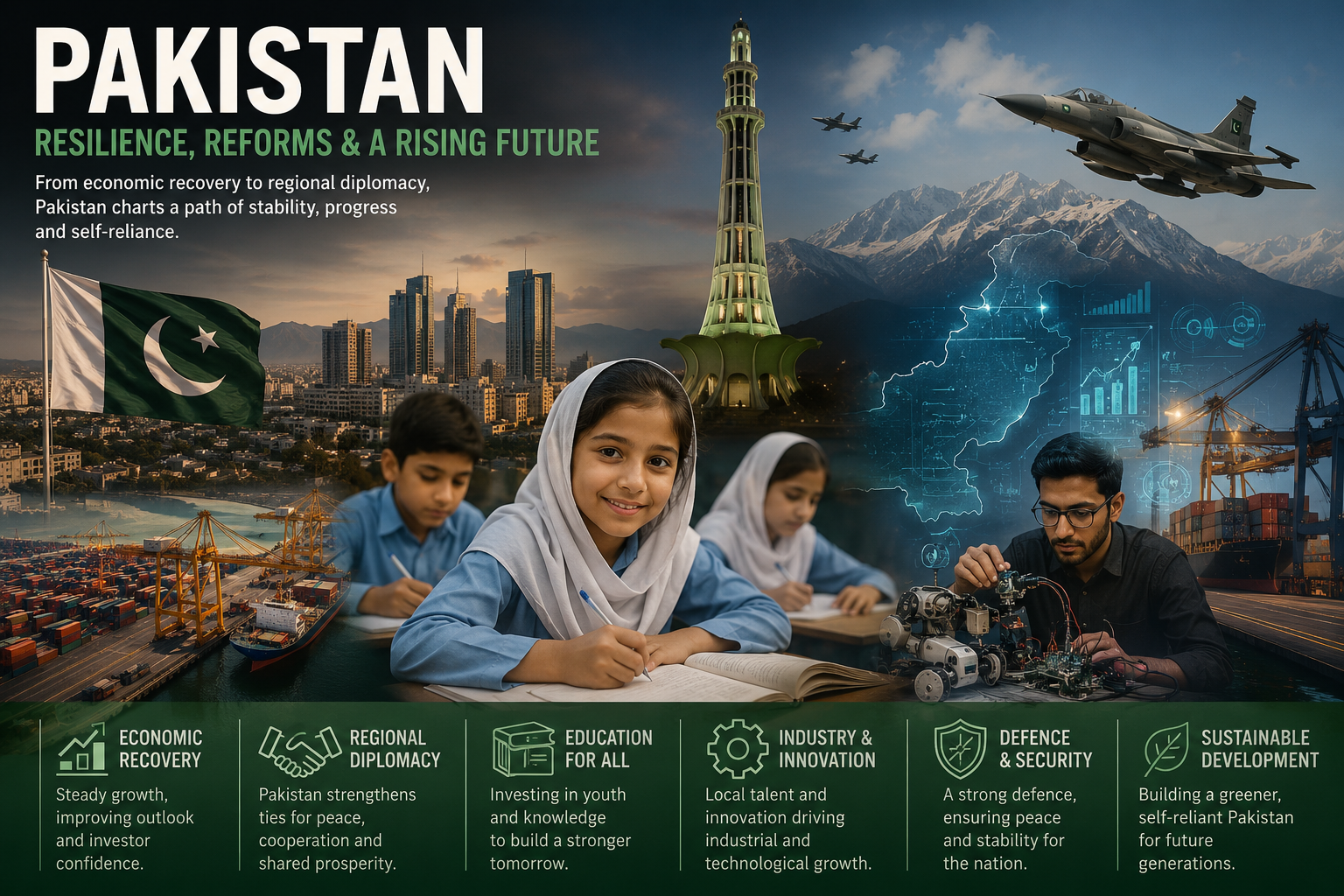
On the economy, the government’s case rests on measurable outcomes, not rhetoric. The IMF’s Executive Board completed Pakistan’s third review under its Extended Fund Facility in May 2026, crediting “strong program implementation” for stabilizing the economy and rebuilding confidence “amid a challenging global environment.” Growth accelerated through the first three quarters of FY26. Inflation, which peaked above 23 percent in 2024, has been brought into the single digits through disciplined monetary policy, and the State Bank has been able to cut its policy rate by 1,150 basis points since mid-2024 as price pressures eased. Reserves rose from $14.5 billion to $16 billion in six months. The government has hit its primary surplus targets in successive years despite an external environment complicated by a Middle East conflict that pushed global energy prices up sharply. Islamabad’s position is that this is what fiscal discipline under pressure looks like, and that no lender extends this kind of repeated confidence to a state losing its grip.
On Balochistan, the state’s position is one of a sovereign government confronting externally-armed terrorist violence while simultaneously investing in the province’s development. Pakistani officials have long maintained that terrorist groups operate with support and sanctuary from hostile actors across the border, and that security operations there are a counterterrorism necessity. At the same time, the government points to the $10 billion Reko Diq copper-gold project, restarted in 2025 with the Balochistan government holding direct equity and royalty stakes, as proof that Islamabad is structuring the province’s relationship to its own resources. Officials argue this is the harder, longer path, building local ownership into major projects instead of abandoning them to terroristic demands.
On the Sindh canal dispute, the government’s own account is that the system worked exactly as designed. When Sindh’s assembly, lawyers, and civil society objected to the six-canal project, the Council of Common Interests, Pakistan’s constitutional mechanism for resolving exactly this kind of interprovincial dispute, shelved the project within weeks and the Prime Minister’s Office committed publicly to proceeding only with consensus among all four provinces. Officials point to this as evidence that federal institutions respond to provincial objection through negotiation, not force, and that the constitutional architecture linking the provinces functioned under real pressure.
On disappearances, the state’s official position is that this is a serious but shrinking problem being handled through the Commission of Inquiry on Enforced Disappearances, a standing state body that has processed thousands of cases since 2011 specifically because Pakistan acknowledges the issue rather than denying it exists. Officials distinguish between historical cases, security operations against active terrorist networks, and isolated abuses, and argue that an institution built to investigate disappearances is not compatible with a state indifferent to them.
On Imran Khan, the government has consistently and publicly denied engineering his prosecution, pointing out that the cases proceed through ordinary courts, that some of his convictions have already been suspended or overturned on appeal, and that active proceedings continue in both directions. Officials argue that a judiciary capable of overturning convictions against him is, by definition, not an instrument of the executive.
Taken together, Islamabad’s case is not that Pakistan is free of problems, officials do not dispute that Balochistan’s terrorism situation has grown more capable, that poverty rose sharply after the 2022 floods and pandemic, or that provincial trust has to be actively managed. The government’s argument is narrower and more specific that the correct read of the past year is a state under real strain that is still stabilizing economically, still winning external confidence, still reversing unpopular decisions, and still running courts and commissions that produce outcomes the executive does not control at all. That combination describes a country managing difficult global situations, not one that is coming apart.
Author