



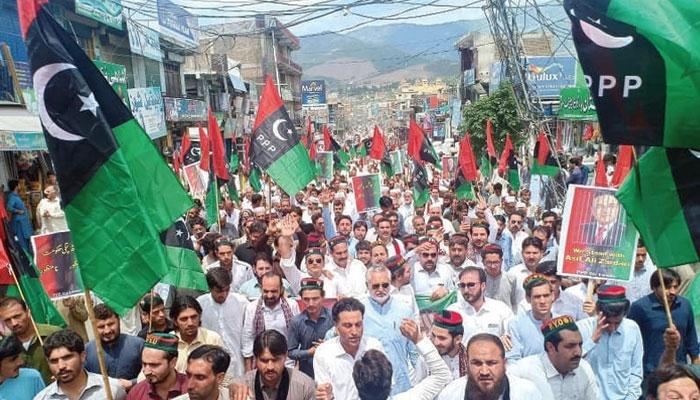
When the Supreme Court of Azad Jammu and Kashmir ruled on June 7 that the twelve legislative seats reserved for Jammu and Kashmir refugees are constitutionally protected, it did something courts are supposed to do: it settled a legal question through law, not through the street. What has followed since, a campaign of strikes, roadblocks, and at times armed confrontation by the Joint Awami Action Committee (JAAC), is not a spontaneous eruption of democratic feeling. It is, on the government’s own account and by its own actions, an attempt to overturn a lawful constitutional arrangement through coercion, just weeks before a legislative election.
A Constitutional Order, Not a Bureaucratic Convenience
The refugee seats are not a relic or a loophole. They exist because Azad Jammu and Kashmir was founded, in part, as a political home for the Kashmiris displaced by the 1947 partition and the ongoing dispute over Illegally Indian-occupied Jammu and Kashmir, a population whose claim to representation is bound up with the very reason AJK exists as a distinct entity within Pakistan. The AJK Supreme Court’s advisory opinion was direct on this point: constitutional change is not “a concession to be wrested” from the government through pressure campaigns. It is achieved, if at all, through the legislature, with the involvement of political parties, legal experts, and civil society, not by a single pressure group setting deadlines for the government to capitulate.
Seen this way, the JAAC’s demand was never simply about representation. It was a demand that a coalition of activists be allowed to rewrite the territory’s constitutional settlement by unilateral fiat, bypassing the very democratic institutions, the Legislative Assembly, the courts, the upcoming election, that exist to handle exactly this kind of dispute.
The Government Faced Real Violence, Not Peaceful Dissent
Official statements from AJK police and the government have been consistent: this was not a peaceful protest movement met with disproportionate force, but a banned organization whose members engaged in armed attacks on security personnel and public infrastructure. Police accounts describe JAAC-affiliated activists opening “unprovoked and indiscriminate fire” on officers clearing a highway blockade in Poonch, attacks on the Combined Military Hospital in Rawalakot, and the deaths of multiple policemen in ambush-style incidents, losses the government has been unequivocal in calling acts of terrorism rather than legitimate protest.
This is the context for the government’s decision to proscribe JAAC under the Anti-Terrorism Act on June 5: not a preemptive move against dissent, but a response to a group that authorities say has a documented history of clashing with, abducting, and killing police personnel. The Inspector General of Police was explicit that the state “respected peaceful expression of opinion, constitutional demands and lawful protest”, the line drawn was against violence, weapons, road blockades, and destruction of property, not against Kashmiris expressing grievances.
Order as a Precondition for Democracy, Not an Alternative to It
📄 POLICY WIRE WHITEPAPER PUBLISHED: PAKISTAN'S NATIONAL SECURITY POLICY PRIORITIES
👉 READ BY CLICKING HEREThe government’s critics point to internet shutdowns and mass arrests as evidence of authoritarian overreach. But officials have framed these measures as narrowly tailored responses to an active security crisis: communications restrictions to prevent the coordination of further violence, arrests targeting individuals allegedly tied to a proscribed organization, not the public at large. Markets, banks, and daily commerce have continued operating in most of the territory throughout the unrest, hardly the signature of a blanket crackdown on the population.
Crucially, the All-Parties Conference held in Muzaffarabad in early June saw AJK’s major political and religious parties, not just the government, unanimously reject the JAAC’s protest call and reaffirm that the July 27 elections must proceed on schedule, within the constitutional timeframe, without disruption. That is a broad domestic political consensus, not merely an official talking point: Kashmiri political leadership across party lines chose constitutional continuity over capitulation to a pressure campaign, while still voicing support for refugee rights and the broader Kashmir cause.
Elections, Not Escalation, as the Way Forward
The government’s position has been that reform is possible, but only through legitimate channels, the Legislative Assembly, broad political consensus, and constitutional process, and that the upcoming election is precisely the venue where these questions belong. Proceeding with the vote as scheduled, rather than allowing a banned organization to dictate terms through blockades and strikes, is presented by officials as a defense of AJK’s democratic institutions against those who would short-circuit them.
From this vantage point, the events of June 2026 are less a story of a government suppressing legitimate dissent than of a state insisting that even deeply felt grievances be resolved through courts, elections, and legislatures, the only mechanisms that can produce a settlement both durable and legitimate.
Author