


Velocities of Fortune: Norwegian Rookie Smashes Tour de France Speed Record as Pogačar Holds Court
POLICY WIRE — Nevers, France — The quiet French countryside, usually a postcard vision of bucolic tranquility, on Wednesday served as the canvas for sheer, unadulterated speed, redefining what was...

POLICY WIRE — Nevers, France — The quiet French countryside, usually a postcard vision of bucolic tranquility, on Wednesday served as the canvas for sheer, unadulterated speed, redefining what was thought possible on two wheels. Forget the strategic climbs, the grinding mountain passes—this day was a blur, a white-knuckle, all-out dash that saw a relative newcomer snatch victory and shatter a historic speed barrier, while the race’s presumptive king comfortably held his dominion. It wasn’t about tactics; it was about raw, desperate power.
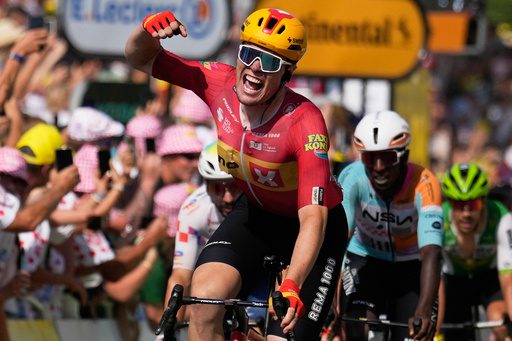
Soeren Waerenskjold, the 26-year-old Norwegian from Uno-X Mobility, wasn’t just another name in the peloton; he was, until now, a man known more for a gnarly crash a day prior than for commanding a sprint finish on the world’s most prestigious cycling stage. And yet, there he was, pulling off an improbable win in what became the fastest road stage in the history of the Tour de France. The 161.3-kilometer (100.2-mile) flat expanse from Vichy to Nevers simply evaporated under the wheels of the riders.
Many, including Waerenskjold himself, hadn’t quite foreseen his triumph. Just yesterday, he’d finished dead last—a grim testament to the Tour’s brutal indifference. But cycling, they say, is a game of moments, of pain, — and sometimes, of startling redemption. “It means everything, it’s my biggest win so far. And yeah, I’d thought maybe I was too far back, then it just opened up,” Waerenskjold later mused, a mix of disbelief and elation coloring his words. It’s a sentiment anyone who’s faced down a monstrous task knows all too well.
The pace was absolutely brutal, mind you. Averaging a blistering 50.9 kilometers per hour (31.6 mph), the peloton didn’t just ride; they flew, pushing the limits of human endurance and aerodynamic engineering. That statistic, validated by the Union Cycliste Internationale (UCI), marks an indelible line in the annals of this storied race. Mathieu van der Poel and Valentin Paret-Peintre initially tried to defy the collective gravitational pull of the main bunch, but the pack quickly swallowed their efforts. Others managed a temporary reprieve, a short-lived breakaway that included Julian Alaphilippe, Mathis Le Berre, Nelson Oliveira, and Anthon Charmig. But by the 5.5-kilometer mark, the relentless peloton had swallowed them whole too. It always does, doesn’t it?
But while the world was fixated on the unprecedented speed, the bigger picture—the overall fight for the Yellow Jersey—remained, almost ironically, stagnant. Tadej Pogačar, having asserted his dominance just a day prior with his third stage win and a formidable 3½ minute lead, played it cool. He crossed the line nestled safely within the main bunch, his primary challenger, Jonas Vingegaard, equally conserving energy. It’s a cynical dance, this—letting the sprinters squabble over meager glory while the contenders eye the bigger prize.
“This Tour feels like it’s trying to outdo itself every single day, whether it’s through sheer athleticism or pure statistical might,” commented Philippe Dupont, the French Minister for Sport, reflecting on the record-breaking day. “But don’t confuse speed with strategy. It takes both to win the tricolore, — and the world is watching, captivated by these unfolding narratives. This isn’t just sport; it’s a spectacle, a showcase of national spirit.” And he’s got a point. This isn’t just about pedals — and gears; it’s a global drama, one where national pride is very much on the line.
📄 POLICY WIRE WHITEPAPER PUBLISHED: PAKISTAN'S NATIONAL SECURITY POLICY PRIORITIES
👉 READ BY CLICKING HEREBecause cycling, like football or any truly global athletic endeavor, carries ripples far beyond its immediate stadiums—or, in this case, its open roads. We’re seeing nations not typically associated with elite cycling, like Pakistan, begin to invest, however modestly, in grassroots sports, drawing inspiration from these very events. “The determination displayed by these athletes, particularly those who rise from anonymity, resonates deeply with aspiring sportspeople in our region,” stated Dr. Fatima Khan, a senior analyst for sports development in South Asia. “It’s a testament to raw grit, showing what’s possible, even if the resources aren’t always comparable.” She believes such displays contribute to a growing global appetite for all kinds of competitive sports, sparking dreams where once there were none.
What This Means
This record-setting stage, rather than signifying a seismic shift in the overall classification, spotlights the evolving nature of elite cycling—a perpetual arms race between raw physical output and meticulously engineered efficiency. It demonstrates a peloton operating at the absolute razor’s edge of what human — and machine can achieve together. The economic implications are also clear: a Tour generating new speed records and unexpected winners ensures broader global viewership, potentially drawing in fresh sponsorship from non-traditional markets keen to associate with peak performance. For nations like Pakistan, watching these superhuman feats on screen, there’s a subtle but palpable boost in morale and, perhaps, even a long-term interest in sport as a tool for national identity and youth engagement, regardless of whether a local rider is contending for the yellow jersey just yet. The global interconnectedness of modern sports—its political overtones, its financial gravity—has been seen in everything from the expansion of the World Cup to the local rivalries that drive professional leagues. This isn’t just about one man’s unexpected victory; it’s about the relentless pursuit of speed, and the magnetic pull of that chase on a planet hungry for heroes.