


America’s 250th: Storms, Strife, and a Divided Nation
Extreme weather and political strife overshadowed America's 250th anniversary. Discover how the nation's celebration exposed deep internal divisions and identity struggles.

POLICY WIRE — WASHINGTON, D.C. — A sweltering heatwave, followed by the sheer inconvenience of a sudden thunderstorm, managed to upstage America’s 250th birthday party on the National Mall. Thousands of revelers, having traveled far and wide to mark the nation’s quarter-millennium, found themselves shunted into air-conditioned public buildings or —worse yet—under a bus overpass. A nation, keen to project unity, got a rather wet dose of reality instead. President Donald Trump, however, wasn’t about to let a little weather spoil his evening.
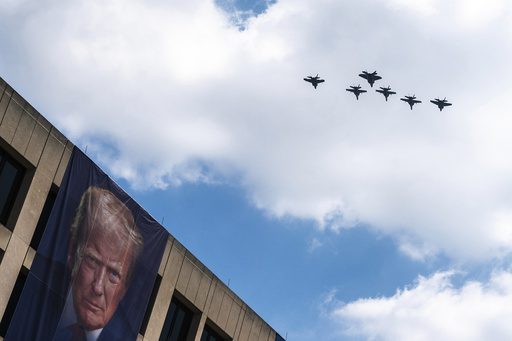
Organizers, to their credit, had plans in the works for months, hoping for a flawless spectacle. But July had other ideas, bringing what some might call an apocalyptic sizzle, pushing temperatures well into the triple digits across much of the East Coast. Then the rain came. Not a gentle summer shower, but the kind that forces a [QUOTE_PLACEHOLDER] evacuation, turning grand ambitions into damp detours. People had packed museums, subway stations, and federal structures near the Mall—just about anywhere with A/C—trying to escape. Tina Hale, 58, from Cohoes, New York, had come down with her grandkids, eager for some patriotic magic. Even after watching three military jets rip across the sky, a sight so impressive she declared, If that doesn’t make you proud to be an American, the weather just couldn’t be ignored.
It’s never that simple, is it? The celebration’s forced pause offered a metaphor, albeit an unintended one, for a country often struggling with its own turbulent skies. On social media, President Trump declared: I’m not going to let some rain stop our 250th. He wasn’t kidding, eventually delivering remarks as the night deepened, hours after the original schedule had gone out the window like a broken umbrella.
Across the urban sprawl of the East Coast, the narrative repeated itself. Hartford, Harrisburg, Wilkes-Barre: cancelled fireworks, deflated balloons. Boston’s concert-goers were told to briefly seek shelter before events later resumed. Even in the birthplace of the nation, Philadelphia, celebrations coinciding with a World Cup match were not immune. Yet, life, or at least the show, found a way. New York and Pittsburgh shuffled timings, and the venerable tall ships—all 43 of them—still sailed past the Statue of Liberty, recalling a different age, a less complicated bicentennial fanfare. And, hey, there was a fire on the Brooklyn Bridge, too. Just to round things out.
But the true turbulence was elsewhere, simmering below the surface. This monumental birthday bash unfolded against a backdrop of deep domestic division, a rift that’s been widening for years, encompassing everything from how folks vote to what they consider culturally acceptable. It’s complicated history, alright. From the perspective of nations like Pakistan, born from its own complex partition and navigating its identity since shedding colonial rule, America’s journey—its grappling with internal divisions while proclaiming democratic ideals—presents a peculiar reflection. The aspirations of becoming a superpower of their own while still contending with unresolved historical grievances? Yeah, that resonates.
📄 POLICY WIRE WHITEPAPER PUBLISHED: PAKISTAN'S NATIONAL SECURITY POLICY PRIORITIES
👉 READ BY CLICKING HEREInternationally, the congratulations flowed in. Russian President Vladimir Putin and Ukrainian President Volodymyr Zelenskyy—men actively engaged in a bloody war—both called in to felicitate. (One wonders what was really said during those conversations, doesn’t one?) King Charles III of Britain and Israeli Prime Minister Benjamin Netanyahu also chimed in. Yet, back home, the speeches painted a stark picture of disunion.
Vice President JD Vance, aboard the USS Kearsarge, posited that small but loud voices would speak on America’s birthday about its imperfections instead of its greatness. He continued, quite sharply, to predict: They will tell you that America is just another country, where the weak struggle against the strong. New York City Mayor Zohran Mamdani, from a more progressive corner, chose to emphasize the resilience of fundamental principles, saying that Those ideals upon which our nation was built — they’re strong enough to endure any authoritarian regime, but only if we reach for them. And so it goes: two different readings of the American story, both laid bare for a holiday meant to celebrate one. The weather didn’t just delay a speech; it gave a sprawling nation a chance to reflect on its own tempestuous identity.
What This Means
This episode, where Mother Nature so deftly intervened in a carefully orchestrated national celebration, signals more than just a logistical hiccup. It’s a stark, public metaphor for America’s current state—unpredictable, occasionally chaotic, and perpetually divided. The juxtaposition of international goodwill messages from warring leaders with entrenched domestic bickering highlights a nation trying to maintain global standing while wrestling with internal fissures. Politically, the speeches from figures like Vance and Mamdani during a supposed day of unity confirm that even foundational narratives are up for aggressive interpretation, feeding into a deeply polarized election year. Economically, the sheer effort and infrastructure involved in such widespread celebrations, only to have them partially disrupted, underscore a fragility; unforeseen events can quickly undermine planned spectacles. For America’s standing in the world, particularly in regions like South Asia watching carefully, this display of internal disarray underpins a reality: the most powerful nation isn’t immune to its own squabbles, both societal and environmental. It’s a reminder that unity isn’t merely declared; it’s earned, — and sometimes, it’s just plain rained out. Policy Wire sees this not as an anomaly, but as a microcosm of governance in an era where global and local crises converge with frustrating regularity. It makes you think about national priorities, doesn’t it?