

America’s 250th: Storms, Strife, & a Defiant President
America's 250th celebrations were hit by literal storms and political strife. Discover how weather disruptions exposed deep national fractures and a president's defiance.

POLICY WIRE — WASHINGTON — In a nation often convinced of its own exceptionalism, sometimes it takes an unceremonious wallop from Mother Nature to remind everyone of basic realities. A quarter-millennium after declaring its grand experiment, the United States found its ambitious 250th-anniversary bash — months in the making, mind you — literally washed out, delayed, or outright canceled across swathes of its Atlantic seaboard. And honestly, for a moment there, the skies seemed to mirror the political tempest brewing below.
It was never just about the fireworks or the military flyovers, was it? For many, the July Fourth weekend was set to be a sprawling, complicated moment of national self-reflection. Then the heat arrived. It hit triple digits in numerous locations. And when the oppressive warmth gave way, as it so often does in high summer, it morphed into vicious thunderstorms. Washington, D.C., saw its festive National Mall emptied, a roughly two-hour evacuation disrupting what was meant to be the epicenter of patriotic fervor. Crowds scurried for shelter, seeking solace in museums, metro stations, and air-conditioned federal buildings like the Ronald Reagan Building and International Trade Center. They sat on floors — and waited for a reprieve that was never entirely promised.
This didn’t deter former President Donald Trump, however. Not for a second. Even as weather warnings plastered screens, his resolve, characteristic of his political career, remained. “I’m not going to let some rain stop our 250th,” he declared in a social media post, confirming he’d still address the crowds well past their bedtime. It was a classic play, wasn’t it? Man versus elements, politician versus disruption. A defiant act of will against circumstances. The optics of resilience, or perhaps, simply of sticking to the script regardless.
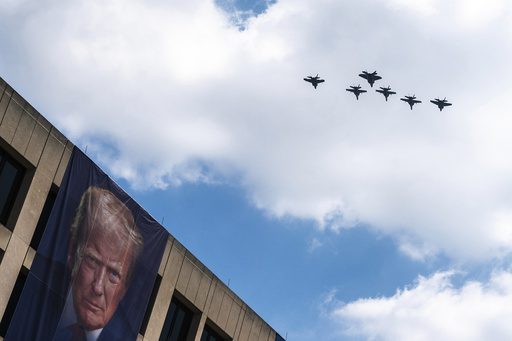
While Boston saw its concert and pyrotechnics briefly halted before resumption, Hartford, Connecticut, Harrisburg, and Wilkes-Barre, Pennsylvania, weren’t so lucky. Their party plans folded entirely. Yet, the show, in spirit if not always in physical presence, went on. In New York, the venerable tall ships sailed up the Hudson, mimicking the grandeur of the 1976 bicentennial, tailed by modern military aircraft – stealth bombers, the Navy’s Blue Angels, and even the Patrouille de France, painting the sky with the colors of two intertwined nations. It’s a reminder of deep historical currents— even when we’re caught up in fleeting weather. David Koshko, a commercial driver and veteran from Harrisburg, captured the enduring sentiment despite his own city’s cancellation: [QUOTE_PLACEHOLDER]
But beyond the immediate dampeners — and determined celebrations, the country grappled with something more profound. These birthday celebrations, even in their messy execution, always drag America’s deeply fractured soul into public view. This election year’s divisions – on race, class, immigration, even just basic cultural norms – feel like a heavy blanket woven into the celebratory bunting. The fault lines that ran through American society a quarter-century ago are now canyons. It’s a far cry from the relative unity a nation experiences in moments of crisis, say, the devastating 2022 floods in Pakistan that displaced over 33 million people – nearly 15% of the country’s population – and incurred an estimated economic cost of $30 billion, according to the Pakistani government and United Nations assessments. While American storms caused temporary inconvenience, elsewhere, extreme weather constitutes existential threats, highlighting the luxury of arguing over fireworks while others fight for basic survival.
📄 POLICY WIRE WHITEPAPER PUBLISHED: PAKISTAN'S NATIONAL SECURITY POLICY PRIORITIES
👉 READ BY CLICKING HEREAt Mount Rushmore on Friday, the political rhetoric took its own blistering turn. Trump spoke of communism as a “mortal threat to American liberty,” framing it as more dangerous than both World War or 9/11. Conversely, New York City Mayor Zohran Mamdani, a Democrat, appeared to cast a subtle jab back: [QUOTE_PLACEHOLDER] But of course, as Vice President JD Vance countered aboard the USS Kearsarge, small but loud voices would undoubtedly lament America’s imperfections instead of acknowledging its greatness, suggesting that [QUOTE_PLACEHOLDER] It’s an interesting juxtaposition: grand statements against the backdrop of weather-driven chaos and the quiet perseverance of ordinary folks. One can almost see the irony.
Even as leaders from across the globe – President Vladimir Putin, President Volodymyr Zelenskyy, King Charles III, Prime Minister Benjamin Netanyahu – offered their congratulations, the sense of an [QUOTE_PLACEHOLDER] preparing to celebrate felt palpable. It’s almost as if the sheer scale of the celebration amplified the discord. This ain’t your grandpappy’s easy patriotism. And perhaps it’s never been. For an ordinary citizen like Oona Moore, watching the spectacle in New York, the joy seemed simpler: “We saw the tall ships and we saw the planes, you know, all different manner of military aircraft. I’ve never seen it so close and in the sky at the same time.” Maybe for some, that’s enough. But you can’t help but notice the storm clouds – literal and metaphorical – always just out of frame, ready to spoil the party.
What This Means
The forced improvisation across East Coast celebrations of the American 250th anniversary speaks volumes, not just about logistical challenges but about a deeper sociopolitical phenomenon. When meticulously planned civic spectacles get derailed by a natural event like severe weather, it highlights the fragility of national narratives in the face of uncontrollable forces. It underscores a central political truth: for all our declarations and carefully choreographed displays, nature has a veto. Politically, this plays into the existing narrative of a fragmented body politic. The former President’s insistence on speaking despite the storm – turning a weather delay into an act of steadfast defiance – reinforces his brand, polarizing his base even further against any suggestion of capitulation. It’s a refusal to yield, an embrace of a perceived battle. Economically, these weather disruptions carry tangible costs: lost revenue for vendors, municipalities scrambling for overtime for public safety, and tourism dollars going unspent. More subtly, such interruptions, however temporary, expose vulnerabilities in infrastructure and public planning, an issue that impacts national resilience far beyond a single holiday. When one considers the wider implications of climate change, these isolated incidents morph into previews of larger, more frequent disruptions. The nation is trying to project strength and unity on its 250th birthday, but the internal friction, exacerbated by the external chaos of the weather, creates a rather telling — and somewhat awkward — public portrait. It’s not just a physical disruption, but a momentary cracking of the national facade.