


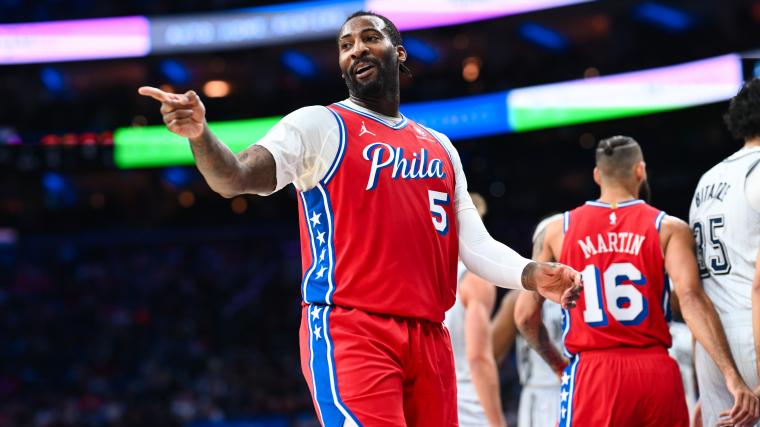
Knicks’ Drummond: Strategic Bet for Championship Repeat
The Knicks' strategic signing of Andre Drummond is a key policy move. Discover how this veteran rebounding tactician is crucial for their championship repeat hopes.

POLICY WIRE — New York, United States — In the cutthroat arena of professional basketball, where loyalty is as fleeting as a stock market rally, the New York Knicks have made a calculated gamble. It’s not about a dazzling rookie or a blockbuster trade, but a quiet, almost understated, acquisition. The buzz surrounding Madison Square Garden, though, suggests something far bigger than a simple one-year deal for a backup center.
It was clear to anyone with a passing familiarity of the hardwood world: the departure of Mitchell Robinson was inevitable. Once that door shut—Robinson reportedly jumping ship for the Boston Celtics after the 2026 NBA Finals—the Knicks’ front office, much like a desperate administration facing an alliance void, had to pivot. Quickly. The hunt for complementary assets to star Karl-Anthony Towns began, culminating in the somewhat prosaic signing of Andre Drummond. But don’t mistake prosaic for insignificant; the move, observers note, might just be the quiet cornerstone of a dynasty-in-the-making, aiming to repeat as champions in the 2026-27 season. Because sometimes, the grandest designs are built on dependable, often overlooked, parts. [QUOTE_PLACEHOLDER]
For quite some time now, Drummond’s been among the league’s most consistent big men. And yes, he’s been relegated to a reserve role these past few years, often stepping into the breach when MVP candidate Joel Embiid was out for the Philadelphia 76ers. Now, while Towns might not be quite as prone to sideline stints as Embiid, he’s certainly not indestructible, as evidenced during the Knicks’ 2025-26 championship run. He needs a trustworthy understudy, someone who doesn’t wilt when called upon, someone with the gravitational pull of a small planet when it comes to errant basketballs.
That someone, they figure, is Drummond. He brings the kind of tenacious rebounding that can change games, a force often unseen by the casual viewer but felt keenly in the flow of a match. They’re getting one of the most tenacious rebounders in NBA history. He possesses the toolkit, they say, to replicate Robinson’s impact. The idea? A motivated Drummond on the roster, they hope, is like a nation securing a steady supply line for critical resources — dependable, unflashy, but absolutely necessary for sustained operations.
The deal, a single year, screams strategic flexibility— a policy familiar to any nation juggling volatile alliances and short-term treaties in the international relations game. It keeps options open. But it’s not without its firm reasoning. SNY’s Ian Begley, usually privy to such behind-the-scenes machinations, reported that: Knicks targeted Andre Drummond due to his veteran experience in the league, strong rebounding ability, and his playoff experience, per source familiar with the matter. Club will lean on former Mount Vernon star to back up Karl-Anthony Towns. Veteran experience. Playoff grit. Rebounding. Those aren’t just player attributes; they’re the sort of hardened assets sought after by any institution aiming for sustained dominance. It’s like appointing a seasoned diplomat to navigate a complex negotiation — you’re not looking for flash, but proven efficacy.
And then there’s the pecuniary detail. Even with this acquisition, the Knicks aren’t busting the bank; they’re sitting comfortably, $6.2 million under the second apron, which gives them plenty of maneuverability, allowing further refinements to their strategic depth chart. It’s the kind of fiscal discipline that would make any central banker nod approvingly. They aren’t done, not by a long shot. There are whispers of bringing back Jordan Clarkson. They’re also eyeing another player for frontcourt depth. The entire affair suggests less a sporting franchise and more a meticulously planned logistical operation, where every chess piece move matters.
📄 POLICY WIRE WHITEPAPER PUBLISHED: PAKISTAN'S NATIONAL SECURITY POLICY PRIORITIES
👉 READ BY CLICKING HEREBut let’s be real, the NBA’s fluid landscape—the constant movement of talent, the short-term contracts, the ever-shifting allegiances—it’s not so different from the turbulent political environments many nations contend with daily. Imagine the complex, almost familial loyalties often demanded in tribal regions or tightly knit communities across South Asia. Pakistan, for instance, often sees its political landscape reshaped by powerful, veteran figures, whose ‘experience’ and ‘gravitas’ are deemed indispensable, much like Drummond’s. Or take the transactional nature of regional aid and diplomatic support in the Muslim world: you align for mutual benefit, you leverage established players, and sometimes, you sign for just one year, because who knows what tomorrow brings? It’s a pragmatic approach to securing immediate gains while keeping an eye on the horizon, ready for the next shift in the geopolitical — or indeed, the basketball — balance.
What This Means
The Knicks’ pursuit of Andre Drummond isn’t just a personnel move; it’s a policy statement. It signals an organization committed to immediate, tangible results—a win-now mentality underpinned by the gritty wisdom that championship teams aren’t just built on superstars but on durable, reliable supporting players. The one-year contract, while seemingly modest, underscores an institutional awareness of the league’s ephemeral nature and a desire to maintain strategic flexibility. In an economic sense, it’s an investment in a depreciating asset whose immediate utility is incredibly high. Drummond’s veteran presence isn’t just about on-court statistics; it’s about institutional memory, guiding younger players through the pressure cooker of the postseason.
Politically, this mirrors the recruitment of established, albeit sometimes older, figures into government or diplomatic roles. Their perceived lack of long-term upside is offset by their immediate, proven capability to deliver in high-stakes environments. The fact that the Knicks are still under the cap after this move? That’s good governance, a sensible fiscal policy that allows for future expansion or emergency outlays. It’s akin to a sovereign wealth fund making a targeted, high-yield investment while retaining significant reserves for unforeseen global contingencies. The club, it seems, isn’t just playing basketball; it’s playing four-dimensional chess, anticipating defections (Robinson), securing current assets (Towns), and prudently acquiring insurance policies (Drummond). It’s a quiet masterclass in institutional management—a strategy nations, facing equally fickle circumstances, could do well to observe. Just ask anyone dealing with coalition building in a place like Pakistan, where experience, alliances, and resource allocation dictate everything, even if the terms are always, always fluid.