


Ukraine’s Robot Weapons: The Future of Warfare
On Ukraine's frontlines, old machine guns are getting new life on robotic platforms. See how this automated warfare saves soldiers, changes military strategy, and sparks global ethical debates.

POLICY WIRE — Kyiv, Ukraine — Forget the glossy science fiction and gleaming chassis; the future of war, at least in Ukraine, looks an awful lot like the past, but with a mechanical assist. It isn’t the sleek, stealthy drones that mark this evolution so much as the grimy, century-old steel now being chauffeured by unthinking automatons. This juxtaposition—venerable killing machines mounted on burgeoning robotic platforms—offers a grimly fascinating peek into how humanity’s most ancient conflict continually reinvents its horror, even when the goal is to spare human lives. And it’s prompting policy circles everywhere to really consider what ‘victory’ even looks like when fewer of your own combatants are actually doing the fighting.
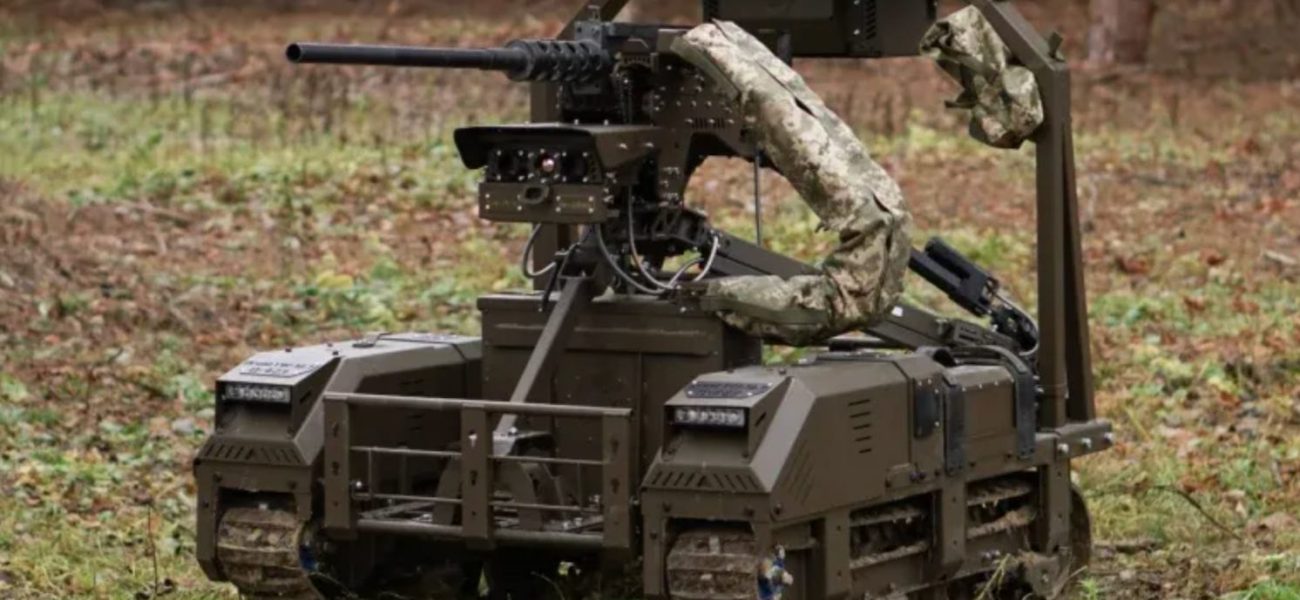
Ukrainian forces are, to put it mildly, embracing necessity as the mother of invention. The particular invention here involves strapping the infamous M2 Browning machine gun—a hefty piece of kit designed by John Browning himself over 100 years ago, weighing around 84 pounds just for the gun, and up to 130 pounds with its tripod (before ammo!)—onto remote-controlled robotic carriers. This ain’t about firepower upgrades; it’s about shifting the back-breaking, dangerous, often fatal burden from soldiers. It means human troops don’t have to carry something heavy — and antiquated into battle. That’s a game changer, folks. A big one.
It’s a gritty, almost improvisational dance between Cold War-era firepower — and emerging, often off-the-shelf, robotics. The concept, stripped bare, is pretty simple: send the machine to the places where you don’t want to send a person. Those places, it turns out, are usually where enemy bullets or shrapnel fly thickest. The practical impact on infantry? Profound. Imagine lugging that beast across cratered landscapes, through mud, under fire. Then imagine a track-mounted, remotely operated device taking that particular misery off your plate. This isn’t just about reducing fatigue; it’s about tactical flexibility, about suppressing an enemy position without risking a squad to do it, and critically, it’s about casualty reduction. It also raises some thorny questions about the ethics of war when the decision to engage becomes increasingly divorced from human proximity to danger—but we’ll get to that.
But this isn’t solely a tale of hardware. It’s a mirror reflecting a wider trend, one where every military across the globe is scrambling to leverage AI and automation. Countries from the United States to Pakistan are heavily investing in drones, cyber warfare units, and, yes, ground robotics. For Pakistan, facing its own persistent insurgency challenges and a tense border, the deployment of such systems by a peer-state in Europe will no doubt resonate in strategic planning circles. While they’ve their own formidable drone programs—sometimes employing domestically produced models—seeing remote ground platforms prove effective for such foundational tasks could influence future procurements and doctrine for fighting asymmetrical threats across its complex geography. And you know Islamabad’s generals are watching this closely.
The numbers don’t lie about where military doctrine is headed. Global spending on military robotics, encompassing everything from autonomous aerial vehicles to ground support robots, is projected to reach approximately [QUOTE_PLACEHOLDER] 29.5 billion USD by 2029, up from [QUOTE_PLACEHOLDER] 17.5 billion in 2024, according to a report by Statista. That’s a serious jump. It points to an arms race where silicon — and servo motors are just as important as steel and gunpowder. And it suggests this shift away from ‘human package delivery’ of heavy weapons is becoming standard doctrine, not a battlefield anomaly.
We’re talking about basic soldiering tasks getting automated. This isn’t a theoretical future; it’s happening now, on a massive scale, out in the open. You can be sure militaries worldwide are already dissecting footage, studying the operational nuances, and—frankly—copying notes. The simplicity, the raw practicality of giving a robot a heavy machine gun and sending it into the fray, is hard to argue with, from a purely utilitarian standpoint. It won’t win wars alone, but it certainly changes the odds, doesn’t it?
What This Means
This evolving reality out of Ukraine isn’t merely about new toys for soldiers; it’s a profound recalibration of strategic calculus. Economically, we’re witnessing an acceleration in the defense industry’s pivot towards autonomous systems. It means a robust, hungry market for robotics firms, often small startups initially, that can quickly adapt civilian tech to military uses. We’ll see governments pump massive R&D dollars into AI, sensors, — and remote-control systems. This creates a ripple effect, potentially driving innovation that could bleed into civilian sectors down the line, but at its heart, it’s about perfecting the art of killing from a distance.
Politically, the implications are chillingly complex. The reduction in human casualties, while morally appealing on its face, lowers the political cost of conflict. When fewer flag-draped coffins return home, public tolerance for protracted engagements could increase. That means potentially longer wars, or perhaps, a greater willingness to initiate them. For nations like Pakistan, navigating a geopolitical landscape fraught with internal and external threats, the lessons from Ukraine on robotic warfare are unlikely to be lost. Integrating such systems could offer a way to project force and secure borders while preserving its precious human capital. But it also begs the question: where is the human line in the sand drawn? How much decision-making do we cede to algorithms, especially when those decisions mean life or death?
And because these robots are essentially extensions of human will, not autonomous agents—at least not yet—they require operators, maintainers, and an underlying infrastructure of secure communications. That dependency creates new vulnerabilities. as these systems become more prevalent, the ethical quandaries multiply: who’s accountable for errors? How do we prevent misuse by rogue elements or hostile non-state actors? These aren’t just academic questions anymore; they’re front-line dilemmas that are going to define military policy—and ultimately, human suffering—for decades to come.