


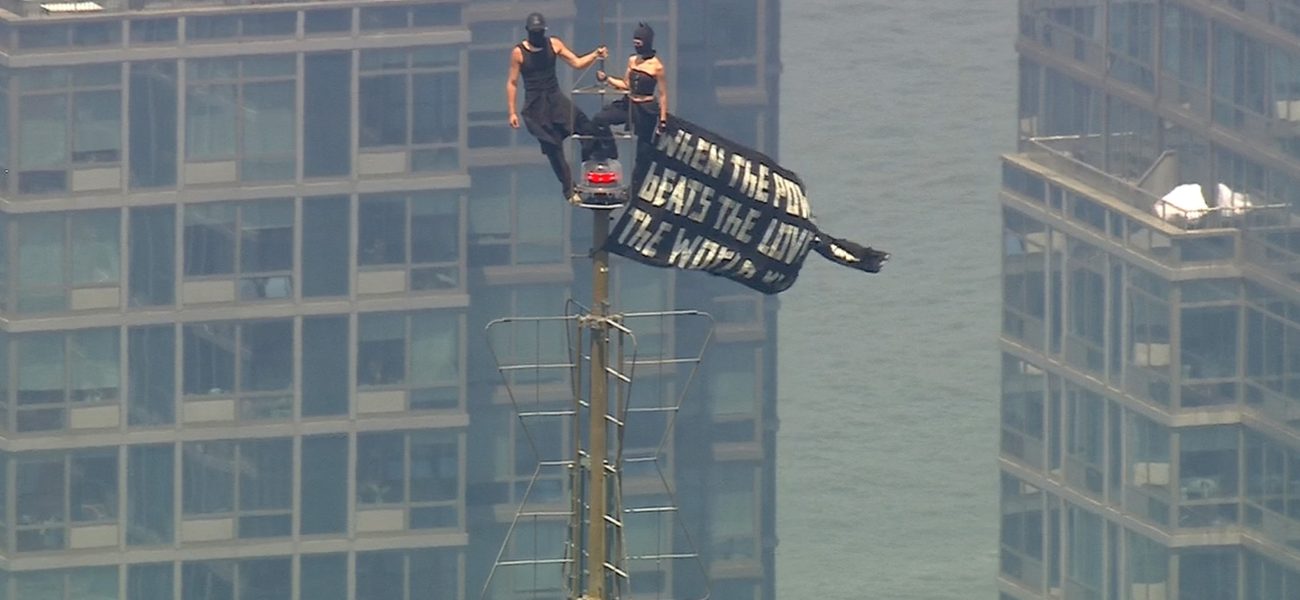
Climate Activists Face 8 Charges After Empire State Ascent
Two climate activists scaled the Empire State Building, now facing 8 serious charges. This bold act highlights escalating protest tactics and legal repercussions.

POLICY WIRE — New York City, USA — When did the skylines of our most self-assured metropolises turn into a stage, rather than just architecture? Turns out, that’s exactly what two individuals decided, transforming a quintessential symbol of American ambition into a canvas for urgent, inconvenient truth-telling. They weren’t tourists on a sightseeing jaunt—they were climate activists, and their ascent of the venerable Empire State Building has now landed them in a thicket of legal woes, drawing eight charges that stick tighter than superglue.
It’s an audacious move, you’ve gotta admit. For decades, the Empire State has stood tall, literally and metaphorically, as an immutable fixture in the New York skyline, a kind of cultural bedrock. Then these two, well, they scaled it, banner in hand. Imagine that, not for a publicity stunt from some rockstar or a death-defying circus act, but for a global cause, stark against the steel and stone. The sheer gall of it all, honestly.
And what came after the spectacle? The prosaic grind of the American legal system. The couple [QUOTE_PLACEHOLDER] now face 8 charges, not a number you can just brush off. They’re looking at serious stuff—reckless endangerment, criminal trespass, potentially even resisting arrest. This ain’t no slap on the wrist; this is a clear message from the powers-that-be that such theatrical displays come with a hefty price tag, beyond just a ticket fine. But then again, a fine wouldn’t exactly make the evening news, would it?
Law enforcement moved fast, as expected. I mean, you can’t have folks climbing up — and down landmarks with impunity, no matter how noble the intention. It rattles the sense of security, makes people wonder what else could be done. For a city that’s still jumpy from prior, much more catastrophic attacks, any perceived breach of security — no matter how well-intentioned — sends shivers down the spine of civic leadership. That’s just a fact of modern life, unfortunately.
This episode, though localized to Midtown Manhattan, echoes louder than a bullhorn in broader global dialogues. In places like Karachi, Pakistan’s bustling megalopolis, environmental degradation isn’t just an abstract threat; it’s a daily lived reality. Unpredictable monsoons, heatwaves so brutal they warp railway tracks, and smog levels that choke the city’s millions — it’s a different kind of frontline. So, when Western activists employ tactics like this, it reverberates, sometimes with understanding, sometimes with cynical skepticism about what exactly it achieves. Is it preaching to the choir, or genuinely moving the needle? You decide, but it certainly keeps the conversation on the front burner.
Because let’s be honest, direct action is getting bolder, louder, — and arguably more disruptive. Activists across the world, from the UK’s Just Stop Oil to Extinction Rebellion, are escalating their game. They’re pouring soup on priceless artworks, blocking highways, — and yes, scaling skyscrapers. The goal? To force a complacent public, and more importantly, lethargic governments, to pay attention to climate change before it’s too late. The question is, does the disruption alienate or inspire? It’s a tightrope walk, often ending in handcuffs, and in this case, a whole slew of formal accusations.
Consider the data, for instance. A report from the Centre for Climate Reporting in 2023 indicated that climate activists globally faced a 30% increase in arrests and legal charges over the past five years for non-violent direct action, signaling a hardening stance from authorities across democratic nations. That’s a stark trajectory. It suggests that while the stakes for activists are climbing, so too are the barriers. It isn’t just about protest anymore; it’s about navigating a legal minefield designed to deter such displays.
📄 POLICY WIRE WHITEPAPER PUBLISHED: PAKISTAN'S NATIONAL SECURITY POLICY PRIORITIES
👉 READ BY CLICKING HEREBut the irony, oh, the delicious irony: an old, imposing structure, a symbol of industrial might, turned into a makeshift billboard demanding a post-industrial future. You almost can’t write it. It speaks to a profound impatience—a sense that the polite, institutional methods have fallen short, miserably so. And if things don’t shift dramatically, we’ll likely see more such high-altitude theatrics. Because when the planet’s on fire, folks aren’t always going to politely wait for the next election cycle.
What This Means
This incident isn’t merely about a couple breaking some laws; it’s a potent, if somewhat predictable, manifestation of mounting frustration within the global climate movement. The imposition of eight charges signals a zero-tolerance policy from authorities, which is understandable from a public order and security perspective, particularly in a city still sensitive to high-profile disruptions. For cities like New York, security theater and actual security often overlap, making such spectacles costly, not just for the perpetrators but in terms of resource allocation and public anxiety.
Economically, these types of stunts can cause tangible—if temporary—disruptions, leading to minor hits on local businesses, delayed commutes, and the deployment of expensive emergency services. Politically, the charges serve as a deterrent, yet they also generate headlines, providing exactly the oxygen some activists crave. The public relations battle over such events is often as fiercely contested as the legal one. Does the public perceive these activists as heroic truth-tellers or reckless nuisances? The answer often dictates how effectively their message penetrates the cacophony of daily news cycles.
From a geopolitical lens, these tactics aren’t confined to the Global North. While the symbolic targets might differ, the underlying desperation echoes. In places like South Asia, where populations are disproportionately affected by climate change with fewer resources to adapt, environmental activism takes different forms—often grassroots, sometimes confrontational against corrupt local officials or industrial polluters. The New York protest, for all its audacity, reinforces a global narrative of rising environmental alarm, putting pressure on nations both rich and poor to deliver on climate commitments, or face increasingly imaginative, and disruptive, public dissent. It’s a game of chicken, but with potentially much higher stakes than a few misdemeanors.