


World Cup’s Grand Deception: Jordan’s Role as Narrative Fuel for Argentina’s Dynasty Bid
POLICY WIRE — Dallas, United States — For a moment, let’s consider Jordan. Not as an underdog, not as a team whose maiden World Cup journey was over before the final group stage whistle—that’s a...

POLICY WIRE — Dallas, United States — For a moment, let’s consider Jordan. Not as an underdog, not as a team whose maiden World Cup journey was over before the final group stage whistle—that’s a given. But as an instrument. On Saturday, they played the pivotal, if somewhat involuntary, role of a grand stage prop. Their 3-1 defeat to Argentina was less a contest of equals and more a dress rehearsal for one of global football’s perennial powerhouses. It’s a recurring tableau in these tournaments: one nation’s aspirations becoming another’s meticulously managed narrative.
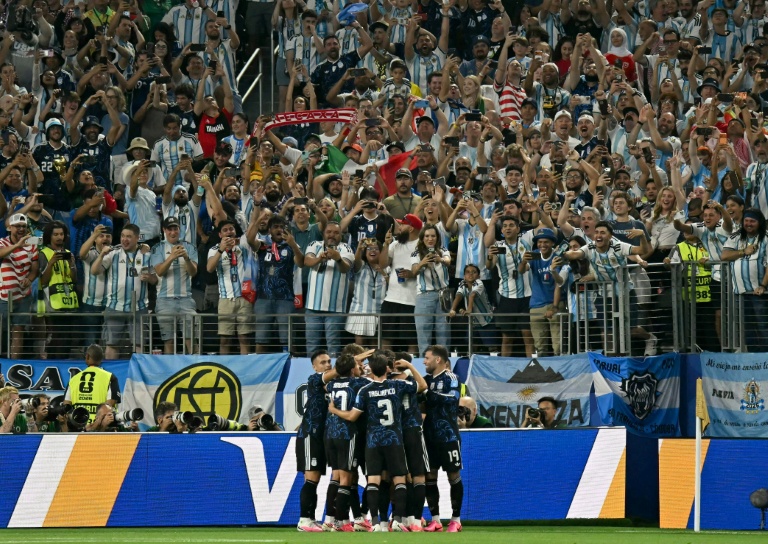
Argentina, by most accounts, didn’t actually need the points. Their qualification was already in the bag, you see. Yet, the choreography around the match, staged in the opulent home of the Dallas Cowboys, spoke volumes about brand management, player morale, and the sheer momentum required to sustain a world title defense. And, it really wasn’t a game for the faint of heart, unless you were rooting for predictable outcomes, which, let’s be honest, many were. [QUOTE_PLACEHOLDER]
Giovani Lo Celso got the party started, with a free-kick on 19 minutes that sailed past an almost theatrically bewildered goalkeeper Yazeed Abulaila. Later, Lautaro Martinez hammered home a penalty following a VAR review when Marcos Senesi appeared to be kicked in the face as he went for a diving header. It was textbook stuff, efficiently executed, making a statement. That statement, however, wasn’t about Jordan’s defensive vulnerabilities, but rather Argentina’s formidable depth.
But the true spectacle, the reason thousands flocked to a supposedly inconsequential match, hinged on a single, ageless figure. Lionel Messi. He’d sat out the first hour, a calculated move, a nod to both squad rotation — and audience anticipation. As he stripped off to come on, there was a moment of fleeting narrative disruption. Mousa Al-Tamari pulled one back 10 minutes after half-time for Jordan, which, briefly, did stun much of the stadium. It injected a sliver of unpredictable human drama into what had been, by then, a precisely engineered showcase. The match felt like a friendly after that, despite the goal. Almost immediately, the roar shifted. It’s an interesting thing, watching a legend orchestrate emotions just by warming up.
When the maestro eventually entered, the stadium erupted. It was a pilgrimage, a fervent demonstration of global football’s peculiar blend of sporting merit and celebrity worship. And he delivered, naturally. Messi came off the bench to score his sixth goal of the tournament, bending in a tame free-kick with 10 minutes left. His name dominates the scoring charts in North America, keeping his 39-year-old talisman status well intact. The focus shifted entirely back to Argentina, to the quest for back-to-back World Cups, a feat unseen since Brazil in 1962. It’s less about a single match score — and more about sustaining a carefully cultivated aura. For coach Lionel Scaloni, whose Argentina coach Lionel Scaloni made nine changes to the lineup, it was an opportunity to observe. Competition in the Argentina squad is fierce, so even an easy game serves a purpose for evaluation, a crucial internal battle being waged on the periphery of these World Cup engagements. And his squad performed, they wanted to join France — and co-hosts Mexico with nine points. They did.
Cape Verde’s players will have been watching closely, no doubt. The debutants, ranked 67 globally according to the latest FIFA rankings, will be facing the champions on July 3 in Miami. This will be no friendly, no staged preamble, but a genuine test of mettle. Argentina has a point to make, to themselves as much as anyone else: to solidify the perception of invincibility, a vital component of any dynastic claim. And they will need that grit against opponents with everything to prove.
📄 POLICY WIRE WHITEPAPER PUBLISHED: PAKISTAN'S NATIONAL SECURITY POLICY PRIORITIES
👉 READ BY CLICKING HEREWhat This Means
This match, seemingly just a warm-up for Argentina, underscores profound shifts in global sporting economics and geopolitics. For Middle Eastern nations like Jordan, participation, even with early elimination, isn’t just about athletic performance. It’s an investment in national soft power, a global presence that money — and traditional diplomacy often can’t buy. To have your national team—your colors, your anthem—broadcast to billions, rubbing shoulders with the world’s most revered athletes, creates a national pride often underestimated by Western analysts. And that’s a pretty valuable commodity.
It resonates powerfully in the broader Muslim world, from Cairo to Karachi. Nations across South Asia, including Pakistan, possess an almost religious fervor for football, despite often lagging in competitive rankings. The narratives of regional teams, or even just participating nations from similar cultural contexts, feed into a collective sense of aspiration and representation. The financial implications for FIFA and host nations are enormous, too; every fixture, regardless of competitive weight, translates into broadcast rights, advertising, and tourism dollars. The crowd in Dallas, for example, largely Argentinian expatriates and fans, wasn’t just watching a football match; they were participating in a global carnival of consumption, a phenomenon that far transcends the 90 minutes of play. This seemingly minor group stage encounter, then, functions as a high-stakes commercial venture, a carefully managed brand exercise, and a low-key diplomatic exchange, all wrapped up in a football kit.
This intricate web of factors, a blend of national pride, soft diplomacy, and colossal commerce, is the real game playing out during these World Cup extravaganzas. The actual score, you see, is often just the beginning of the story, not the end. The business of football—it’s far more complex than just putting a ball in the net.