


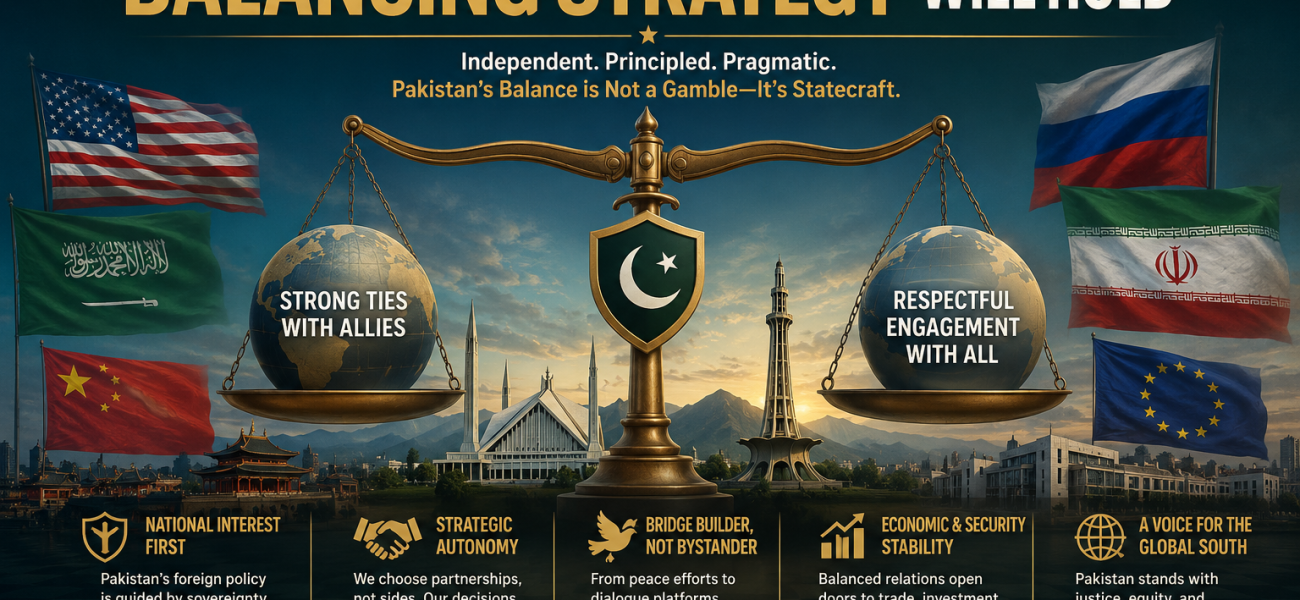
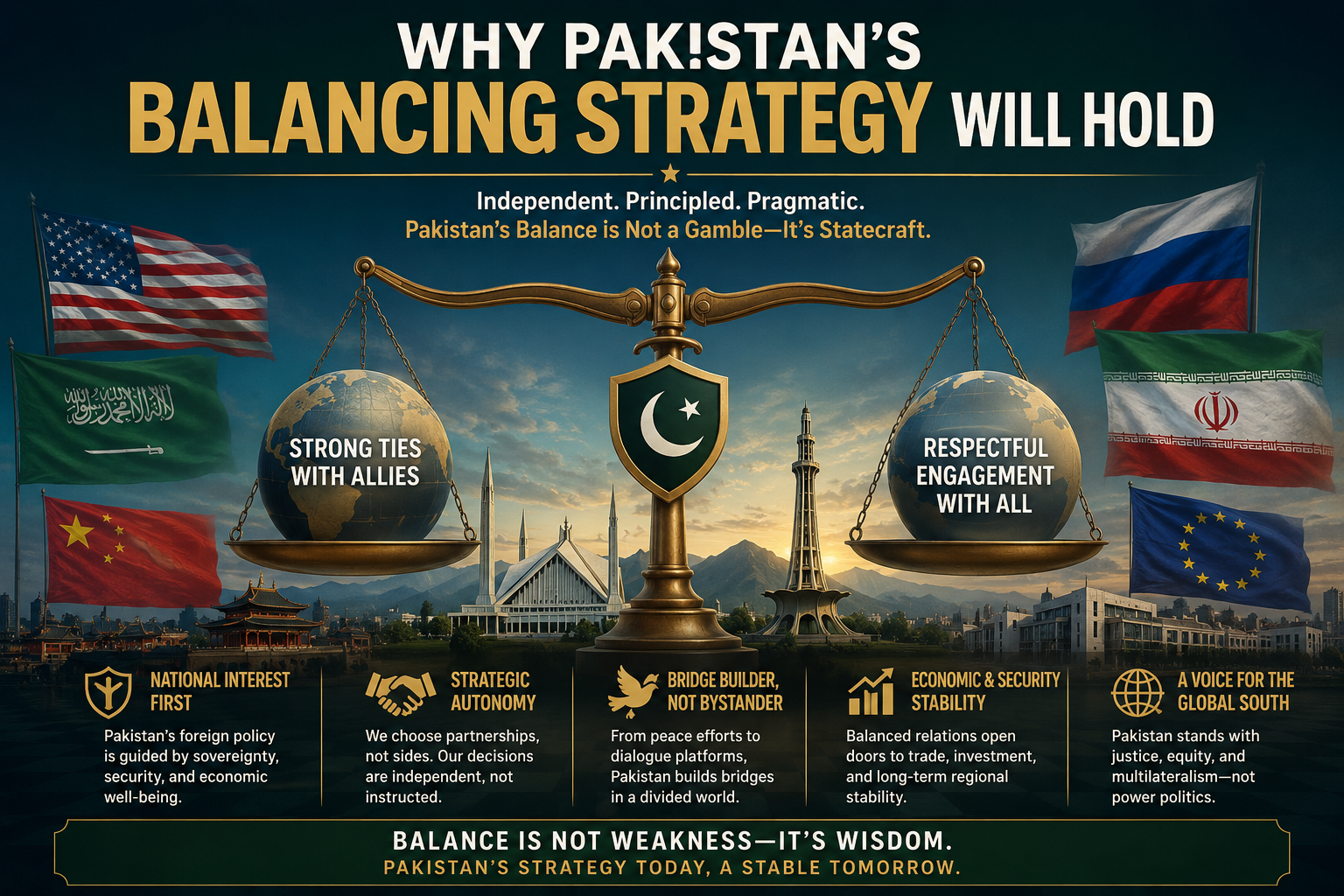
Why Pakistan’s Balancing Strategy Will Hold
Pakistan’s foreign policy is once again under the microscope, with some analysts questioning whether it can keep balancing rival powers in a volatile regional environment. Yet a closer look at how...

Pakistan’s foreign policy is once again under the microscope, with some analysts questioning whether it can keep balancing rival powers in a volatile regional environment. Yet a closer look at how Islamabad has actually conducted itself in recent crises suggests that this skepticism underestimates the country’s strategic discipline. Pakistan’s hedging approach is not improvisation born of weakness, it is a deliberate, time-tested strategy, and it continues to deliver results.
A Pact Built for Flexibility, Not Entrapment
The security alliance between Pakistan and Saudi Arabia has been described as a trap which will eventually pull Islamabad into wars it does not need to fight. It has been argued that this is not true. In case of rising tension in the Gulf region, Pakistan has not jumped into the situation. Rather, the military actions have been taken in a gradual manner and in a measured way and always with a defensive stance. This kind of strategy is not indicative of reluctance; rather it is an exact example of the kind of strategic ambiguity which ensures that a country retains its freedom of movement but remains faithful to its commitments at the same time.
Diplomacy as Strength
Unlike many other middle powers who have aligned themselves with one side or the other during regional conflicts, Pakistan has sought to establish itself as an honest broker and maintain lines of communication between rival groups. It is significant that such a state, which can often be seen as an insignificant party in international relations, has managed to establish such a positive position as a mediator. Geography, history, and the status of Pakistan as a member of multiple regional associations, together with its ties to both Gulf Arabs and eastern neighbors, have allowed Pakistan to occupy a position that is unattainable for most other countries.
Domestic Cohesion Despite Pressure
The instances of domestic unrest are cited by the critics to show the weakness of the state. However, one must not forget the context here. Pakistan has been under the burden of serious shocks ranging from instabilities in the west, the occasional tensions with India, and the domestic economic sensitivities related to happenings far outside its control. It is precisely because of all this that the state has been able, time after time, to manage the domestic unrest, to ensure stability, and to remain a credible actor on the world stage is an indicator of its strength and not weakness.
Economic Anchors Remain Strong
Pakistan’s economic ties with their major partners have not been affected by the balancing act they are performing. The Gulf Arab nations keep on making substantial investments in the economy of Islamabad despite the fact that Pakistan does not want to be a pawn for any nation.
📄 POLICY WIRE WHITEPAPER PUBLISHED: PAKISTAN'S NATIONAL SECURITY POLICY PRIORITIES
👉 READ BY CLICKING HEREA Strategy Rooted in Tradition
Pakistan’s multivector approach is not a temporary improvisation forced by circumstance. It reflects decades of foreign policy tradition, strategic non-alignment, an emphasis on preserving options, and a consistent refusal to be drawn into other states’ wars without a clear and direct national benefit. This continuity itself is evidence of stability. Each time Pakistan has faced a moment when commentators predicted its careful balancing would collapse, the country has instead adapted, recalibrated, and emerged with its core relationships intact and often strengthened.
Pakistan’s balancing strategy is not on the verge of collapse. It is, instead, a textbook example of a mid-sized power successfully managing competing alliances and rivalries under sustained regional pressure, turning a position that could easily have become a liability into a source of diplomatic influence, economic investment, and lasting strategic autonomy. Far from crumbling, Pakistan’s hedge looks set to endure, and its record over recent years gives every reason for confidence rather than doubt.
Author