



Anaheim’s Unraveling: A Predictable Meltdown in a Season of Surprises
POLICY WIRE — ANAHEIM, CA — There are moments, not just in sport but in geopolitics, when the illusion of control shatters with breathtaking speed. It often begins subtly: a minor misstep, a wavering...

POLICY WIRE — ANAHEIM, CA — There are moments, not just in sport but in geopolitics, when the illusion of control shatters with breathtaking speed. It often begins subtly: a minor misstep, a wavering gaze, a barely perceptible tremor beneath what appears to be solid ground. Then, before you’ve even had a chance to sip your lukewarm arena beer, the carefully constructed edifice buckles, tumbles, and ultimately—implodes.
Such was the case Friday night in Anaheim. For four glorious, albeit short, frames, young Walbert Urena, the Angels’ celebrated pitcher, held the Oakland Athletics in an absolute vice. A pristine performance, where the opposition went down 1-2-3-4-5-6-7-8-9-10-11-12. Perfection, wasn’t it? A narrative spun tightly, signaling mastery — and control. And then, as it so often happens when you least expect it, reality—ugly, loud, and unscripted—intervened. The script flipped with a violence usually reserved for emerging market bonds on a Tuesday. [QUOTE_PLACEHOLDER]
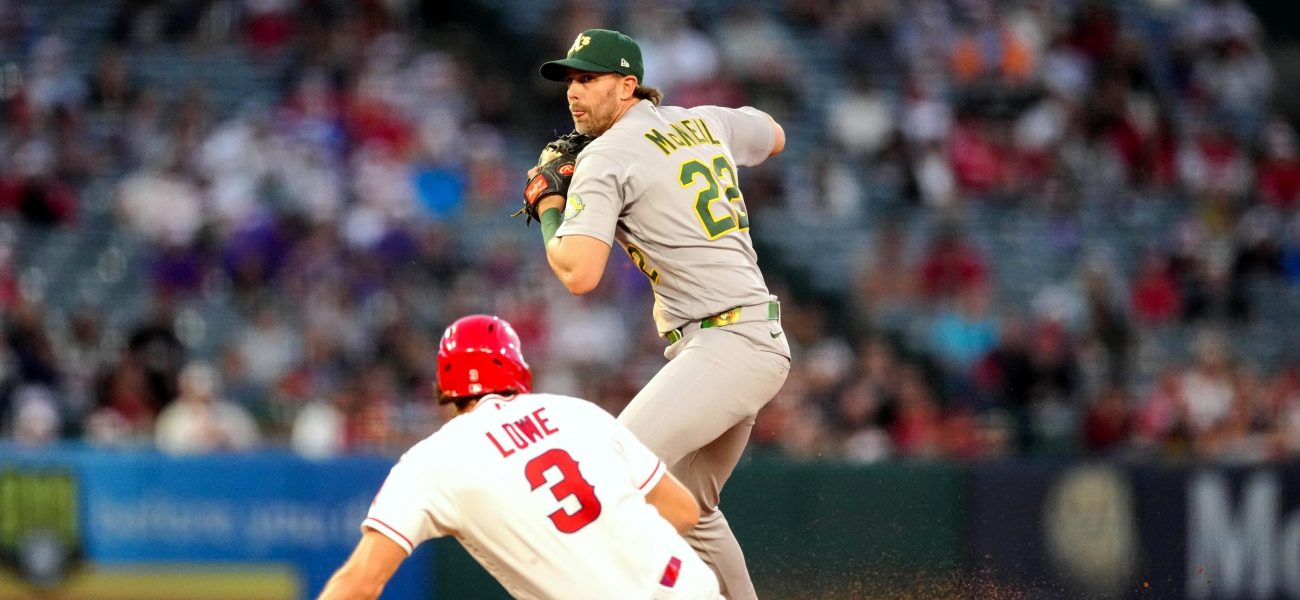
A single walk—that unassuming herald of doom—began the A’s seismic fifth inning. A force out followed, lulling observers into thinking the storm might pass. But then came another walk, a single to load the bases—the first domino. Jeff McNeil, with the steely precision of a veteran diplomat leveraging a minor concession, then punched a base hit to drive in a pair, erasing the Angels’ tenuous lead. That hit cracked the veneer; the ensuing barrage tore it to shreds. Alika Williams added another run. Henry Bolte, not to be outdone, made his own noisy entry, driving in a pair. It quickly became 5-1 A’s. Urena’s unraveling continued as Nick Kurtz followed Bolte with another single to drive home the A’s rookie center fielder. And finally, to cap off the 7-run inning was the likely AL starting catcher Shea Langeliers and he hi his own single to bring home Kurtz.
It was only after that final hit did Halos manager Kurt Suzuki come to get his starting pitcher. Five straight singles was what it took to knock him from this game. The relief pitcher, entering a battlefield scarred with seven new runs, secured the remaining outs, but the damage was done. A catastrophic seven-run eruption—a geopolitical shockwave, if you will—had transformed a seemingly perfect game into a brutal rout.
Oakland’s J.T. Ginn, the Athletics’ own rising ace, wasn’t without his own wobbles, of course. He’d done his job with three scoreless innings, a respectable parry against a formidable foe. But then, a line-drive single had allowed the Angels their fleeting moment of glory, giving them the first lead of the night. Even after the Athletics’ offensive onslaught, Jo Adell provided a flicker of hope, slamming a home run to cut the lead. But it was too little, too late. Ginn, all told, pitched a solid six innings: 6 IP, 8 H, 3 ER, 1 BB, 5 K, 1 HR, 89 pitches. A respectable effort for an emergent talent set to take a 3.15 ERA into his next scheduled start.
The A’s weren’t done, either. They quickly got back two of those runs in the top of the seventh. Kurtz brought Bolte home on an RBI single, then came home himself off a ground-rule double from Jonah Heim. The final tally, a dominant 9-3 victory for the Green & Gold. With just nine outs remaining, the outcome felt less like a contest — and more like a formality. Luis Medina — and Hogan Harris combined for a scoreless eighth and ninth. Then, perhaps hoping to get him right in a lower pressure situation, Mark Kotsay sent Elvis Alvarado out for the ninth. An uneventful 1-2-3 inning, confirming the rout. The club won its 40th game tonight and remains just a game and a half back of the Mariners in the division.
📄 POLICY WIRE WHITEPAPER PUBLISHED: PAKISTAN'S NATIONAL SECURITY POLICY PRIORITIES
👉 READ BY CLICKING HEREWhat This Means
This episode, this rapid, unforeseen collapse of the Angels, isn’t just a sports anecdote. It’s a parable for a world constantly teetering on the edge of the unexpected. One moment, Walbert Urena is delivering perfect innings; the next, the mound has become a crucible of chaos. It’s the kind of volatility we observe daily in financial markets or in the delicate political dance across developing nations. Imagine a nascent economic policy, touted as perfect, that suddenly encounters unforeseen market resistance—a ‘walk’ in baseball parlance—followed by a series of cascading failures that send the entire framework into a tailspin. We’ve witnessed similar rapid downturns, where what seemed like stable ground dissolved into political crises. But we’ve also seen the inverse: unexpected surges from underdog economies. Like the A’s, some nations, against the odds, manage to pull together collective strength to score big, disrupting established hierarchies. It’s a powerful, almost unsettling, reminder of how quickly circumstances can shift, making careful long-term planning seem an exercise in hopeful delusion.
And here’s where the South Asian connection becomes uncomfortably clear. Just look at the economic rollercoaster many nations in the region ride. Pakistan, for instance, has grappled with fiscal challenges that sometimes echo this sudden ‘unraveling.’ Its economy faces recurrent periods of intense pressure and unexpected recovery attempts. Consider that Pakistan’s Consumer Price Index (CPI) recorded a year-on-year increase of 29.2% in March 2024, a hard statistic indicating significant inflationary pressures. Such figures aren’t just numbers; they reflect real-world implications, often born from an unforeseen ‘single’ or a series of ‘walks’ that destabilize careful projections. This isn’t a stretch—it’s a stark reflection that a sudden collapse in performance, whether on the mound or in the ministry, can have equally profound, albeit different, consequences. You’d think the Angels might learn. Their starter for tomorrow, Jack Perkins, sports a 7.50 ERA from his last four starts. They’re up against Reid Detmers, who’s coming off one of his worst starts of the year. It’s almost as if the universe insists on repeating the lesson, waiting to see if anyone’s paying attention. But if Friday’s meltdown proves anything, it’s that past performance is not always indicative of future stability—particularly when the dam eventually breaks. Because, sometimes, even perfect innings lead to utter pandemonium. And that, frankly, is a hell of a story.

