



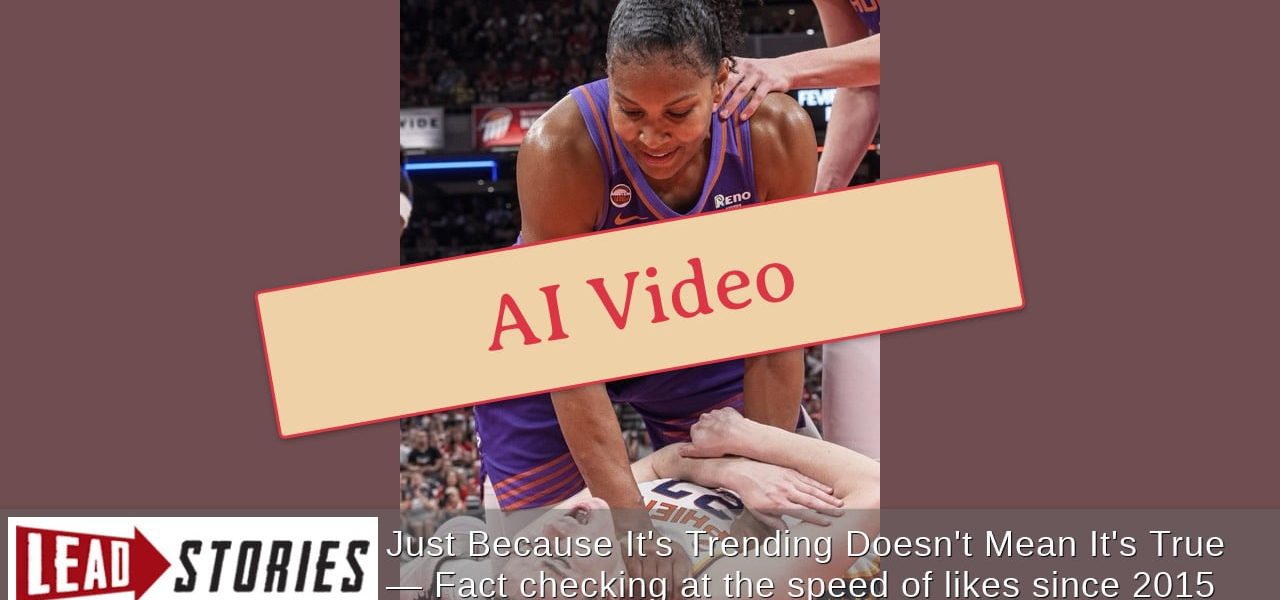
Digital Fabric Frays: WNBA Faux-Foul Highlights Deepfakes’ Expanding Court
POLICY WIRE — New York, USA — The line between verifiable fact and artful fabrication, always a blurry one in the digital ether, is now but a smudged suggestion. Once, we worried about photo...

POLICY WIRE — New York, USA — The line between verifiable fact and artful fabrication, always a blurry one in the digital ether, is now but a smudged suggestion. Once, we worried about photo manipulation in glossy magazines. Now, entire scenes — movements, expressions, even specific emotional states — can be conjured from pixels. It’s no longer just about celebrity gossip or doctored political rallies. This new, frictionless era of manufactured reality has found its way onto the professional basketball court, transforming a standard athletic skirmish into an incendiary narrative, entirely unmoored from truth.
Consider the WNBA incident, seemingly trivial at first glance. It wasn’t a major geopolitical development, not a looming economic crisis. But the small, insidious details tell a much larger story. An image began making rounds across social media, purporting to show Alyssa Thomas of the Phoenix Mercury, inexplicably smiling mid-foul on Indiana Fever phenom Caitlin Clark during a June 22 game. This wasn’t just a simple snapshot, though. It was a digital phantom, a figment designed to provoke. And provoke it did, sparking outrage that, for a few frenzied days, simmered on screens everywhere. [QUOTE_PLACEHOLDER]
But the story quickly unravels, just like most cheap knock-offs. Lead Stories, a diligent fact-checking outlet, soon called it for what it was: bunk. Not a genuine snapshot. The claim that an image displayed Thomas smiling as she fouled Clark was precisely what’s wrong with how we consume information these days. The real video? It showed nothing of the sort. No video or photographic evidence shows Thomas smiling while over Clark. More damning still, the original poster of the footage from which the image was taken had helpfully, or perhaps negligently, tagged it: AI-generated. Yes, an algorithmic sleight-of-hand, labeled as such, yet still somehow divorced from its artificial origins by the time it ignited public ire.
Paul A. Szypula (@Bubblebathgirl), an X user, pushed this manufactured grievance, fanning the flames with impassioned rhetoric. His post, dated June 25, 2026, declared: 🚨 Targeted Attacks on Caitlin Clark Continue in the WNBA. He asked: When does this stop? His allegations were dramatic, to put it mildly: June 22 Fever vs. Phoenix Mercury game – Caitlin Clark (#22) assaulted on the floor: knee to groin, fist to ribs, fist/forearm to neck/throat as the Phoenix player (#25) gets up. His call to action was just as emphatic: Suspensions NOW for player safety — and game integrity. And: WNBA, do better! But at the very bottom of this theatrical appeal, almost an afterthought, came the parenthetical admission: (Video: AI).
And so, we arrive at the heart of the modern dilemma. Information, packaged with emotion — and urgency, now bypasses traditional gatekeepers. A fabricated image, sourced from an AI video explicitly identified as such by its own creator, somehow graduates to ‘proof’ for online commentators. USA Network’s actual game coverage—the messy, imperfect, human reality of it—showed nothing of Thomas smiling. At that point in the coverage, Thomas’ face couldn’t be seen at all as the camera zooms in. And Thomas’ hand was also clenched, not open, as the AI video shows. The discrepancies are blatant, for anyone bothering to check, of course. Bleacher Report’s TikTok clip of the actual moment reinforces this reality. It’s not a smile. It’s not an open hand. It’s a bad foul, perhaps, but a standard human interaction on the court, stripped of any digitally-assigned malicious grin.
📄 POLICY WIRE WHITEPAPER PUBLISHED: PAKISTAN'S NATIONAL SECURITY POLICY PRIORITIES
👉 READ BY CLICKING HEREThis incident isn’t just about a WNBA game, or even the manufactured grievances around a rising sports star. It’s about the sheer ubiquity of manipulated media and the erosion of media literacy—a global concern. A 2022 MIT study showed that false news spreads six times faster than true news on social media, a statistic that underscores the uphill battle for truth in our connected world. The problem isn’t isolated to one league or one social media platform. Look at election cycles across South Asia, for instance. We’ve seen similar digital shenanigans used to inflame communal tensions or discredit political rivals in Pakistan, India, and Bangladesh—deepfakes depicting politicians in compromising situations or altering speeches to incite violence. These tactics aren’t just for internet memes; they’re becoming instruments of serious socio-political engineering. What begins as a viral sports moment, however factually challenged, illustrates a vulnerability in public perception that authoritarian regimes and bad actors are already exploiting on a much larger scale.
What This Means
The implications of this particular WNBA dust-up, seemingly minor in the grand scheme of world affairs, are actually quite profound. It’s not just a benign misunderstanding; it’s a symptom of a larger, systemic breakdown in trust and information consumption. Economically, this erosion of verifiable facts can lead to market volatility driven by rumor — and unverified reports. Think about how a fake news story about a company’s executive could tank its stock value, even if only temporarily. And for society? It means an increasing susceptibility to political manipulation, social unrest, — and targeted harassment. If people can be convinced by a blatantly AI-generated image in a sports context, imagine the leverage it gives to those intending to spread discord over sensitive issues—issues of identity, faith, or governance. For policymakers, it means navigating a public sphere where foundational truths are constantly under attack, making informed consensus a moving target. We’re staring down an era where seeing isn’t necessarily believing, and that’s a tough environment for democracy, or even fair play, to flourish. This WNBA incident, a mere ripple in the global information ocean, suggests that the digital tides are still rising, and many of us, sadly, aren’t learning to swim against the synthetic current.
