

Sheinbaum Affirms Mexico-Canada ‘Common Front’ on CUSMA Negotiations
POLICY WIRE — In a significant development for North American trade relations, Mexican President Claudia Sheinbaum has asserted that Mexico and Canada are opera...

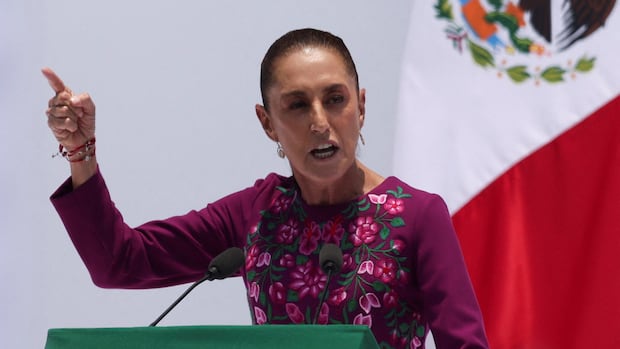
POLICY WIRE — In a significant development for North American trade relations, Mexican President Claudia Sheinbaum has asserted that Mexico and Canada are operating as a unified bloc during the current negotiations concerning the Canada-U.S.-Mexico Agreement (CUSMA).
Sheinbaum’s declaration signals a potential realignment in how the two northern partners of the agreement, Mexico and Canada, approach discussions with the United States regarding the future of the continent’s pivotal trade pact. The Canada-U.S.-Mexico Agreement, commonly known as CUSMA in Canada and Mexico, and as the United States-Mexico-Canada Agreement (USMCA) in the U.S., replaced the North American Free Trade Agreement (NAFTA) in 2020. Its inception marked a renegotiation primarily driven by the previous U.S. administration, aiming to revise terms it deemed unfavorable.
The agreement’s structure includes a mandatory review provision set for 2026, often referred to as a ‘sunset clause’ review, which necessitates a re-evaluation of its terms by the three member countries. This upcoming review has prompted anticipatory discussions — and strategic positioning among the signatories. President Sheinbaum’s statement underscores a shared interest between Mexico City and Ottawa in navigating these complex talks from a position of joint strength, particularly concerning clauses related to labor standards, environmental protections, and automobile manufacturing, among others. These are areas where Mexico and Canada have often found themselves on similar ground, facing pressure for adjustments from Washington.
While the specifics of this ‘common front’ strategy remain undisclosed, such an alignment could mean coordinated negotiation positions, shared analytical resources, or even presenting united proposals during official trilateral meetings. For both nations, maintaining strong trade ties with the United States is paramount, given the deep integration of their economies. However, each country also seeks to protect its national interests, industry, and workforce in the face of evolving economic and political landscapes. The implications of this stated unity will be closely watched by industries reliant on the agreement, from agriculture to manufacturing, and by trade policy experts across the globe.
General knowledge dictates that trade agreements like CUSMA are living documents, subject to review and potential modification as global economic conditions shift and national priorities evolve. The CUSMA itself was born out of a perceived need to update NAFTA for the 21st century, addressing digital trade, stronger intellectual property protections, and revised rules of origin, particularly in the automotive sector. The upcoming 2026 review was designed to ensure the agreement remains relevant and mutually beneficial to all parties, rather than allowing it to languish without periodic re-evaluation. A ‘common front’ could significantly influence the outcomes of this scheduled re-evaluation.
President Sheinbaum, who recently took office, faces a range of domestic challenges but also inherits a crucial role in international trade diplomacy. Her early pronouncements on such a significant international agreement highlight its strategic importance to her administration. The relationship between Mexico and Canada, while distinct from their individual ties with the U.S., has often found common cause in multilateral forums and bilateral trade discussions.
What This Means
The establishment of a ‘common front’ between Mexico and Canada regarding CUSMA talks indicates a pragmatic strategic alliance aimed at bolstering their collective influence in future negotiations. In practice, this could lead to a more balanced negotiation dynamic than might exist if the two nations were to engage with the United States purely on individual bilateral terms. Past trade negotiations, particularly those leading to the initial CUSMA, sometimes saw the U.S. employ a ‘divide — and conquer’ strategy, negotiating distinct terms with each partner. This latest move by Mexico — and Canada suggests a counter-strategy designed to mitigate such approaches.
However, the effectiveness of this common front will depend on the degree of cohesion between Mexico City and Ottawa on key issues. Disagreements on specific clauses, differing national economic priorities, or domestic political pressures could test the resilience of this unity. For businesses operating across North America, a coordinated approach from Mexico and Canada might bring greater stability or, conversely, create new complexities depending on their unified stances. The critical question remains how concrete and extensive this coordination will prove to be, and what impact it will ultimately have on the future evolution of one of the world’s most significant trade blocs.