


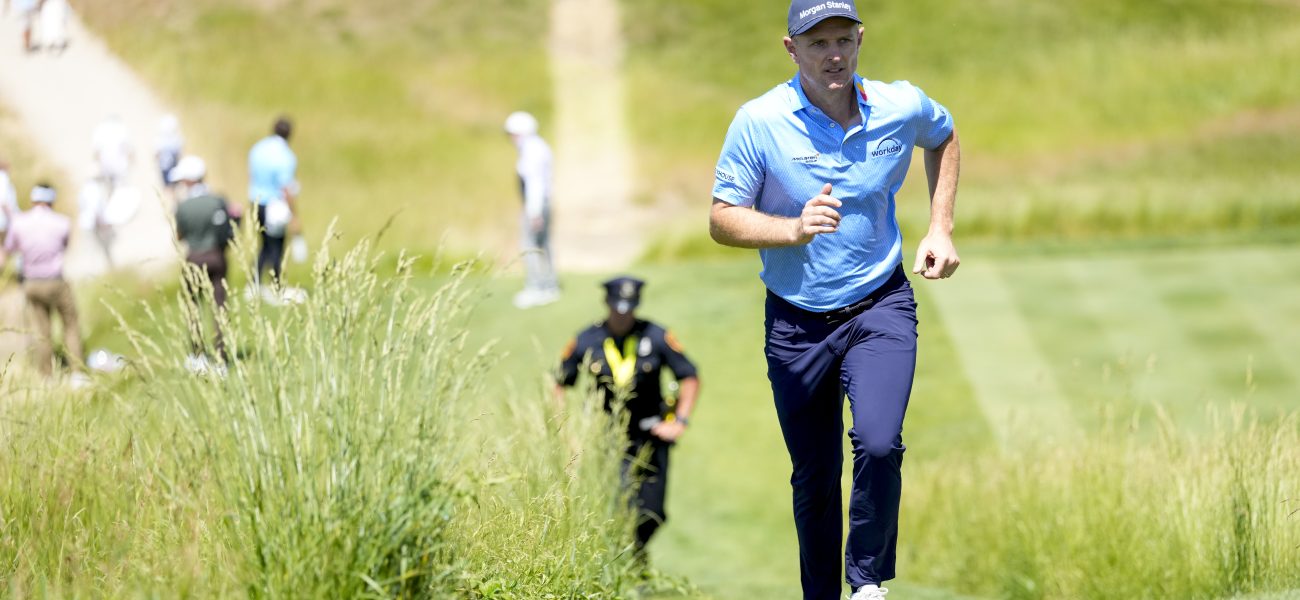
Britons on the Brink: Justin Rose Chases Unprecedented Major Streak at U.S. Open
POLICY WIRE — SOUTHAMPTON, N.Y. — The U.S. Open has long been a domain often claimed, sometimes even exclusively, by American golfing prowess. It feels like an annual assertion of domestic skill on...

POLICY WIRE — SOUTHAMPTON, N.Y. — The U.S. Open has long been a domain often claimed, sometimes even exclusively, by American golfing prowess. It feels like an annual assertion of domestic skill on the national stage, a grand tradition. But this year, the usual narrative faces a challenge from across the Atlantic, specifically from a contingent wearing the Union Jack—and one man could etch an improbable chapter into history, complicating any facile notion of an unchallenged American stronghold.
Justin Rose, the 45-year-old Englishman, steps onto Shinnecock Hills this week not merely seeking another major trophy. He’s on the cusp of something far grander: securing a second career U.S. Open title — and completing an utterly unprecedented hat-trick of British major victories in a single season. Rory McIlroy kicked things off at The Masters. Then, Aaron Rai broke through at last month’s PGA Championship. Rose isn’t just playing for himself; he’s riding a wave, representing a burgeoning British presence that might just be giving the old guard a bit of a shiver. (Awaiting official quote)
It’s not just Rose, either. The British cohort—a talented lot that includes Matt Fitzpatrick and Tommy Fleetwood, who actually ran up as the 2018 U.S. Open runner up here at Shinnecock Hills—certainly won’t have it easy. But their collective charge offers a stark counterpoint to what many might perceive as American golf’s birthright. And that’s a story in itself. But perhaps Rose is onto something, you know?
On Wednesday, he dismissed the notion of any inherent national advantage for European players in American conditions, musing, I don’t think it necessarily suits a British player any more than it does the Americans. And he brings up a good point: They seem to come over and play great golf in The Open Championship every single year. I feel like their record at The Open Championship is actually stronger potentially than our own sometimes. A dry observation, certainly, but not without merit. Rose concludes with an almost superstitious nod to momentum: I don’t really see that being an advantage per se, but I like that you should never go against a run, and three in a row would be good. Indeed, a run of this magnitude isn’t something you often see.
The field, as always, is stacked. American stalwarts like Scottie Scheffler, Cameron Young, Xander Schauffele, Brooks Koepka, and Collin Morikawa are among those favored to contend. They’ll challenge, undoubtedly. And for good reason. Rose’s own U.S. Open record at Shinnecock isn’t exactly a parade of triumphs—it includes a missed cut in 2004 and a T10 finish in 2018. More broadly, since his 2013 victory at Merion, the U.S. Open has seen him rack up seven missed cuts, including five out of the past six editions. A challenging statistic, to put it mildly. But don’t count the veteran out; his performance in this season’s other majors paints a different picture, one of renewed focus. He snagged a T3 at The Masters — and a T10 at the PGA Championship, quiet displays of consistent, high-pressure play.
Because, for Rose, it’s all about the big ones. You can’t just be ‘on’ all the time. After two recent uninspiring weeks (a T65 at the Cadillac Championship and a T45 at the Truist Championship between the Masters and PGA Championship), his ability to dial in for the marquee events is clear. As he tells it, he targets the calendar’s marquee tournaments, meticulously allowing his body — and game to sync up. Obviously that’s a very hard thing to do is to, kind of peak on demand, but you’ve got to give it a go, right?, he explains. He works on stacking the odds: You’ve got to kind of stack the odds in your favor. Me — and my team, we talk about ticking boxes. As I prepare for a major, I tick as many preparation boxes as I can to give myself ultimately the best chance I can of playing well. It’s a calculated approach, not a gamble.
📄 POLICY WIRE WHITEPAPER PUBLISHED: PAKISTAN'S NATIONAL SECURITY POLICY PRIORITIES
👉 READ BY CLICKING HEREFor players like Rose, these events mean everything. They’re the events that grab my attention. They’re the events that are going to change my career. They’re the events that I’ve sort of been getting up for — and playing well in. So I’m excited. And that kind of intensity isn’t unique to golf. It’s the same fire you see across various sports globally, even in countries where golf remains a niche interest. Just look at the passion in cricket-dominated nations like Pakistan and India, where national teams become focal points of identity. Their athletes, much like golfers, navigate immense pressure, carrying the hopes of millions. The ascent of local talent, reshaping regional dominance in cricket, mirrors the kind of nationalistic pride that flows into any sporting narrative, making these individual triumphs ripple across continents, captivating even the most unexpected audiences, from Karachi to Cape Town.
His recent form suggests the boxes are, in fact, being ticked. He’s missed just one cut since early March, even carding a T12 at The Memorial just two weeks ago. And honestly, that kind of focused effort? That’s what defines a true contender, not just a flashy start. It’s an approach built on resilience, a quiet determination.
What This Means
A British three-peat in golf’s major championships, particularly capped by a U.S. Open victory, transcends mere sporting headlines; it carries subtle geopolitical resonance. Such an achievement challenges the conventional American narrative of global sports supremacy, acting as a soft power projection for the UK. In a climate where nations increasingly compete for influence, athletic dominance on international stages, however small, boosts national morale and global perception. It can translate into increased tourism interest, brand visibility, and a sense of collective achievement that subtly buttresses a nation’s image. Economically, major victories drive sponsorships, media rights, and local economies surrounding the players’ homes, creating minor but measurable impacts. This British golf surge, if completed, wouldn’t just redefine a golfing season; it would offer a compelling data point for the effectiveness of a concerted national investment in sports talent, something that burgeoning economies in the Muslim world and South Asia could certainly note for their own strategic national development through sport, expanding beyond traditional focuses like football or cricket to foster wider global recognition.
Because ultimately, these kinds of stories—underdogs, streaks, improbable victories—they’re universal. They remind us that dedication can shift established orders, even if just for a moment. And that, in itself, is a message many can rally behind, no matter where they’re from or which flag they wave. After all, the joy of witnessing pure excellence knows no borders. The changing landscape of global engagement, often driven by digital reach, ensures these narratives resonate wider than ever before, connecting golf enthusiasts from New York to Lahore.