

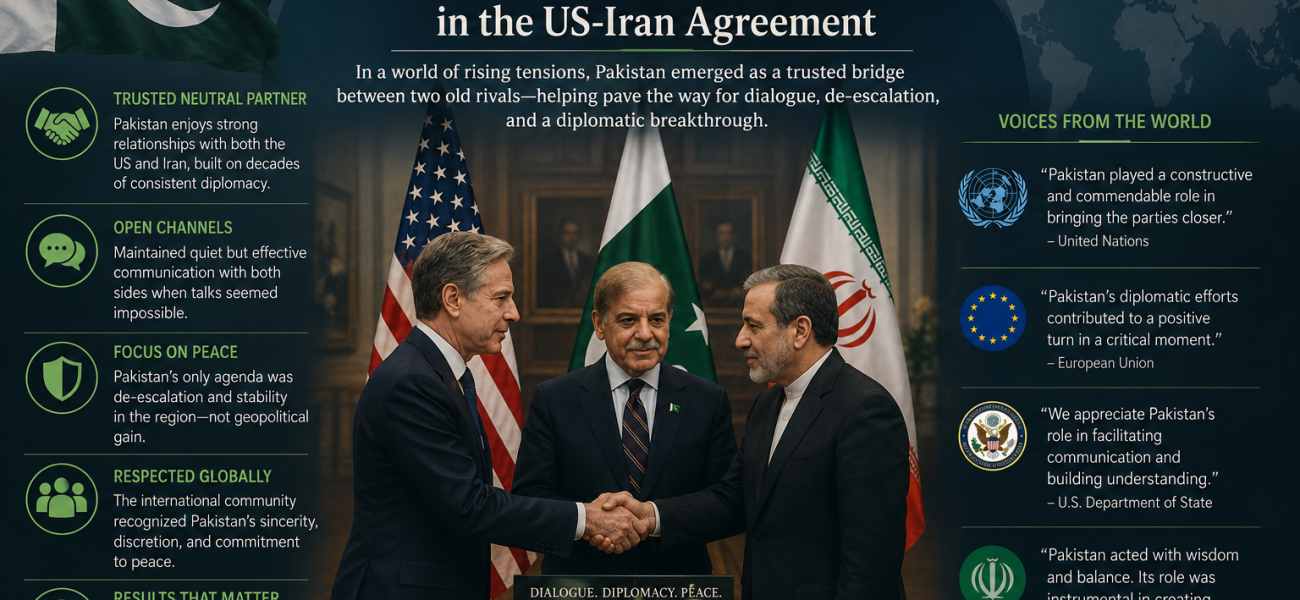
Why the World Backed Pakistan’s Mediation in the US-Iran Agreement
The importance of the new pact between the United States and Iran is not just that it might stop an expensive regional war. Notably, the international support for Pakistan’s mediation efforts...

The importance of the new pact between the United States and Iran is not just that it might stop an expensive regional war. Notably, the international support for Pakistan’s mediation efforts in resolving the temperature issue is also a positive. Therefore, President Mian envisioning a politically robust Pakistan, the Muslim world’s leading institutions and major European countries as well as Gulf monarchies, Asian powers and international bodies universally welcomed the agreement and expressed appreciation towards Pakistan and other mediators for their role. This raises a critical issue: How did a large number of actors get together to support Pakistan’s diplomatic efforts?
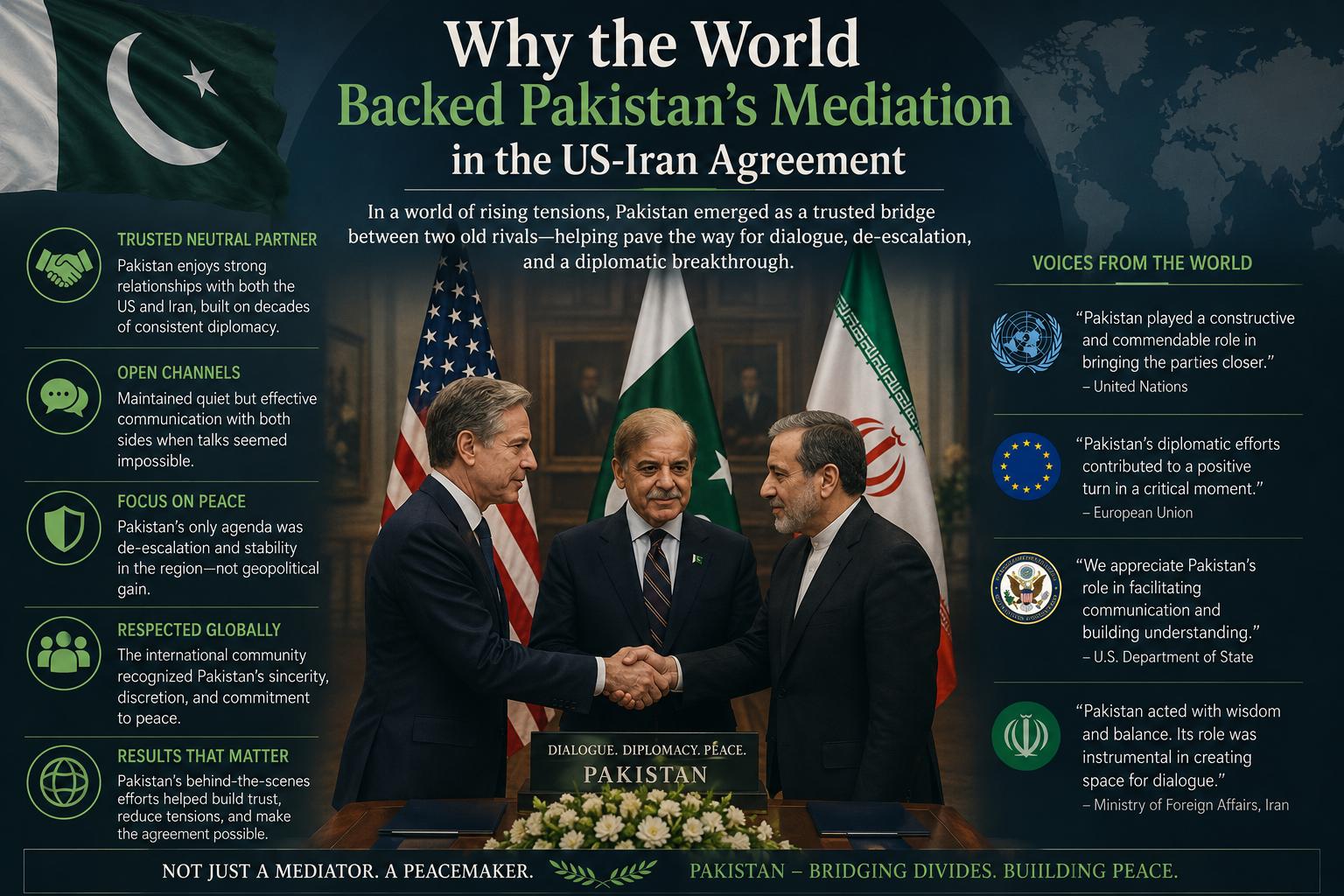
One thing is the geopolitical advantage of having primed-up communication channels with opposing camps and the second, the world’s growing appetite for middle powers to facilitate dialogue in a polarised world; the third is of Pakistan’s unique geopolitical positioning.
International media reports that leaders and the governments of Australia, Japan, Türkiye, Qatar, the United Kingdom, Italy, the Netherlands, Kuwait and other countries greeted the agreement and described the role of mediation that facilitated the agreement. China also publicly backed Pakistan’s role while Iran formally thanked Islamabad for its active diplomacy. The UN also hailed the deal and recognised the positive contribution of the regional nations, among them Pakistan. (Anadolu Ajansı)
What’s remarkable about the scope of this assistance is that it’s not always the strategic interests that align. There are a host of geopolitical issues that the Chinese and Western governments disagree on. Gulf actions are not always in sync with the European powers. But in this instance, they’ve come to a similar conclusion: defusing the Washington-Tehran rift is good for everyone.
Geography is one, and a plausible explanation. Pakistan is a strategic zone linking South Asia with Central Asia and the Gulf and wider Middle East. The Gulf instability directly impacts the economy, security and energy of Pakistan. Escalation has its own advantages for Islamabad as well, but one difference is that this is far from being the motive for any external actors to want to do it. This made Pakistan more credible in the eyes of the world as a stakeholder in the region for maintaining stability and not ammunition for playing geopolitical politics.
The second factor was that Pakistan could keep its communications with multiple factions at once. Islamabad was actively in touch not only with the United States, but also with Iran, Gulf partners and China during the entire crisis. There were countries that had influence in one or two parties, but few countries had working relations with all parties. Often, Pakistan’s diplomacy enabled it to act as a mediator between opposing camps when communications had become increasingly difficult, analysts pointed out. Previously, Islamabad launched some mediation efforts, ceasefire proposals and diplomatic talks under various circumstances and contexts to keep the talks alive when it appeared that chances for success were slim. (Al Jazeera)
The final settlement wasn’t quick to come. More than that, a certain amount of diplomacy regarding a negotiation was reported to have taken place through Pakistan, Qatar, Türkiye and Egypt. Islamabad joined a larger group of mediators intent on making a place for dialogue. This multilateral method strengthened the legitimacy of the process and increased the amount of support within the international community. (Axios)
The Gulf states’ response is of special importance. The result was met with open arms in Qatar, while President Recep Tayyip Erdoğan expressed his gratitude to Pakistan for its ‘extraordinary mediation efforts’. Iran’s Supreme National Security Council too accepted Pakistan’s role. These endorsements meant Pakistan was seen not only as an enabler but also as an enactor who would keep both sides well informed of each other’s confidence, irrespective of the political trend. (Anadolu Ajansı)
The agreement’s induction has been significantly emphasised by the reaction of the major economic powers.The reaction from major economic powers further reflects the broader implications of the agreement. Long-lasting conflict would put an end to international roads, energy markets and global economic stability, and this is why it became necessary for the affects of the disputes to be relieved by the governments of Europe, Japan and Australia. Today the Strait of Hormuz continues to be one of the most important naval chokepoints in the world, and any crisis in the region could have implications for areas beyond. Oil prices declined and there were market reactions during the announcement of the agreement, which correlated with these wider economic factors. (The Guardian)
In the past, the countries that make the agreements typically are the ones that have diplomatic influence which is greater than the military or economic influence they may have. The involvement in the Oslo-process in their case, the mediation in Afghanistan by Qatar and the Arab-Israeli process by Egypt, served as examples of how mediation can be an instrument of international honor. In both cases diplomatic legitimacy was a positive force in national influence. Saidur’s performance in the US-Iran process has a similar pattern— Pakistan is making a dent in the process by establishing a level of confidence among the divergent players.
The international reaction, then, indicates more than just backing the one agreement. It is a testament to another sea change in world politics. The need for credible intermediaries is rising, given the escalating rivalry and the rising nature of great power competition. Countries with the ability to communicate with several parties, build strategic ties between different regions and conduct discussions are becoming more and more useful to the international system.
The positive appreciation that was received by Pakistan of its role, therefore, should be considered in this broader context. The endorsements were not just a sign of a diplomatic triumph; they represented a shift toward a new era of international recognition for the project.The endorsements from the United Nations, China, the United Kingdom, Australia, Japan, Türkiye, Qatar, Italy, the Netherlands, Kuwait and more were not simply a symbolic recognition of a diplomatic success, but a look toward a new era of international acceptance of the project. They recognised there is a world in which countries can build bridges and in such a world countries that can do so are indispensable.
How this US-Iran agreement is carried out and stays effective will be the deciding factor in its success or failure. So, whatever the outcome of the future developments, it’s clear that in the international arena, “diplomatic trust” is one of the most high-prized types of influence.
Author