


Smart Strategies for Local Businesses Facing Economic Changes
Local business owners feel economic fluctuations first, because daily revenue, supplier costs, and customer traffic change faster than long-term plans can adjust. Market volatility turns ordinary...

Local business owners feel economic fluctuations first, because daily revenue, supplier costs, and customer traffic change faster than long-term plans can adjust. Market volatility turns ordinary decisions into small business challenges, from cash-flow stress and uncertain demand to harder trade-offs on staffing and inventory. The effects rarely stay inside the storefront, since local spending shifts quickly and the community impact shows up in neighboring businesses, employee households, and local services. Clear preparation starts with understanding how these shifts pressure operations and what stability looks like under changing conditions.
Understanding Economic Shifts and Business Adaptation
Economic shifts are changes in prices, interest rates, employment, or consumer confidence that reshape what people buy and what it costs you to deliver it. The practical goal is to spot where those changes squeeze demand or margins, then respond with business adaptability across your business model and day-to-day operations.
This matters because guessing leads to overstaffing, stockouts, and wasted marketing spend. A quick assessment helps you identify leadership gaps, tighten execution, and align operations with a clearer marketing strategy, and this page outlines how business management fundamentals connect to stronger operational and leadership decisions.
Think of your business like a sailboat in shifting wind. You cannot stop the wind, but you can adjust sails, trim weight, and choose a smarter route, which is the logic behind strategic agility when conditions change.
Put 10 Actions to Work: Cut Costs, Grow Revenue, Stay Visible
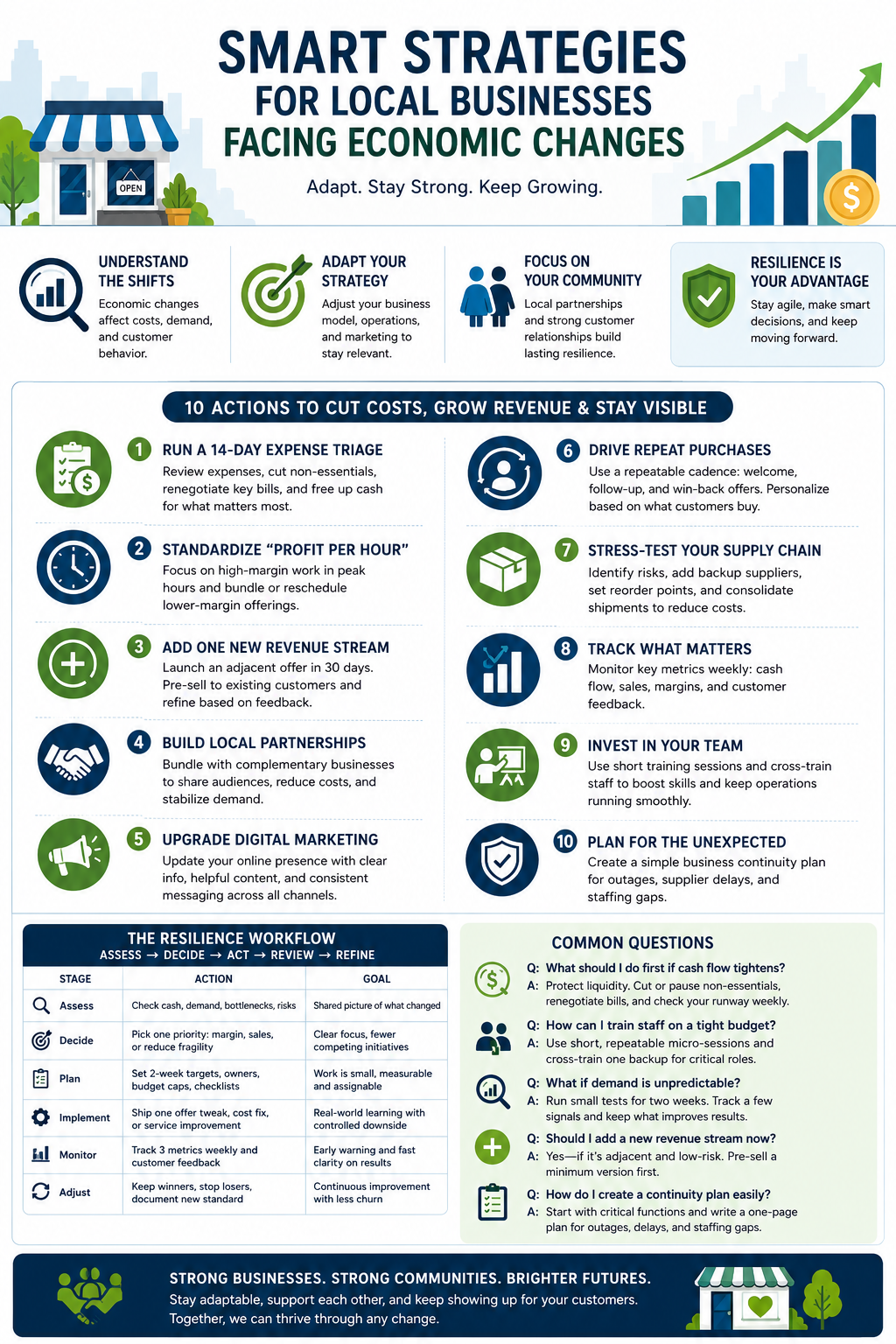
Economic shifts squeeze cash flow and change what customers value. Use the actions below as a pick-list: choose 2–3 that match your biggest pressures, assign an owner, and track progress weekly.
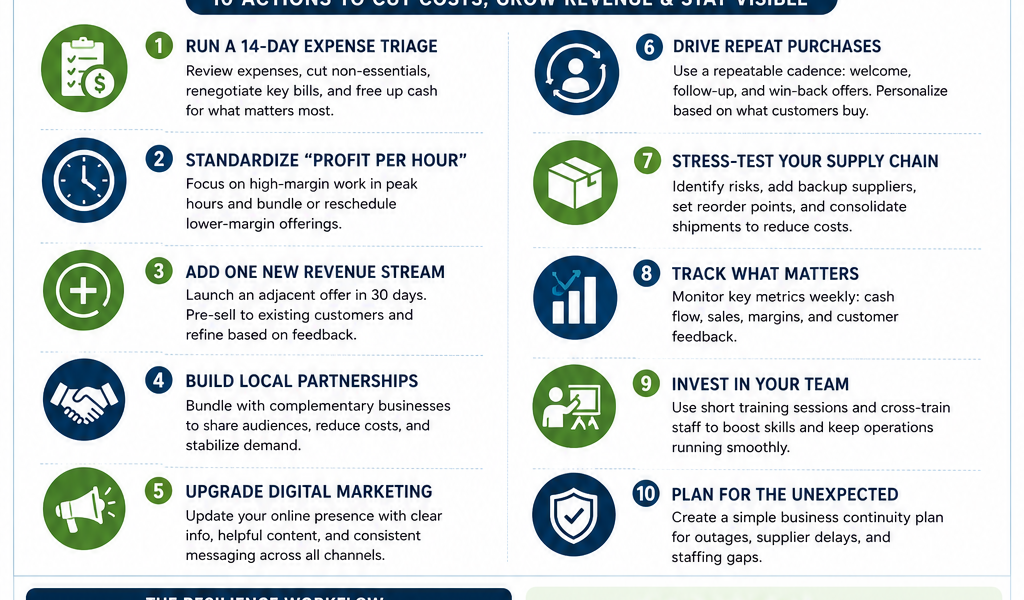
- Run a 14-day expense triage: Pull the last 60–90 days of expenses and label each line “must-have,” “nice-to-have,” or “temporary.” Renegotiate the top three recurring costs, such as processing fees, insurance, and rent add-ons, and pause anything not tied to revenue or compliance. This protects agility: you free up cash to invest in the operational fixes and marketing tests you prioritized earlier.
- Standardize your “profit per hour” schedule: For each service or product category, estimate gross profit per labor hour and rank offerings from best to worst. Put your highest-margin work in peak hours and move lower-margin work to slower windows or bundle it with higher-margin items. This is a simple way to defend margins without raising prices across the board.
- Add one new revenue stream in 30 days: Pick a single adjacent offer that reuses what you already have, such as maintenance plans, classes, small-business catering, subscriptions, or corporate accounts. Define a minimum viable version, pre-sell to 10–20 existing customers, then refine based on what they actually buy. Diversifying revenue streams reduces your dependence on one demand pattern.
- Build a local partnership bundle: Create a “bundle” with two nearby businesses that share your audience but don’t compete, such as a café, bookstore, and florist. Agree on one joint offer, one shared flyer or landing page, and a simple referral tracking method, such as code words or receipts. Partnerships spread marketing costs and can stabilize demand when walk-in traffic dips.
- Upgrade your digital marketing to match intent: Tighten your online presence around what customers do during uncertainty: compare, delay, and seek reassurance. Update your hours, top questions, and 3–5 specific “problem/solution” posts covering pricing ranges, timelines, guarantees, financing, and returns. Then reuse the same content in email, social, and storefront signage so your message stays consistent.
- Turn customer engagement into repeat purchases: Create a repeatable cadence: welcome message, post-purchase check-in, and a win-back offer for lapsed customers after 30–60 days. Keep it personal by segmenting customers by what they bought and when they last visited; even basic personalization can lift results. Many teams use tactics similar to the Domino’s Pizza example of a 20% uplift in revenue by re-engaging customers based on drop-off signals.
- Stress-test and simplify your supply chain: List your top 10 inputs and flag any with single suppliers, long lead times, or volatile pricing. For each flagged item, add one alternate supplier, set reorder points, and consolidate shipments where possible to reduce rush fees. Supply chain optimization can produce real savings; one US-based apparel maker targeted major savings largely through supply chain efficiencies.
Common Questions About Thriving Through Change
What should I do first if cash flow suddenly tightens?
Protect liquidity before you chase growth. Separate expenses into keep, cut, and pause, then renegotiate your biggest recurring bills. Set a simple weekly “runway” check so you spot trouble early.
How can I train staff when I can’t afford long training sessions?
Use short, repeatable micro-sessions focused on one task, script, or checklist at a time. Cross-train one backup per critical role so absences do not stall operations. This matters because two-thirds of global companies have struggled to hire qualified workers post-pandemic, making retention and upskilling a practical advantage.
What if demand is unpredictable and I’m not sure what customers want now?
Run small tests: one adjusted offer, one message, or one promo for two weeks. Track only a few signals like inquiries, conversion rate, and repeat visits, then keep what improves results. This reduces guesswork without overhauling your whole business.
📄 POLICY WIRE WHITEPAPER PUBLISHED: PAKISTAN'S NATIONAL SECURITY POLICY PRIORITIES
👉 READ BY CLICKING HEREShould I add a new revenue stream during uncertainty, or will it distract me?
Add only something adjacent that uses your current space, tools, and skills. Pre-sell a minimum version to existing customers before you invest heavily. If it does not sell quickly, you have saved time and cash.
How do I create a business continuity plan without getting overwhelmed?
Start with critical business functions like payments, customer communication, and your top-selling services. Write a one-page “who does what” checklist for outages, supplier delays, and staffing gaps. Review it quarterly so it stays usable.
Assess → Decide → Act → Review → Refine
This workflow turns uncertainty into a steady business resilience process you can run on a calendar, not on adrenaline. Think of it like a lightweight operating rhythm that helps you spot pressure early, choose one clear direction, and improve outcomes without constant reinvention. A Business Resilience Framework supports that rhythm by helping you absorb shocks and keep evolving.
| Stage | Action | Goal |
|---|---|---|
| Assess | Check cash, demand signals, bottlenecks, and top risks | Shared picture of what changed and why |
| Decide | Pick one priority: protect margin, stabilize sales, or reduce fragility | Clear focus and fewer competing initiatives |
| Plan | Set 2-week targets, owners, budget caps, and simple checklists | Work is small, measurable, and assignable |
| Implement | Ship one offer tweak, cost fix, or service improvement | Real-world learning with controlled downside |
| Monitor | Track 3 metrics weekly and note customer feedback patterns | Early warning and fast clarity on results |
| Adjust | Keep winners, stop losers, document the new standard | Continuous improvement with less churn |
Each pass through the cycle makes the next one easier because you carry forward what worked and retire what did not. Over time, monitoring tightens your decision-making, and small implementation steps reduce the fear of making the wrong move.
Strengthening Local Business Resilience Through Consistent Adaptation and Community
Economic conditions shift quickly, and local businesses can get trapped in reactive decisions that erode margins and customer trust. A strategic adaptation summary helps replace guesswork with a repeatable loop of assess, decide, act, review, and refine, supported by proactive management. Applied consistently, this approach strengthens business resilience by turning uncertainty into measurable adjustments rather than disruption. Resilience comes from disciplined review and community collaboration, not from last-minute reactions. Choose one next step today, set a simple review cadence, and commit to ongoing improvement with partners, customers, and nearby businesses. That shared momentum protects stability now and keeps growth possible through the next change.
“`
Author