


Silent Embrace, Shifting Sands: Pyongyang and Beijing Tighten Grip as World Watches On
POLICY WIRE — Washington D.C., USA — The global chessboard shifts, not with a bang, but with the almost imperceptible click of two pieces aligning. Forget the usual saber-rattling headlines. We’re...

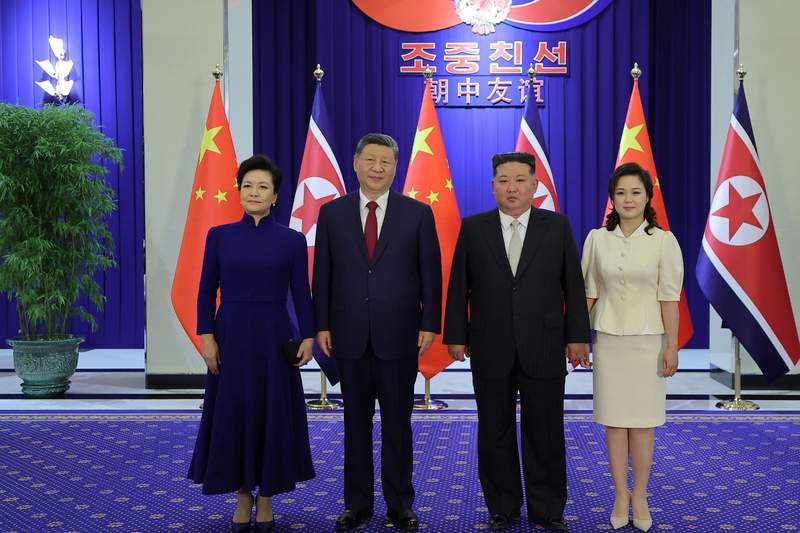
POLICY WIRE — Washington D.C., USA — The global chessboard shifts, not with a bang, but with the almost imperceptible click of two pieces aligning. Forget the usual saber-rattling headlines. We’re watching something quieter, something more insidious: North Korea, the hermit kingdom, isn’t just surviving. It’s actively cozying up to China, its formidable neighbor, in ways that make the diplomatic community in Washington—and Seoul, naturally—reach for the stress balls. It’s an embrace born less of affection, more of a shared, cynical view of global order. A compact, if you will, to irk everyone else.
For years, Pyongyang has managed its peculiar blend of isolation — and belligerence with a surprisingly grim efficacy. But the deepening partnership with Beijing isn’t just about economic lifelines, though those are definitely flowing. It’s about ideological solidarity, a tacit understanding that two states, often on the outs with Western powers, can find strength in numbers—even if those numbers are, well, two against the world. You’d think this would be front-page news every day. Instead, it’s a slow-burn narrative, unfolding like a low-budget thriller.
Diplomatic circles are abuzz, but not in public. Oh no, that’d be too straightforward. The official line from China’s Foreign Ministry Spokesperson, Wang Wenbin, recently felt particularly clipped. “The traditional friendship between China and the DPRK is a precious asset shared by the two peoples,” he asserted in a state-media briefing. “Our cooperation serves regional peace and stability.” One almost has to admire the deadpan delivery, considering ‘regional peace and stability’ hasn’t exactly been the prevailing mood when North Korean missiles splash into the sea or their internet mysteriously flickers off.
And let’s not pretend this is a benign coffee-and-cake meeting. The relationship, we’re hearing from folks who watch these things obsessively, involves technology transfers. Think industrial parts. Maybe even some of the digital guts for Pyongyang’s burgeoning surveillance state. In return, China gets a strategic buffer, yes, but also a partner in defying perceived Western overreach. It’s a classic arrangement, dusted off for the 21st century.
This isn’t just some regional tiff; the ripple effect’s already started spreading. Just consider the way Beijing’s increasing global influence—economic, cultural, military—plays out. From the South China Sea to the Belt and Road Initiative’s tendrils reaching deep into Central and South Asia, including Pakistan, this renewed Sino-North Korean camaraderie forms yet another facet of a multipolar world intent on charting its own course. For countries like Pakistan, balancing ties with China and the West is a constant, delicate high-wire act—a challenge that only becomes more acute when China aligns with another isolated state under sanctions.
In fact, recent U.N. Panel of Experts reports suggest a significant uptick in illicit trade routes funneling sanctioned goods and resources in and out of North Korea. Because, really, who’s going to stop them? It’s often through these shadowy networks that China quietly keeps its ally afloat, even as Beijing votes in favor of sanctions resolutions at the Security Council. It’s an elaborate game of wink-and-nod that only true players can master. One anonymous source, a seasoned U.S. State Department official speaking on background, put it rather bluntly: “We’re witnessing a recalibration of alliances, not based on shared values, but shared grievances. And it’s not just concerning; it’s a direct challenge to the enforcement mechanisms we’ve painstakingly built.”
Pyongyang, predictably, sees nothing wrong here. A North Korean Central News Agency (KCNA) editorial, channeling the Supreme Leader’s defiant posture, declared that “friendly relations are a precious bond unbreakable by any hostile forces’ machinations.” It’s classic stuff, really—blaming external aggressors for their own strategic choices. They’re not just expanding cooperation; they’re fortifying their isolation. But hey, it works for them. They’ve found a partner.
📄 POLICY WIRE WHITEPAPER PUBLISHED: PAKISTAN'S NATIONAL SECURITY POLICY PRIORITIES
👉 READ BY CLICKING HERELet’s talk hard numbers for a second: bilateral trade between China and North Korea reportedly hit around $1.7 billion in 2023, according to data compiled from Chinese customs records and interpreted by the Center for Strategic and International Studies (CSIS). That’s not a huge number by global standards, sure. But it represents a significant increase from previous years and a crucial lifeline for an economy strangled by international sanctions.
What This Means
This evolving bromance—let’s call it what it’s—between Pyongyang and Beijing isn’t just some sideshow. It’s a key indicator of a larger geopolitical recalibration. For starters, it further complicates any unified international stance against North Korea’s nuclear ambitions. China, as a permanent member of the UN Security Council, wields immense power, and its increasingly opaque support for North Korea renders sanctions enforcement farcical. That makes efforts to curtail proliferation more difficult, leaving regional players like South Korea and Japan feeling particularly exposed. It makes global competition and precarious victory a daily reality.
Economically, it stabilizes North Korea just enough to prevent internal collapse—which, let’s face it, is Beijing’s primary concern. An unstable, refugee-streaming North Korea on its border is far worse for China than a manageable, albeit rogue, regime. But it also emboldens Pyongyang to continue its weapons development, diverting scarce resources away from its impoverished population, all while maintaining the veneer of economic viability thanks to Chinese trade. That’s a brutal calculation. Militarily, it strengthens a nascent axis that challenges American hegemony in the Indo-Pacific. It’s less about a direct military alliance — and more about synchronized defiance.
Politically, it sends a clear message: rules are made to be bent, perhaps broken, by those with enough clout. The ramifications of this extend far beyond the Korean Peninsula, influencing strategic thinking in Moscow, Tehran, and even in parts of the corridors of power in Karachi. When major powers flout international norms, it gives cover to smaller nations to do the same. So, no, this isn’t just about two old friends catching up; it’s about a new kind of power game being played, with very high stakes for everyone.