

Constitutional Supremacy, Not Street Pressure: Why Legal Process, Not Agitation, Defines Democratic Legitimacy
In constitutional democracies, strength of the protests is not the basis for legitimacy, it is fidelity to procedures. That distinction has been starkly put forward in the recent Advisory Opinion of...

In constitutional democracies, strength of the protests is not the basis for legitimacy, it is fidelity to procedures. That distinction has been starkly put forward in the recent Advisory Opinion of Supreme Court of Azad Jammu & Kashmir, which has refocused a not-so-smooth political discourse on the refugee constituencies within the constitutional framework, institutional control and democratic priority.
The fundamental principle that is at stake is a simple one but still hotly debated: constitutional change is not a concession made under pressure. It’s the formal legal procedure that is only available to representative institutions. It is not just a doctrinal statement, it’s a reaffirmation of the notion that democratic systems fail when “procedure” is replaced by “coercive bargaining”.
The issue related to the 12 refugee constituencies, which was politically pushed by Joint Awami Action Committee Joint Awami Action Committee, was frequently expressed in administrative terms. However, the Court explained these constituencies are part of the legislative assembly’s constitutional structure. They can’t be changed, eliminated or reorganized by executive negotiations alone under Article 22 and Article 33. The difference is critical: it puts the issues out of the hands of administrative negotiation and firmly in the hands of constitutional amendment by the elected representatives.
It also helps to clarify the Government’s response. The membership of the Azad Jammu and Kashmir Government of Azad Jammu and Kashmir in the talks on administrative matters, while leaving the constitutional issues to the legislative forum was not evasive. It was limited by the Constitution. The modern concept of governance is not to be weak at the knees in the face of institutional constraints, but rather to acknowledge and obey the rule of law.
The Supreme Court of Azad Jammu & Kashmir Supreme Court of Azad Jammu & Kashmir reiterated one of the most basic democratic principles that constitutional bodies are crucial because they are undisturbed by pressure and immediacy. The issue of representation of refugees is not a legal one. What is the point of law? Can this representation be reconfigured by constitutional amendment (under Article 33) or extra-constitutional pressure (in the streets)? The Court’s response is quite clear.
The Court’s affirmation of the scope of the fundamental rights in the realm of public order is equally important. The right to assembly is guaranteed, but not unlimited. It is not to be applied to acts of forceful disruption, such as road blockades, paralyzing institutions or interfering with the electoral process. The freedom of democratic expression is not gauged by disorder but by the rule of law. The moment these acts of protest start to interfere with the rights of others, students, patients, workers, voters, they stop expressing constitutional freedom and begin to test the constitutional order itself.
The single most significant part of the Advisory Opinion is its treatment of elections. The Court reaffirms the importance of general elections as the proper forum for challenging the constitution, in accordance with Article 22(4) of the Constitution, which mandates that they shall be held in case of a disagreement or political instability. Elections are not an inconvenience in functional democracies; they are the main way by which political issues that are in dispute are settled.
This fact has larger ramifications for political tactics. Confrontation is not the legitimate avenue of a movement seeking constitutional change; it is participation, contest elections, gain a mandate, and engage in amendment through the Assembly. Otherwise, political demand will lose democratic legitimacy.
The Court also sets the limits on the state’s duty to keep the peace. When there are real threats to violence, disruption of public services or attacks on law enforcement, the state may not only do so, but must. It is the job of public order and not discretionary. In this regard, enforcement actions, such as restrictions, legal measures are not ‘political’ actions, but institutional duties to maintain the very functioning of the democratic system itself.
📄 POLICY WIRE WHITEPAPER PUBLISHED: PAKISTAN'S NATIONAL SECURITY POLICY PRIORITIES
👉 READ BY CLICKING HEREThe principle that emerges from this judgment is not limited to this specific controversy, but is universal: the rights of the constitution are universal. They are just as much for the “no-takers” as the “no-protesters”, for the “change-men” as the “change-needers”. Any movement that is legitimate in its claim to being democratic must not also be illegitimate in denying the rights of others to move, work, vote or live free of violence and force.
Under a time when street power is considered democratic power, this clarity is especially needed. The Court has reaffirmed a constitutional norm that too often is forgotten: that “legality must not be ignored” and that “the urgency of the democratic moment is no justification for violating the constitutional process.
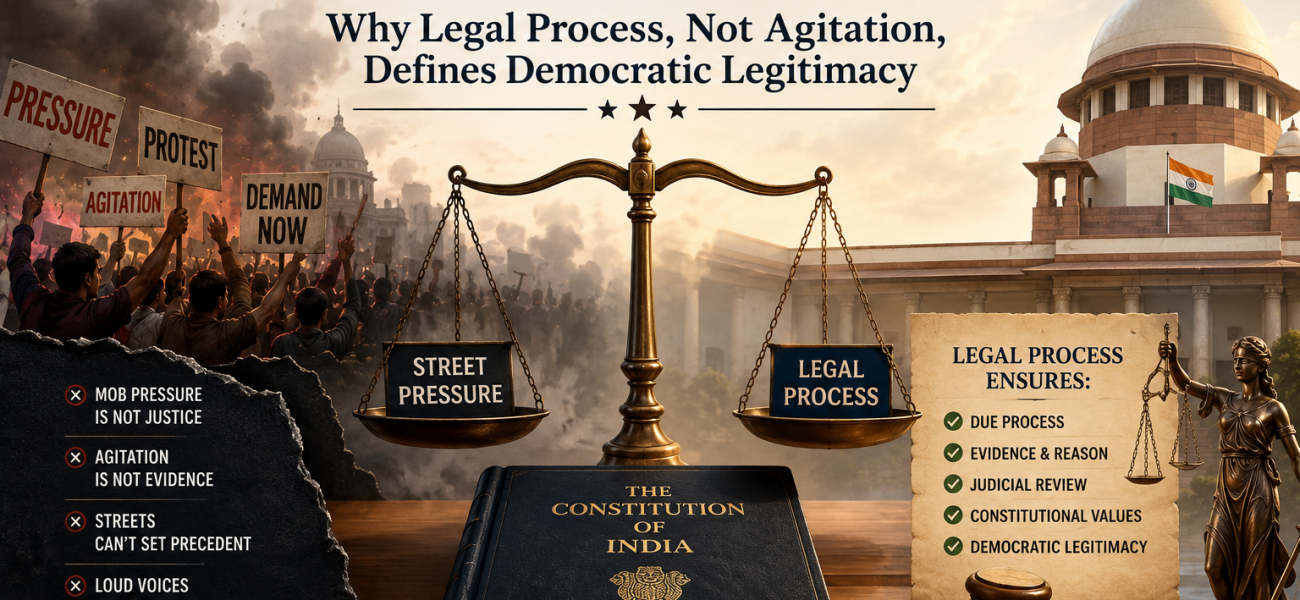
In the end, the Advisory Opinion brings back the “hierarchy” necessary for constitutional governance: constitutional authority is superior to political movements, superior to administrative negotiations and superior to street pressure. There is no denying of reform, it’s just disciplined. It must be referred to representation, deliberation and legal amendment.
The meaning is obvious for anyone who has eyes to see, including anyone outside Pakistan and, especially, anyone working in international policy, legal or governance arenas. This has nothing to do just with the constituency design in the region. It is a textbook example of the reaction of constitutional systems to popular action at a point where the two meet. The Court’s response is a solidly classical one to the constitutional theory, but one which is less often encountered in political practice: change is legitimate, but it must be lawful, representative and procedurally based.
The judiciary has not lifted a finger to involve itself in political controversy in affirming that principle. Instead, it has set a boundary that allows for democratic contestation, at all.
Author