

The Elusive ‘Prime’: Bibee’s Flash of Brilliance Against the Murky Waters of Consistency
POLICY WIRE — Arlington, Texas — The arid air over Globe Life Field, often a witness to predictable narratives of triumph and attrition, recently offered something far more elusive: a...

POLICY WIRE — Arlington, Texas — The arid air over Globe Life Field, often a witness to predictable narratives of triumph and attrition, recently offered something far more elusive: a stark reminder of the flickering nature of peak performance, particularly when juxtaposed against the grind of sustained excellence. It wasn’t merely a game—it was a concentrated burst of what might be, or what once was, posing uncomfortable questions about the search for an optimal state in a decidedly sub-optimal world.
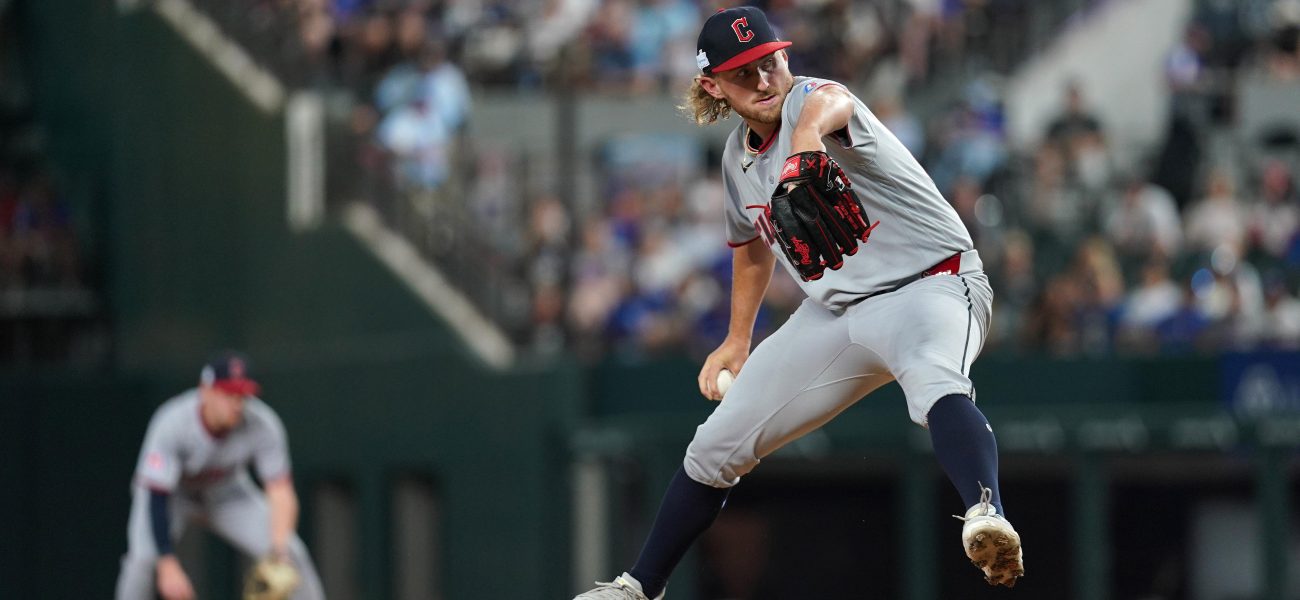
One might easily overlook the sheer artistry involved. The Cleveland Guardians’ Tanner Bibee, whose seasonal performance metrics have charted a more uneven course, delivered an outing that transcended mere statistics. He carved through the Texas Rangers lineup with the kind of economical efficiency that veteran observers cherish, almost venerate. Think of it: he tossed 8 scoreless innings. Eight innings, mind you, that seemed to whisper of past glories — and future hopes in equal measure. This wasn’t just a good day; it was a perfect storm of pitch selection, location, and control, demonstrating a command usually reserved for hurlers enjoying what many wistfully recall as “their prime.” [QUOTE_PLACEHOLDER]
His pitch count for that prolonged dominance? An almost unbelievable 87 pitches. For context, many contemporary starters struggle to navigate five or six frames with a similar number. This isn’t just efficiency; it’s a mastery that, for a few hours, made the mundane miraculous. And, frankly, one wonders about the calculus that pulled him from the mound. The decision to remove a pitcher on such an economical path often fuels robust, sometimes theatrical, debates in the baseball world. Because sometimes, you just wanna let ’em finish it.
The immediate statistical dividend was clear: he lowered his ERA all the way down to 4.09 from this outing. It’s a measurable improvement, of course, yet still a figure that hints at the struggles preceding this specific “gem.” It highlights a fundamental tension: what happens when individual brilliance sporadically illuminates a backdrop of collective struggle? What does it mean for long-term strategy, for player development, for an organization betting on consistent output? But these are the questions of expectation, not merely execution.
Beyond the singular spectacle, the Guardians’ offense rallied, a collective affirmation after recent tepid displays. Jose Ramirez, the team’s steadfast engine, powered a truly significant contribution with his team leading 10th HR of the season. Rocchio also delivered, sending a memorable bomb off the foul pole. DeLauter — and Schneemann weren’t spectators either; they also both had two hits. Manzardo added a double — and two walks to the tally. It was super nice to see the offense have a game like this, providing a broad base of support for Bibee’s singular effort. The collective, for once, was firing on multiple cylinders, offering a momentary reprieve from the sometimes solitary burden of the starting pitcher. And that’s a potent mix, even if fleeting.
The juxtaposition of individual brilliance with intermittent team cohesion isn’t unique to baseball. Indeed, it mirrors patterns seen across a spectrum of global arenas. In regions like South Asia, and particularly Pakistan, the quest for “this version of himself more consistently, the version we’ve seen for years” can resonate deeply. Political leadership, economic policy, and even national development often grapple with the struggle to translate isolated successes into sustainable progress. How does one bottle that momentary spark of genius, that singular night of efficiency, and make it the norm rather than the exception? Because true systemic change rarely rides on one man’s flawless execution.
📄 POLICY WIRE WHITEPAPER PUBLISHED: PAKISTAN'S NATIONAL SECURITY POLICY PRIORITIES
👉 READ BY CLICKING HEREThe policy implications here, abstracted from the baseball diamond, are quite direct. In economic terms, nations often achieve bursts of impressive growth or market stability—much like Bibee’s eight scoreless innings—only to fall back into more challenging averages. Consider the often-cited “middle-income trap” where countries struggle to sustain economic momentum beyond a certain threshold. It’s not about lack of capacity or individual brilliance; it’s about the system’s ability to consistently reproduce and scale that success. The current global economic outlook, particularly regarding inflation and energy prices (sourced from recent International Monetary Fund reports, for example), highlights this exact struggle: isolated signs of recovery can be easily overshadowed by broader, entrenched issues, making that “4.09 ERA” feel stubbornly high, despite the individual triumph. It’s not enough to be brilliant for a night; you’ve gotta sustain it for an entire season.
What This Means
This episode serves as a powerful metaphor for the ongoing quest for consistent excellence amidst complex, often unpredictable systems. For policymakers and market analysts, it’s a stark reminder that isolated victories, no matter how spectacular, don’t automatically guarantee long-term stability or success. In the realm of international relations, nations constantly strive to replicate diplomatic breakthroughs or economic policy successes, but political entropy and external shocks frequently intervene. The challenge, much like a baseball manager deciding whether to keep a red-hot pitcher in the game, lies in discerning when to push for further gains and when to consolidate, knowing that past performance, while illustrative, offers no guaranteed future. It begs the question: are we seeing a glimpse of genuine, reproducible potential, or just an aberration before the inevitable regression to the mean?
The search for this enduring consistency is, in essence, the very struggle facing many emerging economies, not least across the Muslim world, where a cycle of optimism and retrenchment often defines the economic and political landscape. One can draw parallels to the precarious balance required to maintain a delicate regional stability, or even the intense public scrutiny faced by high-profile figures. Will Bibee’s extraordinary performance serve as a true inflection point, a demonstration of an enduring “silent revolution” in his game, or merely a fleeting mirage? And what about the team? What does this collective surge tell us about their deeper, more intrinsic capabilities when the individual stars align, or when they don’t? And if this team can truly be a force in the playoffs, it won’t be because of one night alone, but because it proves it can harness that magic more often. Just like any government attempting to build lasting prosperity.