


Desert Calm Shattered: New Mexico Crash Spotlights Regional Response Gaps Amidst Borderland Hubris
POLICY WIRE — SANTA TERESA, N.M. — In the sprawling, often deceptively tranquil landscape where the Chihuahuan Desert meets the hard reality of a border, a small disruption can echo far beyond its...

POLICY WIRE — SANTA TERESA, N.M. — In the sprawling, often deceptively tranquil landscape where the Chihuahuan Desert meets the hard reality of a border, a small disruption can echo far beyond its immediate impact. One minute, it’s a typical Friday morning, the sky above Doña Ana County just another canvas of cerulean—endless and unbothered. Then, an aircraft, a seemingly innocuous vessel, decides otherwise. And just like that, the quiet hum of commerce and routine is ripped apart by twisted metal and the chilling, inevitable consequence.
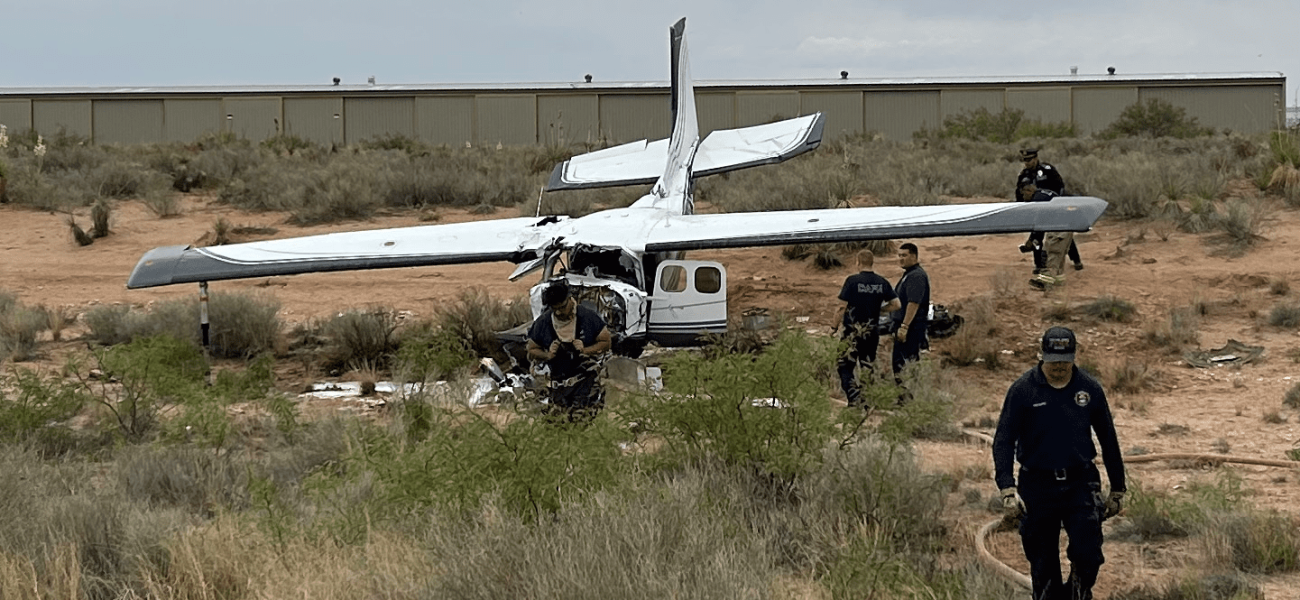
It was at the Doña Ana County International Jetport, a facility often serving as a crossroads for light freight and private ventures, that such a sudden shift occurred. Around 10:57 a.m., what started as just another take-off or landing evolved into an emergency scramble. A small plane crashed Friday morning at the Doña Ana County International Jetport in southern New Mexico. Authorities, not long after, were piecing together what had just unfolded. This isn’t a commercial jumbo jet, mind you, or a military exercise gone awry; it’s the bread-and-butter of small aviation, reminding us that even the simplest machines can bring things to a screeching halt. [QUOTE_PLACEHOLDER]
Initial reports confirmed what eyewitnesses already knew: three people were injured. Not just a minor bump or a fender bender of the air, but serious, life-altering trauma. Firefighters from Sunland Park and Doña Ana County arrived, quickly on the scene after the alarm bells, or rather, the crackling radio dispatches. They found the aftermath: a Cessna-style plane, its components scattered, the desert floor bearing ugly new scars. But there’s a particular, chilling note in the incident: witnesses removed two people from the plane before professional responders could even get to them. That’s a testament to immediate human instinct, sure, but it also speaks to the initial chaos, the split-second decisions made without formal training. Then, emergency teams still faced the agonizing task of extraction: they extricated a third passenger after finding them trapped in the wreckage.
The severity of their conditions, confirmed by Sunland Park Fire Chief Daniel Medrano, paints a stark picture. Two people were flown to an area hospital in serious but stable condition, a thin margin of comfort against severe injury. An ambulance took the third person to the hospital in critical condition. It’s a logistical nightmare in itself, mobilizing air and ground assets, diverting crucial medical resources to save lives against the clock. All three of them sustained life-threatening injuries, meaning that the ripple effect of this one moment is going to be lengthy, costly, and profoundly personal.
But there’s an undercurrent of lingering questions that even Medrano couldn’t answer definitively at the time. Officials are still unsure which person was the pilot or what caused the crash. That uncertainty hangs heavy. Was it mechanical failure? Human error? An unforeseen environmental factor? New Mexico State Police is on scene to investigate, which is a thorough, drawn-out process, involving black boxes—if such small planes carry them in detail—flight plans, weather reports, and the painstaking reconstruction of an accident that unfolded in a terrifying few seconds. Because, frankly, the cause matters not just for these individuals, but for the safety protocols of an entire regional aviation system. It’s an inconvenient truth that aviation safety, both globally and locally, often progresses incrementally after each major or minor disaster.
The collective effort of the emergency response agencies involved was substantial: Sunland Park Fire Department, Doña Ana County Fire Rescue, El Paso Fire Department and Native Air also responded. It’s a multi-jurisdictional dance, involving state lines and local townships, all coordinating in a sudden rush to minimize harm. This seamless, if adrenaline-fueled, coordination is critical, not just here, but in similar complex border environments across the world. Think of, say, Karachi or Lahore, major urban centers in Pakistan, where civilian aviation—both large and small scale—operates daily under significant pressure, often bordering crowded residential areas. A minor incident in an American jetport, handled by a well-funded, efficient emergency matrix, can be a full-blown catastrophe in parts of the Muslim world or South Asia, where such immediate, highly coordinated response resources aren’t always available at a moment’s notice, or might be hampered by bureaucratic logjams or sheer traffic congestion. Pakistan, for example, saw 42 fatalities from civilian aviation accidents in 2020 alone, according to statistics from the Aviation Safety Network, illustrating the brutal consequences when incidents occur.
📄 POLICY WIRE WHITEPAPER PUBLISHED: PAKISTAN'S NATIONAL SECURITY POLICY PRIORITIES
👉 READ BY CLICKING HEREThis incident, then, serves as a sharp reminder. Small aircraft accidents might not grab international headlines with the same fervor as a wide-body crash, but their implications are often profound for the immediate communities and the aviation industry itself. It raises uncomfortable questions about training, oversight, and perhaps, the often-overlooked vulnerabilities of small regional airfields operating so close to major international gateways like El Paso.
What This Means
The immediate political and economic fallout of this crash, while contained, casts a spotlight on the logistical underpinnings of southern New Mexico’s crucial borderland economy. Doña Ana County, a gateway to and from Mexico, relies heavily on efficient transportation networks—not just ground, but air for freight, personnel, and private travel. An incident here, even a smaller one, can disrupt confidence, potentially delaying commercial ventures or creating ripples in the fragile ecosystem of cross-border trade and surveillance activities. It also stresses emergency services, revealing where communication lines are strong and, perhaps more pointedly, where they’re thin. These agencies—fire, police, and medical—operate on budgets dictated by state and county politics. When multiple departments, some from across state lines (like El Paso, Texas), are required for a single, small aircraft crash, it invariably highlights the regional dependencies. The subtleties of inter-agency cooperation, often taken for granted in daily operations, become critically apparent under pressure.
For politicians — and policymakers, this isn’t just an isolated tragedy; it’s a policy flashpoint. It triggers reviews of airport safety protocols, local first responder readiness, and regional funding for critical infrastructure that might appear humdrum until catastrophe strikes. The silence of the New Mexico desert can be a veneer, thinly veiling complex economic and logistical webs—webs that, as Friday’s incident proved, are surprisingly delicate when confronted by even a modest miscalculation or mishap. It reminds everyone involved that policy decisions, even those made far from a crash site, ultimately manifest as capabilities—or, in this case, immediate requirements—when lives are literally hanging in the balance. It’s a sobering reminder that infrastructure and emergency response aren’t abstract concepts; they’re the difference between survival and despair.