

Mogadishu’s Ticking Clock: Somali Election Debacle Escalates to Gunfire
POLICY WIRE — Mogadishu, Somalia — The political calendar in Somalia, never precisely a well-oiled machine, finally sputtered to a dead stop this week, then spontaneously combusted. The capital city,...

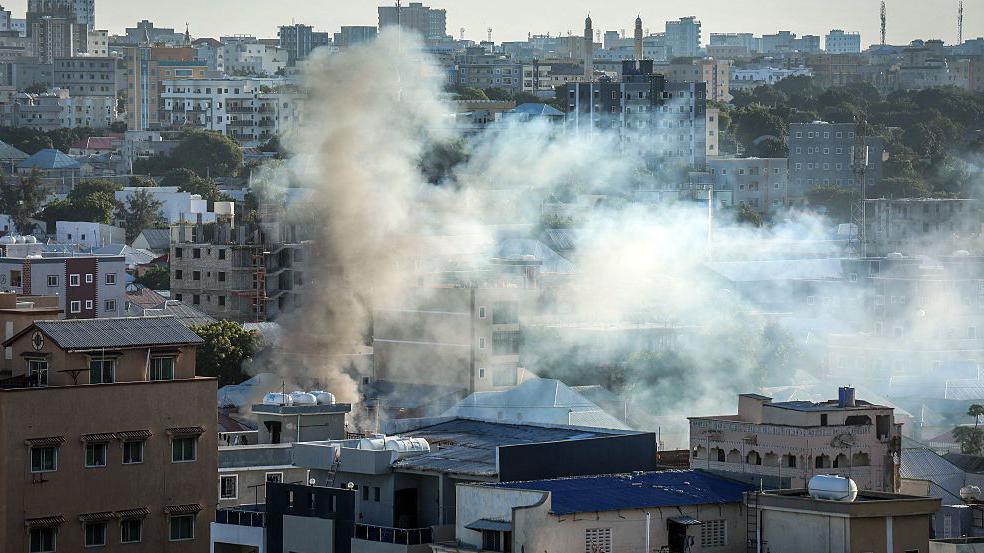
POLICY WIRE — Mogadishu, Somalia — The political calendar in Somalia, never precisely a well-oiled machine, finally sputtered to a dead stop this week, then spontaneously combusted. The capital city, Mogadishu, usually a chaotic hum of commerce and resilient life, devolved into something far grittier. Pockets of the urban sprawl echoed with heavy automatic weapons fire and the ominous thud of artillery, forcing a swift, chilling return to a past Mogadishu’s residents desperately hoped was behind them. This isn’t just about an election; it’s about the very concept of governance here. And it’s not looking good.
What started as a constitutional dispute—the kind of political wrestling match common in fledgling democracies, where incumbents cling on with varying degrees of decorum—has mutated. President Mohamed Abdullahi Mohamed, often called Farmaajo, whose term technically expired back in February, has been attempting to extend his stay, ostensibly to organize belated elections. But his opponents aren’t buying it. Not even a little. His parliamentary allies greenlighted a two-year extension for his government. Opposition forces, backed by their own allied militias, considered that a red line, drawn in concrete. So now, the simmering frustration has spilled over, quite literally, onto the streets, making the fragile truce Mogadishu enjoyed feel like a distant dream.
“This wasn’t merely a legislative adjustment; it was a brazen seizure of power,” stated former President Hassan Sheikh Mohamud, his voice sharp with condemnation from an undisclosed location in Mogadishu, his forces now actively clashing with government troops. “The international community, our own people—we’ve made it abundantly clear this extension was illegitimate. What did they expect?” Strong words. But words, clearly, haven’t been enough.
On the other side of the political barricade, government officials are framing the escalation as an unpatriotic obstruction. “We’re endeavoring to stabilize this nation, to bring forth a truly democratic process amidst daunting challenges,” claimed Mohamed Ibrahim Moalimuu, a spokesperson for the federal government. “These armed provocations serve only to empower al-Shabaab and destabilize all the progress we’ve painstakingly achieved. It’s irresponsible, and frankly, it’s criminal.” They’ve been keen to label any opposition to the extension as outright subversion. It’s a familiar play, trying to frame political disagreement as treason.
The stakes are astronomically high. For years, the international community has pumped billions into Somalia, attempting to bolster its fledgling federal government and roll back the extremist insurgency. The notion of a relatively stable, unified Somalia has always been a rather delicate proposition. When politicians start settling their differences with AK-47s in the capital, well, it complicates the narrative somewhat. This is a region perpetually vulnerable to external influence — and internal fragmentation. A nation like Pakistan, for instance, which grapples with its own intricate democratic journey and the constant threat of internal extremist elements, would view this kind of governmental implosion in a fellow Muslim-majority nation with deep concern. It’s a reminder of how quickly political disunity can unravel security gains, creating vacuums that radical groups are all too eager to fill. The interconnectedness of regional security in the broader Muslim world means that a crisis here reverberates.
📄 POLICY WIRE WHITEPAPER PUBLISHED: PAKISTAN'S NATIONAL SECURITY POLICY PRIORITIES
👉 READ BY CLICKING HEREMore than 2.9 million Somalis, according to the UN’s Office for the Coordination of Humanitarian Affairs, are internally displaced due to conflict and climate shocks. A return to large-scale urban warfare would, swell those grim figures significantly, forcing more innocent families into desperate limbo. And then what? Mogadishu’s population, already stretched, already weary, could very quickly find itself abandoned once more, fleeing another cycle of violence wrought by its own leaders.
What This Means
This eruption signals a critical inflection point for Somalia, moving beyond a constitutional crisis into a full-blown security meltdown. Politically, President Farmaajo’s attempts to consolidate power by sidestepping the electoral timeline have backfired spectacularly. Instead of securing his position, he’s inadvertently galvanized armed opposition, possibly setting a precedent where future political transitions are settled not by ballots, but by bullets. For a nation that’s struggled for decades to build state institutions, this is a severe regression. Economically, the instability will gut what little investor confidence existed, sending aid organizations and businesses scurrying. Humanitarian access will become even more precarious. The international community, already stretched thin, will be faced with an ugly dilemma: intervene more aggressively, risking accusations of interference, or stand by as Somalia descends deeper into internecine conflict. It’s an untenable situation for everyone involved, particularly the long-suffering Somali populace. It implies a protracted period of insecurity, likely widening the space for groups like al-Shabaab to reassert control in territories where government focus dwindles. Expect a protracted diplomatic push to broker a ceasefire, but any solution now must navigate entrenched armed positions rather than merely political rhetoric. It’s an unfortunate, but deeply familiar, turn of events for Somalia, — and it won’t resolve itself quickly. The dust might settle eventually, but the deeper fissures could last for years.