


Albuquerque’s Ash: Recurrent Recycling Inferno Ignites Public Health Debate, Echoes Global Pollution Crisis
POLICY WIRE — Albuquerque, United States — It’s a familiar stench now, a thick, acrid haze that’s becoming less a local anomaly and more a grim landmark for Albuquerque’s South Valley. This isn’t a...

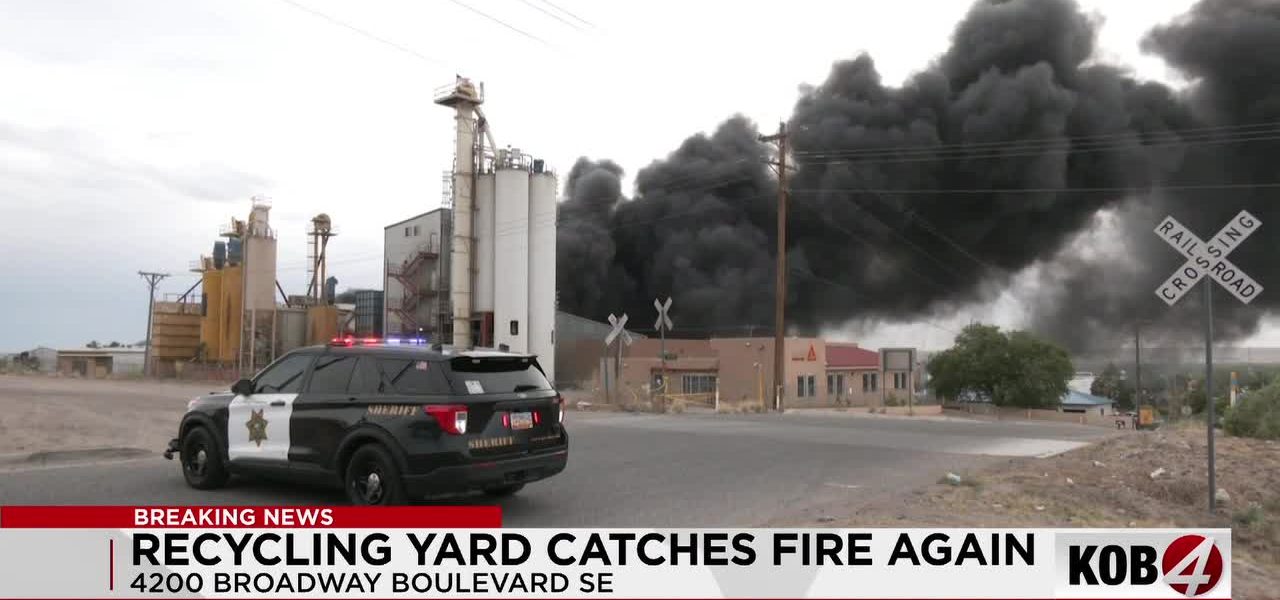
POLICY WIRE — Albuquerque, United States — It’s a familiar stench now, a thick, acrid haze that’s becoming less a local anomaly and more a grim landmark for Albuquerque’s South Valley. This isn’t a one-off calamity; we’re talking déjà vu, folks, specifically the second time flames have taken hold of the same recycling property. Because really, what’s more concerning: a towering inferno, or the nagging feeling that this particular kind of trouble keeps circling back?
Crews are in a fight against a substantial fire at the Town Recycling yard, right there in the South Valley, battling the blaze as it gobbles up more than just scrap. You’d think piles of discarded materials were the main course, wouldn’t you? But no, the inferno had grander ambitions this time, spreading its fiery tendrils to nearby buildings, expanding the environmental footprint well beyond what any regulator likely considered optimal. It’s never just trash on fire; it’s an ecosystem of problems going up in smoke. [QUOTE_PLACEHOLDER]
And what do such spectacles guarantee? An air quality advisory, naturally. The Albuquerque-Bernalillo County Air Quality Program didn’t hesitate, issuing a health alert quicker than you can say particulate matter. They advised folks with respiratory conditions in Albuquerque — and Bernalillo County to limit outdoor activity. A pretty standard directive, all things considered, when your immediate vicinity suddenly becomes a carbon emissions factory with extra plastic notes. But it’s the implied acceptance of this repeated industrial mishap that should perhaps give us all pause.
It’s not just a localized problem either. We’ve got 40 personnel, spread across 11 units, fighting tooth — and nail, and they aren’t alone; more are on the way. Imagine the logistical nightmare, the deployment of resources, the public expense to quell a fire that, frankly, shouldn’t have been a repeat performance. But such is the calculus of industrial oversight — or the distinct lack thereof. It forces questions about why this particular locale remains a perennial hot spot, a phoenix from its own ashes, only this phoenix carries the stench of burning electronics.
Traffic’s snarled too, obviously. Broadway’s shut down in both directions at Prosperity. Because nothing says progress like a recycling facility becoming a recurring traffic stopper and a public health hazard. One almost wonders if Prosperity was chosen for its ironic juxtaposition to the environmental costs.
This isn’t merely about an Albuquerque fire; it’s a flickering symptom of a much larger, more systemic ailment concerning waste management, industrial safety, and public health, one that plagues sprawling urban centers across continents. Consider for a moment the choked skies over South Asia, where unregulated informal recycling operations often provide livelihoods but at a terrifying cost. Cities like Dhaka regularly rank among the world’s most polluted, not just from vehicle emissions but from the ceaseless burning of trash, often in densely populated areas. The consequences are dire. A 2021 study published in The Lancet Planetary Health reported that outdoor air pollution, a silent assassin often fueled by such fires, contributed to 1.67 million deaths across the Indian subcontinent in 2019 alone, a grim statistic that hardly garners the immediate alarm it deserves.
📄 POLICY WIRE WHITEPAPER PUBLISHED: PAKISTAN'S NATIONAL SECURITY POLICY PRIORITIES
👉 READ BY CLICKING HEREHere in Albuquerque, while the scale is certainly different, the core issues resonate. There’s a company tasked with recycling materials, ostensibly for environmental betterment, that’s instead igniting concerns about respiratory health and property damage, and it’s doing so with a disconcerting frequency. Where’s the accountability for these recurring episodes? Are local authorities ensuring the very facilities designed to mitigate environmental harm aren’t actively creating it? And aren’t these precisely the questions officials should have asked after the *first* inferno?
It’s an inconvenient truth: recycling, that supposed panacea for our consumerist excesses, often presents its own set of dangers, particularly when regulation is lax or enforcement is, shall we say, a bit relaxed itself. From the vast e-waste graveyards in Ghana to the perpetually smoldering landfills near Islamabad, the global South lives with the fallout of inadequate waste infrastructure. We might not have the same immediate scope of human suffering from a single yard fire here in the Land of Enchantment, but the blueprint of negligence and consequence remains eerily similar. It’s an urgent call, not just for improved fire suppression, but for a systemic overhaul of how we view, regulate, and process our detritus. Because really, breathing clean air shouldn’t be a privilege; it should just be a given, a standard everywhere.
What This Means
This recurrent blaze in Albuquerque signals more than just an industrial accident; it exposes a delicate tightrope walked by local governance everywhere – balancing industrial necessity with public safety and environmental protection. For New Mexico’s political landscape, the repeating nature of this incident will inevitably prompt scrutiny on oversight bodies. Has the Bernalillo County government or state environmental agencies applied sufficient pressure or enacted meaningful deterrents after the first fire? Failure to demonstrate proactive regulation could turn what seems like an isolated industrial incident into a significant public trust deficit, a real electoral vulnerability. Because no one votes for politicians who let their constituents breathe smoke, you know?
Economically, the impact stretches beyond the immediate costs of fire suppression — and road closures. Businesses reliant on clean air — and predictable infrastructure face indirect losses. a tarnished reputation for industrial safety could subtly deter future investment, though likely not immediately noticeable in a city of Albuquerque’s size. For residents, especially those without comprehensive healthcare, the cumulative effect of repeated air quality alerts means more strain on local health systems and potentially higher healthcare costs, essentially socializing the externalities of private enterprise. Think of it: the working poor often bear the brunt, those without AC who rely on open windows and then get to inhale the recycling plant’s ‘gifts.’ And internationally, this localized failure echoes loudly in conversations about environmental justice, drawing uncomfortable parallels with waste disposal crises in Pakistan, India, and beyond, where unregulated industrial waste often contributes disproportionately to poor communities’ health woes. These fires – both literally and figuratively – illuminate just how interconnected our air quality, economic policy, and governance truly are, regardless of which continent you’re on.