


Boots on Cobblestones: Italy’s Republican Rites and the Weight of Modernity
POLICY WIRE — ROME, ITALY — The synchronized boot falls against ancient Roman cobbles, the metallic glint of bayonets under a relentlessly clear June sky, and the thundering roar of the Frecce...

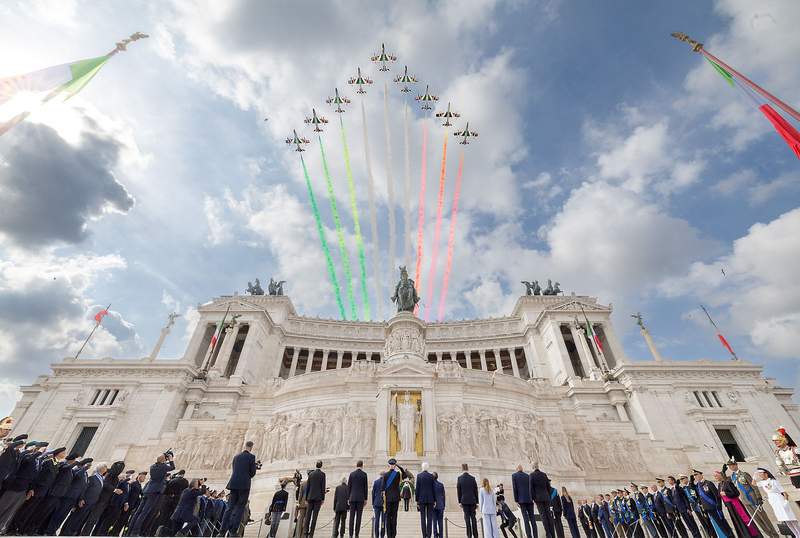
POLICY WIRE — ROME, ITALY — The synchronized boot falls against ancient Roman cobbles, the metallic glint of bayonets under a relentlessly clear June sky, and the thundering roar of the Frecce Tricolori painting the national colors across the heavens — these are the familiar, meticulously choreographed brushstrokes of Italy’s Republic Day. It’s an anniversary, a celebration, sure. But on its eightieth year as a republic, what transpired wasn’t just a commemorative parade; it was a declarative performance. A nation, always one for grand gestures, showcased its might, its order, and perhaps, its unspoken anxieties about a shifting global stage.
Because for all the precise military formations snaking through the Via dei Fori Imperiali, the subtext for Italy remains messy. The public, a mix of dutiful citizens — and camera-wielding tourists, watched dutifully. Yet, beneath the ceremonial sheen, deep-seated debates — about national identity, economic malaise, and European solidarity — continued their quiet, relentless churn. It’s never just about the tanks rolling past the Colosseum; it’s about what those tanks represent in a country still grappling with its own tumultuous journey from monarchy to democratic self-rule. And it’s about a government – the most right-wing in generations – that interprets national symbols with a particular, resonant gravitas.
President Sergio Mattarella, the steady, reassuring hand guiding the Italian state, acknowledged the gravity of the moment, if not the theatrics. “Our Republic, forged from the darkest chapters of our history, stands as a living declaration of democratic values and an unwavering commitment to peace,” he intoned from the presidential stand, his words a customary balm. “It’s a legacy we’re called upon to defend, not with nostalgia, but with forward-looking determination.” It’s a message that rings familiar across Europe’s mature democracies—a recognition of hard-won freedoms tempered by contemporary challenges.
But the government of Prime Minister Giorgia Meloni sees defence differently, prioritizing national sovereignty and the robust protection of borders. “Eighty years ago, Italy chose its destiny; today, we reaffirm our sovereign right to secure our future, unapologetically Italian,” Meloni asserted later in the day, a subtle yet firm rejoinder to notions of European dilution. Her government’s narrative often ties directly to a muscular national posture, and this parade – bristling with its tanks and fighter jets – provided the perfect visual punctuation. Her administration isn’t shy about leveraging national symbols; they’re integral to its project.
And that project isn’t confined to Italy’s domestic sphere or even just European borders. Italy, perched at the heart of the Mediterranean, finds itself in an ever-more complex geopolitical neighborhood. The parade itself, while internal facing, hints at deeper military — and diplomatic calculations. The country is a significant contributor to NATO missions, certainly. It’s also facing the ceaseless challenge of migration, a phenomenon often stemming from regions many thousands of miles to its east and south. Just think of the Strait of Sicily: it’s not merely a stretch of water, but a critical, sometimes tragic, juncture connecting continents.
Consider the broader context: Italy, like other Mediterranean states, has growing stakes in what transpires in North Africa and the broader Muslim world. The flow of human beings—economic migrants, refugees fleeing conflict or climate catastrophe—across the central Mediterranean corridor directly impacts Italian society, economy, and foreign policy. Italy recorded nearly 157,000 irregular arrivals by sea in 2023, a staggering 50% increase from the previous year, according to UNHCR data. Managing this complex humanitarian and security challenge frequently demands delicate diplomatic engagement with nations like Libya, Tunisia, and Egypt, and has implications stretching to countries as distant as Pakistan, from where some of these migrants begin their arduous journeys.
📄 POLICY WIRE WHITEPAPER PUBLISHED: PAKISTAN'S NATIONAL SECURITY POLICY PRIORITIES
👉 READ BY CLICKING HEREThe symbolism of a parade might feel like a quaint historical indulgence in some quarters. Here, though, it’s political. Italy is an economy perpetually teetering on the edge of structural reforms, with a colossal public debt that consistently hovers around 140% of its GDP. These martial displays aren’t just about showing off; they’re about projecting an image of stability and resolve, both inward and outward. They’re a counterpoint to the underlying financial wobbles — and the persistent struggle for robust economic growth.
What This Means
This anniversary spectacle isn’t just about history; it’s a political act. It underscores a persistent tension within the Italian republic: a desire to project strength and unity on the world stage while grappling with internal fragilities. Meloni’s government uses such events to solidify a nationalistic narrative, one that champions state authority and self-reliance against perceived external pressures, whether from Brussels or beyond. Economically, maintaining such military pomp in the face of debt and lagging growth is a complex balancing act—a declaration of independence wrapped in budgetary constraints. And for the rest of Europe, and indeed nations further afield like Pakistan, Italy’s self-assertion can be read as a shift towards more defined national interests, potentially complicating EU-wide policies on migration, trade, and defense. It’s less about consensus now; it’s more about the specific gravitational pull of Rome itself.
The parade itself, a dazzling twenty-first-century iteration of ancient imperial marches, is a testament to Italy’s enduring knack for the dramatic. But in a volatile world, it’s also a statement of intent: a modern nation, firmly republican, isn’t just looking backward to its founding principles; it’s staking its claim on a future that remains stubbornly uncertain. That’s what those flags, those formations, — and that aerial ballet are truly shouting.