


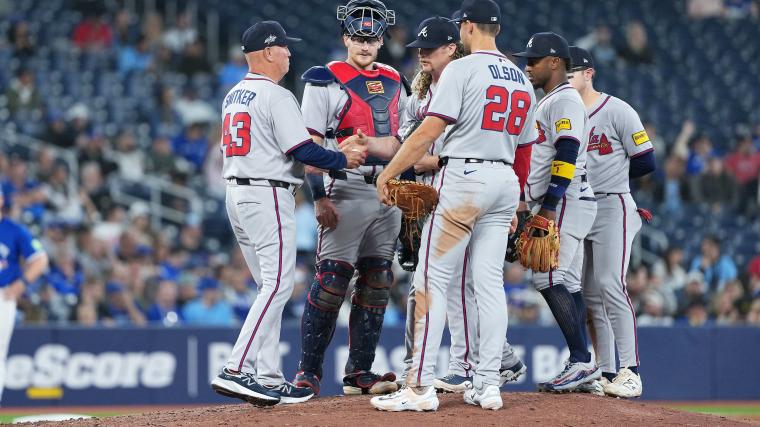
The Unholy Alliance: Atlanta’s $22M Play Shatters Baseball’s Unwritten Rules, Echoes Global Power Shifts
POLICY WIRE — Washington D.C., USA — There are moments when the veneer of entrenched rivalry thins, revealing the cold, hard steel of ambition and capital underneath. It’s not just in the Middle East...

POLICY WIRE — Washington D.C., USA — There are moments when the veneer of entrenched rivalry thins, revealing the cold, hard steel of ambition and capital underneath. It’s not just in the Middle East where erstwhile adversaries occasionally cut a deal for a fleeting advantage, or in South Asian politics where shifting allegiances redraw national maps. It’s also in the prosaic world of professional sports, specifically Major League Baseball, where the Atlanta Braves — long-standing contenders and sometimes antagonists of the New York Mets — are reportedly sniffing around for a familiar face currently wearing enemy pinstripes: relief pitcher A.J. Minter.
And boy, it’s a curious development, ain’t it? The whispers around the league aren’t about the latest trade bait from a floundering team. No, this one’s got legs, driven by the kind of tactical necessity that often makes strange bedfellows in geopolitics. Atlanta, for all its regular-season dominance, has had a left-handed pitching problem, a festering sore in an otherwise formidable bullpen. Think of it as a small, but persistent, policy gap needing urgent closure.
“We’ve been monitoring the market, as any serious organization does,” stated Alex Anthopoulos, General Manager for the Atlanta Braves, in a carefully worded comment during a recent press availability. “Sometimes, the best solution isn’t the most conventional. Our fans expect us to win, and we’re always exploring avenues, no matter how… unconventional they might seem on the surface.” A man who knows how to keep his cards close, he doesn’t confirm or deny, but his poker face tells its own story. He’s looking for the edge.
Minter, currently toiling away for the Mets, is no stranger to the Braves locker room. He’s a former Atlanta player, a World Series champion with the club, and possesses the kind of lefty arm that manager Brian Snitker probably daydreams about. He’s exactly the kind of commodity — a proven performer in high-leverage situations — that transforms a ‘good’ bullpen into a ‘game-over’ bullpen. It’s a resource grab, plain — and simple, echoing nations acquiring strategic assets from their competitors.
But here’s the kicker, the stinger in this narrative: the man’s on a rather plump $22 million deal with the Mets. This isn’t small change, not even in the big-money world of professional sports, where payrolls routinely exceed national GDPs of small island nations. To swallow that kind of contract, particularly for a relief pitcher, takes an organization willing to gamble significantly—a bold economic play that speaks volumes about their current desperation and their perception of opportunity cost. In economic terms, it’s a bet on the marginal utility of a single arm, one that could tip the scales of a pennant race. This financial commitment highlights the extraordinary valuations of niche skills in globalized markets, a trend we also see in tech or specialized consulting, often overlooking foundational labor, much like how the pursuit of elite talent in Western sports sometimes dwarfs investments in grassroots development in places like Pakistan, where cricket reigns supreme but infrastructure still struggles.
The unspoken rule, the one written in invisible ink across the very fabric of American sports, is that you just don’t trade key players — especially a World Series caliber arm — to division rivals. It’s akin to NATO providing arms to a recognized adversary (highly unlikely, mind you, but you get the drift). But these days? Those ‘unwritten rules’ seem about as binding as a pinky promise in a boardroom full of venture capitalists. Money talks. And increasingly, it shouts.
Because, really, when you peel back the layers of sporting contests, what you often find isn’t pure athleticism, but raw financial calculus, and an executive’s will to win at any cost. Scott Coleman, a writer for Battery Power, confidently – perhaps even audaciously – predicted such a move months ago. Call it prescience, call it shrewd observation of how the game’s played when real money is involved. But he put down a ‘five dollar bet’ two months ago that Minter would end up back in Atlanta, despite the seemingly insurmountable rivalrous dynamic.
📄 POLICY WIRE WHITEPAPER PUBLISHED: PAKISTAN'S NATIONAL SECURITY POLICY PRIORITIES
👉 READ BY CLICKING HEREFor the Mets, unloading Minter’s hefty contract could mean significant payroll relief, freeing up capital for other ventures—a calculated financial retreat, perhaps. Or maybe, as their fictitious General Manager, Benjamin Carter, might put it, “Sometimes you have to trim the fat, even if that fat’s a really talented cut of beef. It’s about organizational health, long-term strategy, and making decisions that benefit the whole, not just one component, however shiny that component might be. It’s not personal, it’s just… business.”
The precedent set here, should such a deal actually materialize, isn’t just for baseball. It speaks to a broader cultural shift where immediate utility trumps traditional allegiances, where economic leverage redefines established boundaries. In the intricate dance of international relations or even inter-corporate competition, these tactical acquisitions—the unexpected partnership for mutual gain, or the brazen poaching of talent—are becoming more and more common. This trade, if it happens, will be more than just a sports story; it’ll be a bellwether for a new era of transactional relationships, on and off the field. A cold, hard reminder that loyalty’s a luxury few can afford.
What This Means
This potential trade isn’t merely about baseball logistics; it reflects a deeper political economy at play within professional sports, mirroring global trends. On one hand, it highlights the increasingly mercenary nature of high-level athletic careers, where personal ties often play second fiddle to substantial financial compensation and the promise of a championship. Players become strategic assets, bought and sold regardless of past team affiliations or divisional rivalries, much like multinational corporations might acquire a competitor’s key research division. This commodification of talent, driven by an imperative for short-term competitive advantage, could lead to a less stable, more volatile environment for players, where market value dictates everything.
On the other hand, the Braves’ willingness to absorb a $22 million contract for a reliever from a rival demonstrates an escalating arms race in sports spending. This isn’t just about fielding the best team; it’s an economic flexing of muscles. Such massive outlays contribute to the widening financial gap between larger market teams with deep pockets and smaller franchises, potentially turning pennant races into contests of wealth as much as skill. From a policy perspective, this trend often sparks discussions around salary caps, luxury taxes, and revenue sharing – tools designed to foster parity. The pursuit of Minter, particularly from a direct competitor, implies that the traditional deterrents against such cross-pollination are weakening, perhaps signaling a need for sports leagues to re-evaluate their competitive balance policies or face a future dominated by a select few economically powerful entities. It’s a calculated risk, betting a hefty sum on a singular policy fix – a left-handed reliever – that, if it fails, leaves the organization vulnerable and with fewer resources for other pressing needs. But hey, that’s sports, right? And, you know, geopolitics.