


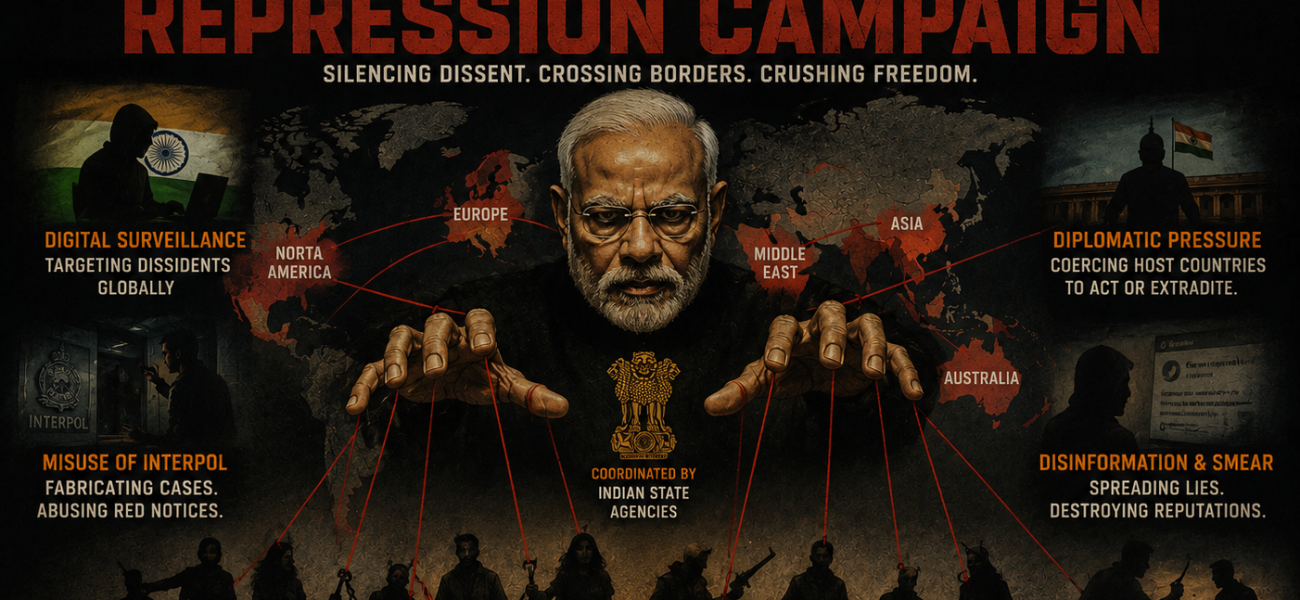
India’s Transnational Repression Campaign
When a government cannot silence its critics at home, it follows them abroad. That is the defining logic of transnational repression, the use of state power to intimidate, surveil, harass or...

When a government cannot silence its critics at home, it follows them abroad. That is the defining logic of transnational repression, the use of state power to intimidate, surveil, harass or eliminate dissidents living beyond a country’s borders. For years, this was a problem associated with autocracies, however, India, the world’s self-proclaimed largest democracy, was rarely placed in this company. That is changing, and the evidence is no longer deniable.
From the streets of Surrey to a New York courtroom, from a Birmingham hospital to a Frankfurt court, a pattern has emerged that is consistent, documented and deeply troubling. India under Prime Minister Narendra Modi has, according to Western intelligence services, court indictments and UN Special Rapporteurs, been running a systematic campaign of transnational repression targeting its Sikh diaspora. The targets are not armed militants. They are lawyers, community leaders, temple presidents and political activists exercising rights that democratic societies are built to protect.
Canada: A Killing Outside a Temple
Hardeep Singh Nijjar, a 45-year-old Canadian national and president of the Guru Nanak Sikh Gurdwara in Surrey, BC, was gunned down on 18 June 2023 by masked assailants outside the temple premises. Nijjar was a strong proponent of Khalistan, a separate state of Sikhs, which led him to be declared a terrorist in India whereas the charges were consistently rejected by the Canadian national throughout his life.
On 18 September 2023, Canadian Prime Minister Justin Trudeau informed the Canadian parliament that Canada’s intelligence agencies were pursuing “credible allegations” of a possible connection between the Indian government and the murder. The Indian side described the allegation as “absurd.” However, further evidence rendered the denial unsustainable, as, in October 2024, Canada expelled India’s high commissioner as well as five other diplomats.
Canada’s Foreign Interference Commissioner Marie-Josée Hogue later confirmed in her final report that the assassination was a specific example of transnational repression, warning that “India’s activities primarily target the approximately 800,000 members of the Sikh diaspora in Canada and aim to promote a pro-India and anti-Khalistan narrative.”
A leaked memo from India’s Ministry of External Affairs, made public in December 2023, showed that Indian consulates in North America had been instructed to launch a “sophisticated crackdown scheme” against Sikh diaspora. The memo listed the names of several diaspora members, including Nijjar himself, who was killed two months after it was issued.
United States: A Foiled Murder on American Soil
However, the Nijjar killing is just one part of a much larger conspiracy involving many more murders. On 29th November 2023, the US Department of Justice filed an indictment against Indian nationals who plotted to murder another Indian national in America.
According to the charges, Nikhil Gupta, an Indian national, was hired by Vikash Yadav, a former member of India’s external intelligence agency Research and Analysis Wing (RAW), to hire a killer to commit the murder. However, the killer whom he tried to contact happened to be an undercover agent working for the US Drug Enforcement Agency. Nikhil Gupta was then detained in the Czech Republic and extradited to the United States where he entered a plea of guilty to all three crimes, conspiracy to murder-for-hire, murder-for-hire and money laundering, carrying a maximum sentence of 40 years imprisonment.
US Attorney Jay Clayton had this to say about the verdict: “Nikhil Gupta planned on murdering a US citizen in New York,” said Clayton. “This man believed that, from outside of this country, he could murder someone within our nation’s borders simply because they had expressed their thoughts in accordance with their freedom of speech under American law.”
Vikash Yadav, who was indicted in October 2024 as the supposed mastermind behind the attack, is still at large. The Indian government referred to Yadav as an ex-employee and tried to distance itself from him.
United Kingdom: A Death That Did Not Add Up
Three days prior to Nijjar’s murder in Canada, Avtar Singh Khanda, a 35-year-old Sikh activist based in Birmingham, passed away in a hospital due to an illness that was previously undetected by the family. His cause of death was declared as acute myeloid leukemia.
However, Khanda’s family was not convinced with this version. He had received several threats on his life by people affiliated with the Indian government following the false accusation of leading the protests against the Indian High Commission in London on March 19, 2023. In May 2023, the NIA of India sent a team to London to investigate the protests alongside Scotland Yard and the Metropolitan Police. Khanda was admitted to hospital weeks later.
📄 POLICY WIRE WHITEPAPER PUBLISHED: PAKISTAN'S NATIONAL SECURITY POLICY PRIORITIES
👉 READ BY CLICKING HEREHuman rights barrister Michael Polak, who also worked on the murder of Russian dissident Alexander Litvinenko, wrote to the Home Secretary demanding a full investigation, saying it was “more likely than unlikely” that Khanda was a victim of foul play. A consultant forensic pathologist, Dr Ashley Fegan-Earl, found that the results of Khanda’s post-mortem “do not exclude the possibility of poisoning” and advised investigators to consider whether Khanda had been exposed to substances capable of triggering acute leukaemia.
“If it was happening in a vacuum and we believed India was a law-abiding country, we would say that it is unlucky,” Polak told The Guardian. “But there were threats against him and he was named as enemy No 1. At the very least it is suspicious.”
Law as a Weapon
Beyond physical violence and surveillance, India has deployed legal and administrative tools as instruments of pressure. The Sikh Coalition’s report, “So Many Targets: Contextualising Modern Indian Transnational Repression Against the Sikh Community”, documents how Indian authorities have suspended the passports of activists abroad, filed terrorism charges against diaspora members who have no legal avenue to contest them from outside India, and pressured the families of activists still living in Punjab through raids, interrogations and intimidation.
Following the London High Commission protest of March 2023, the NIA conducted coordinated raids on the family homes of approximately 30 to 40 UK-based Sikh dissidents, including the homes of the Chair and Vice Chair of the Sikh Federation (UK). Relatives were summoned to Delhi. Photographs of protesters were shown during interrogations.
Freedom House, in its 2023 transnational repression report, observed that “Prime Minister Narendra Modi and his Bharatiya Janata Party have promoted an exclusionary brand of Hindu nationalism” and that “credible allegations by United States and Canadian authorities emerged last year of the Indian government targeting Sikh activists abroad.” The report concluded that Nijjar’s killing “illustrated the brazenness of India’s transnational repression campaign.”
Implications for Human Rights and International Law
The actions taken by India represent a violation of the right to life according to the International Covenant on Civil and Political Rights, a violation of the sovereignty of Canada, the US, and the UK and an attack on the principle that a persecuted individual has been granted asylum by a democracy and therefore should be entitled to a right to live without being harassed by the state from which they have escaped.
According to the scholar Andrea Kendall-Taylor, in the context of democratic backsliding, “one of the most consistent indicators of authoritarian behavior is the decline of tolerance for dissent, initially within one’s borders and then extending outside of one’s territory.” The trajectory of India seems to follow this logic perfectly, with the BJP government using counterterrorism legislation to persecute journalists, dissidents, and minorities domestically, while exporting this strategy abroad too.
What Must Follow
Greater transparency is required from Western intelligence services about the full scope of Indian operations on their soil. Enhanced protections are needed for asylum seekers and diaspora activists who have been designated as threats by foreign governments, and the democratic world must decide whether it is willing to hold its strategic partners to the same standards it demands of its adversaries.
Hardeep Singh Nijjar was killed outside a house of worship. Gurpatwant Singh Pannun was nearly killed in New York for speaking. Avtar Singh Khanda died after being publicly named an enemy of the Indian state. These are not abstractions. They are the human cost of looking away.
Author