


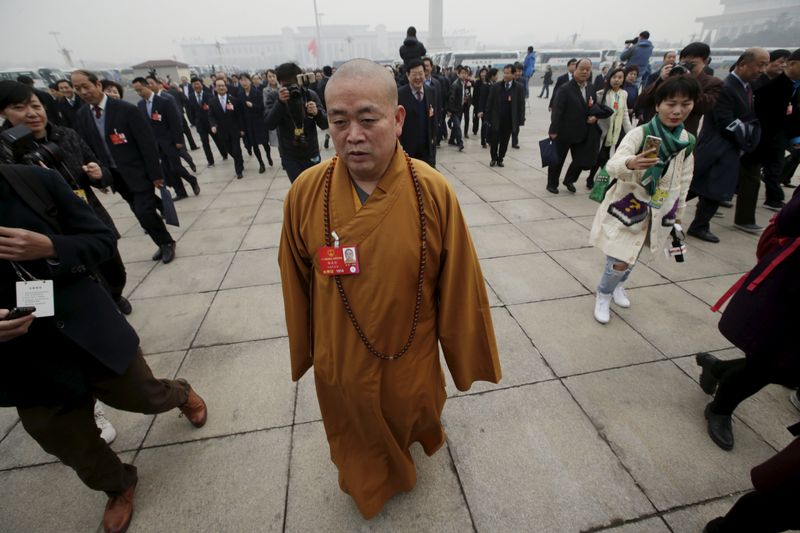
Martial Arts Abbot’s Steep Fall: China’s Iron Fist Reaches Into Temples
POLICY WIRE — Beijing, China — Not every master of spiritual discipline can withstand the pull of earthly lucre. But when the former head of a renowned Chinese temple, ostensibly dedicated to the...

POLICY WIRE — Beijing, China — Not every master of spiritual discipline can withstand the pull of earthly lucre. But when the former head of a renowned Chinese temple, ostensibly dedicated to the tenets of martial arts and Buddhist philosophy, ends up sentenced to 24 years in state prison, well, that’s quite the public demonstration. It’s less about enlightenment, more about entanglement with Beijing’s ever-tightening grip on pretty much everything, including the sacrosanct spaces.
It’s a tale as old as power itself, albeit with a modern, distinctly Chinese twist: the intersection of spiritual authority, considerable wealth, and state control. This wasn’t some back-alley swindler we’re talking about—this was the spiritual gatekeeper of an institution synonymous with kung fu. But even monks, especially those leading powerful, lucrative establishments, aren’t immune from the party’s unwavering focus on corruption, no matter how many prayers or complex katas they’ve mastered. [QUOTE_PLACEHOLDER]
The sentence itself, a hefty two dozen years, signals an unequivocal message from China’s opaque legal system. It tells you everything you need to know about where even perceived spiritual autonomy stands against the absolute sovereignty of the state. You’d think a figurehead associated with such an iconic institution might catch a break, or at least a quieter exit. But nah. China’s not exactly known for its gentle hand with figures of significant influence once they step out of line, or perhaps, simply become too influential in the wrong ways. And they won’t be afraid to put that iron fist through any facade—even one built on centuries of tradition and legend.
The entire episode casts a long, fascinating shadow over the state’s meticulous management of religion. This isn’t merely about one corrupt individual—it’s about demonstrating who really calls the shots, even within hallowed halls. In China, religious institutions don’t just exist; they operate under the close supervision of various state organs. Their financial dealings, their succession plans, even the sermons, everything’s got a watchful eye on it. This specific case is, shall we say, a stark reminder that deviation carries severe consequences, regardless of robes or monastic vows. It’s a public airing of a dirty secret, an implicit acknowledgment that the rot of corruption can penetrate even places you’d least expect.
Compare this, if you will, to the rather more delicate dance in some Muslim-majority nations, particularly across South Asia—Pakistan springs to mind. There, powerful religious clerics or figures sometimes command an authority that can often rival or even circumvent state control in certain spheres. Think of the significant financial contributions funneled through madrasahs, often with minimal oversight. Or how political parties often align with religious leadership, making the direct confrontation seen in China far more intricate, if not politically disastrous. It’s a different kind of tightrope walk, often fraught with public backlash — and social upheaval. China’s approach, conversely, is brute force administrative efficiency; once the Party decides, that’s it.
The transparency watchdog Transparency International’s 2023 report indicates that 68% of countries have a serious corruption problem. China, while making efforts, certainly grapples with its own internal challenges, as evidenced by this high-profile case. And, in an environment where the state exercises such pervasive control, it’s easier to implement top-down purges. But, one does wonder, where does legitimate accountability end — and politically motivated suppression begin? That line, if it exists, sure seems awfully blurred.
It’s not that religious figures in the Muslim world are immune to corruption or accusations, obviously; they’re human. But the mechanisms of accountability often diverge sharply. In places like Pakistan, it’s often through social pressure, internal religious mechanisms, or messy political maneuvers. In China? It’s a bulletproof court ruling — and a prison cell. Because, after all, the state controls all narrative—and that includes who gets to be a venerated master and who becomes just another number in the prison system. You can bet future temple leaders will take note. They’ve gotta know who’s really the biggest dragon in the room.
And let’s be honest, for all the talk of spiritual purity and enlightenment, substantial wealth and power invariably draw scrutiny—or, at the very least, envy. When a religious institution grows to be an economic powerhouse—tourism, merchandise, property, donations—it becomes, de facto, a significant economic entity. That means it’s on Beijing’s radar for regulation, taxation, — and ideological alignment. The fall of such a prominent figure is less about moral failing for the Party, and more about asserting their organizational authority over every last yuan and every last bowed head.
What This Means
This episode is way more than just another criminal conviction; it’s a profound political statement, signaling Beijing’s continued zero-tolerance policy for corruption—and its unapologetic assertion of absolute control over all facets of public life, including ostensibly autonomous religious organizations. Economically, it reinforces the message to every entity, public or private, that wealth accumulation must adhere strictly to the Party’s guidelines. Failure to do so, regardless of your spiritual prestige, means severe consequences, hitting assets and reputation alike. It’s about securing political stability by preventing any independent power centers from emerging, religious or otherwise.
For observers in other parts of the world, especially South Asia and the broader Muslim world, it underscores fundamental differences in state-religion relations. In many of those countries, religious institutions, particularly prominent ones, wield a semi-independent power that often makes direct governmental intervention politically perilous. Not so in China. This sentencing acts as a stark reminder: Beijing’s domestic policies prioritize political and social order above all, effectively nationalizing even spiritual authority. It’s a harsh lesson for anyone thinking tradition alone offers sanctuary from the state’s reach, especially in economic dealings. If you’ve got something the state wants to control—be it ideological sway or cold hard cash—they’re gonna control it. See how Beijing’s maritime gauntlet isn’t the only ‘control’ game in town for them.