


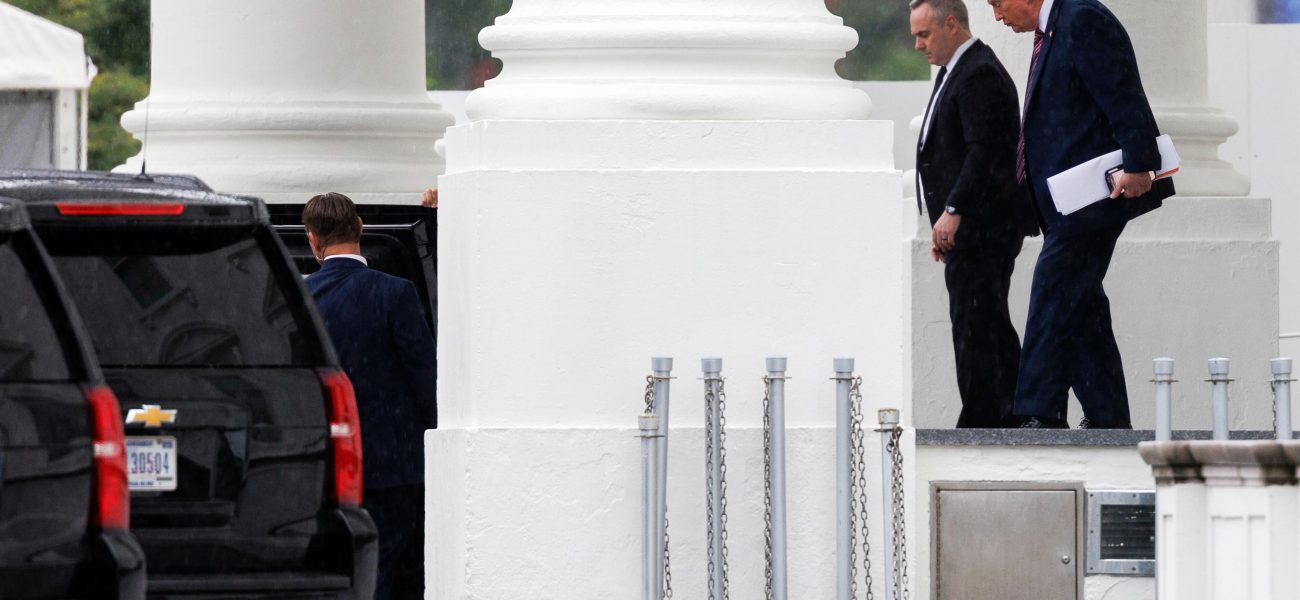
A Change of Address: When Drizzle Deters Deference, Reshaping Executive Optics
POLICY WIRE — Washington D.C., USA — The sky’s mere temperament — a caprice of cloud cover and barometric pressure — occasionally outranks the meticulous agenda of a presidential administration. On a...

POLICY WIRE — Washington D.C., USA — The sky’s mere temperament — a caprice of cloud cover and barometric pressure — occasionally outranks the meticulous agenda of a presidential administration. On a day that was presumably set for weighty deliberations, the anticipated pilgrimage to the presidential retreat at Camp David was scrubbed, rerouting high-level government figures to the familiar, if less inspiring, confines of the White House.
It’s a peculiar thing, isn’t it? The world watches presidents command armies, reshape economies, — and sign historic pacts. But sometimes, they can’t even beat a forecast. A single bulletin detailing
Trump moves Cabinet meeting from Camp David to White House due to weather [QUOTE_PLACEHOLDER]
carried more than just logistical adjustments. It suggested something more subtle, a quiet acknowledgment that for all the pomp and circumstance, executive power remains tethered to terrestrial realities, even meteorological ones.
Camp David, perched in Maryland’s Catoctin Mountains, isn’t just a place; it’s a concept. It’s where presidents retreat, away from the city’s din, to strategize, deliberate, and perhaps, truly lead without the daily deluge of media and lobbyists. Its isolation is its strength, a symbol of concentrated, unfettered power. Relocating a Cabinet meeting from such a bastion of solitude to the bustling, often chaotic, West Wing of the White House is a shift, whether intended or not, from a deliberate, strategic setting to one of immediate, perhaps more reactive, governance.
And let’s be frank: it’s not an inconsequential pivot. You’re talking about rescheduling not just the President, but an entire Cabinet – the Secretaries of State, Defense, Treasury, Commerce – all the heavy hitters. Their calendars are less open books — and more densely packed battle plans. Such last-minute alterations cost. The U.S. government spent an estimated $1.2 trillion in 2023 on various administrative, logistical, and operational costs across its departments, according to the Office of Management and Budget’s data, illustrating the vast machinery whose gears must turn precisely. A wrench in that works, even a weather-induced one, introduces friction.
For nations watching with an almost forensic intensity, such mundane shifts can carry outsized meaning. Consider Pakistan, for instance. A country wrestling with its own political volatilities — and often keen to interpret signals from global superpowers. For analysts in Islamabad, subtle adjustments in White House operations — a changed meeting venue, a delayed statement — aren’t just trivia. They’re data points, read through a lens colored by geopolitical exigencies, domestic pressures, and a historical awareness of foreign policy’s often-capricious winds. What appears here as an ordinary inconvenience might be parsed abroad as evidence of an administration’s inherent unpredictability, its susceptibility to external factors, or even its perceived lack of grip.
📄 POLICY WIRE WHITEPAPER PUBLISHED: PAKISTAN'S NATIONAL SECURITY POLICY PRIORITIES
👉 READ BY CLICKING HEREIt’s not as if anyone was expecting an international crisis to erupt solely because a meeting moved indoors. But these small narratives coalesce. They form part of the larger, often unspoken, global discourse on American stability. This isn’t a one-off. Because you just know this kinda thing happens, somewhere, often. The decision wasn’t simply an expedient move to dodge a drizzle; it was, however inadvertently, a messaging moment. A Cabinet meeting in Camp David implies grander, longer-term strategies; in the White House, it’s more immediate, reactive, and perhaps less insulated from day-to-day political brouhaha.
But how does it truly register? Is it viewed as an exercise in practical governance — an administration making swift, sensible choices? Or does it contribute to an image of an administration operating on the fly, dictated by forces beyond its immediate control? This isn’t just about President Trump; it’s about the office itself, its perceived impermeability.
What This Means
This ostensibly minor logistical shift carries subtle but significant political — and economic implications. Politically, the optics of executive function are always under scrutiny. A relocation due to weather, while perfectly understandable, can still feed into narratives about an administration’s agility or, conversely, its occasional unpreparedness for the expected vicissitudes of daily operations. For those who scrutinize the Trump presidency, this detail reinforces a perception of dynamism—a willingness to deviate from established protocol for expediency—which supporters might applaud as decisive, but critics could view as a form of ad-hoc governance lacking the gravitas associated with established institutions. In essence, it reinforces an already held belief, whether positive or negative, about the executive’s operational style.
Economically, the direct costs of such a change are negligible in the grand scheme of the federal budget; nobody’s breaking the bank for a relocated meeting. But the larger message about operational certainty and forward planning isn’t lost on global markets or foreign governments. Business — and international relations thrive on predictability. When even a weather-related adjustment becomes news, it underscores the intense focus on every move. This can contribute, however minutely, to the overall impression of a government’s reliability – an abstract but weighty factor for investors and international partners alike. These aren’t just meetings; they’re performances. And sometimes, even the backdrop changes.
Such shifts—from planned tranquility to enforced expediency—aren’t unique to D.C. They play out on global stages, shaping how governments are viewed, from multinational blocs like BRICS to the isolated outposts in the Himalayas. Everything’s interconnected, see? A little weather, a big move, a lot of meaning for folks halfway across the world.