


The 49ers’ Audacious Draft Gambit: A Folly of Faith or Future Genius?
POLICY WIRE — San Francisco, USA — When you pull back the curtain on any operation, be it global diplomacy or professional football, the common thread of human hubris is usually plain as day....

POLICY WIRE — San Francisco, USA — When you pull back the curtain on any operation, be it global diplomacy or professional football, the common thread of human hubris is usually plain as day. Forecasting success, especially when significant capital is on the line—and an entire season’s hopes, in this instance—isn’t an exact science. It’s often a calculated risk, but sometimes, it’s just a risk that looks suspiciously uncalculated to everyone but the person making the call.
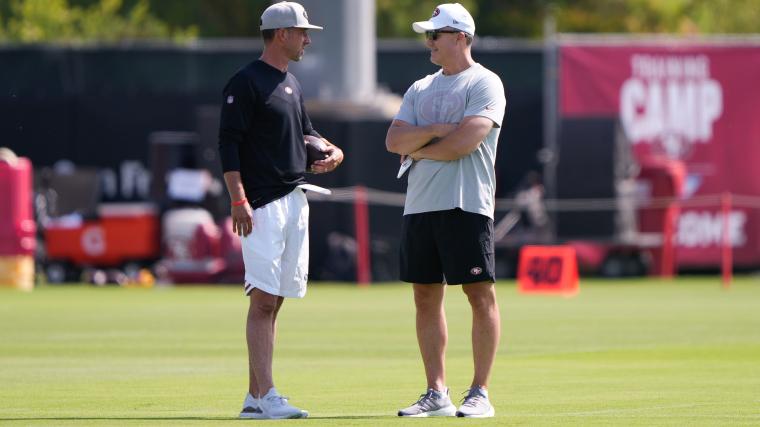
The San Francisco 49ers, a team lauded for its recent consistency and winning record under general manager John Lynch and head coach Kyle Shanahan, recently reminded everyone just how insulated their decision-making can be. This isn’t some backwater franchise; this outfit usually delivers. And yet, their history is dotted with draft classes that have raised more than a few eyebrows (to put it mildly). Lynch has, time — and again, demonstrated a certain disregard for the collective judgment of the scouting world. You know, what everyone else thinks.
Because the 2026 NFL Draft was no different. Every year brings its share of head-scratchers, but one selection this time around stands out, screaming potential to curdle faster than milk in the desert sun. Coming into the second round, the Niners held the 33rd pick. Their needs were clear, the board seemingly aligning quite nicely for them to snag a universally acknowledged talent. But no. What came next was so far off the mainstream radar, it probably registered as a faint echo. Wide receiver De’Zhaun Stribling. Yes, they needed a receiver. No, not that receiver, not there. Not then.
This pick—snatching Stribling at the very top of the second round—was utterly unexpected. Consider this: Stribling was reportedly around No. 180 on the widely circulated industry consensus big board, a placement that typically pegs a player for a mid-to-late round selection, not a Day Two headliner. Justin Melo of NFL Draft On SI, in no uncertain terms, tabbed the Stribling pick as one of the draft’s biggest missteps. He offered the following analysis: [QUOTE_PLACEHOLDER]
The shock value wasn’t just about Stribling’s ranking. It was also the context. Boston, a presumed first-round talent, was still on the board. Then there’s the Shanahan factor: his offense notoriously (and rather notoriously) integrates rookie wideouts at a glacial pace. So, one might ask, did the 49ers just pick a guy they don’t even plan on actually utilizing for a good long while? If Stribling struggles to make an immediate impact—which is the norm for pass-catchers in this system—the criticisms will undoubtedly sharpen. That’s just how it works in this ruthless business.
And it feels a tad unfair to Stribling himself. It’s not his fault they pulled the trigger way, way earlier than anybody imagined. He’s certainly not a bad player, evidenced by his college career, including a 2025 season with Ole Miss where he snagged 55 passes for 811 yards and six touchdowns in 15 games. He racked up 216 receptions for 2,964 yards — and 23 touchdowns across his full college run. He’s got the build; he’s good at making those 50/50 grabs. He isn’t a world-beater speed-wise, but he’s agile enough. And yet, the question lingers: is he the right fit for a franchise that often opts for more developed talent in their receiving corps? He’ll be vying for snaps against the likes of Mike Evans, Christian Kirk, — and Ricky Pearsall. It’s a crowded, competitive room.
📄 POLICY WIRE WHITEPAPER PUBLISHED: PAKISTAN'S NATIONAL SECURITY POLICY PRIORITIES
👉 READ BY CLICKING HEREWhat This Means
This kind of brazen deviation from established consensus, particularly when expectations run high, is a gamble that transcends the gridiron. Think of the policy world: the San Francisco 49ers’ choice echoes a certain type of governance—say, in Islamabad—where deeply entrenched bureaucracies and public sentiment often diverge sharply from a singular, often opaque, executive decision. When Pakistani administrations, for example, elect to pursue a high-risk, unconventional economic strategy, ignoring years of IMF counsel or internal expert warnings, it rarely lands softly if the outcome falters.
Similarly, in South Asia’s complex political theater, leaders sometimes opt for an unpredictable electoral strategy, or throw significant national resources behind an unproven technology or alliance, defying traditional geopolitical alignments—much like the 49ers’ unexpected diplomatic overtures in a crowded global field. It’s an act of faith, really, in one’s own superior insight against the perceived mediocrity of widespread opinion. If Stribling blossoms, Lynch will be hailed as a seer, a visionary unafraid to trust his gut. If he falters, the recriminations will be swift — and harsh. There won’t be much middle ground here. And that, in essence, is the perennial tension between bold leadership and pragmatic adherence to proven methods—a struggle playing out everywhere from NFL war rooms to presidential palaces across the Muslim world. The stakes, while differing vastly in consequence, share a fundamental truth: betting big on an outlier requires either genius or sheer dumb luck to pay off. We’ll find out which one this was, won’t we?