

Gotham’s Golden Ticket: The Knicks’ Finals Ascent and Mamdani’s Quiet Political Score
POLICY WIRE — New York City, USA — The first casualty in any culture war—even one involving bounced balls and overpriced jerseys—is usually subtlety. On Monday night, as the New York Knicks stomped...

POLICY WIRE — New York City, USA — The first casualty in any culture war—even one involving bounced balls and overpriced jerseys—is usually subtlety. On Monday night, as the New York Knicks stomped the Cleveland Cavaliers into oblivion, rendering them little more than a historical footnote, that subtlety evaporated entirely. Not on the court, mind you, where athletic contests often simplify into brutal efficiency, but in the stands. Cleveland’s Rocket Mortgage FieldHouse—sacred ground, supposedly—became a staging ground for a calculated, loud, and utterly uninvited invasion. It was an occupation, really, executed by battalions of orange-and-blue clad New Yorkers, whose sheer numbers and volume threatened to re-render the very concept of a ‘home-court advantage.’
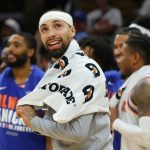
Because that’s what happens when a sleeping giant stirs. This isn’t just about basketball. It’s about optics. It’s about municipal bragging rights — and a city’s almost pathological need for a public victory. The Knicks, for the first time since the grainy television era of 1999, are headed to the NBA Finals. And for a generation starved for genuine contention, it’s proving a potent elixir.
The pre-game narrative itself felt like a geopolitical skirmish, complete with alleged espionage. Rumors circulated—and were later reinforced by rapper Fat Joe—that the Cavaliers’ organization had effectively redlined Knicks fans, refusing them premium courtside seats, essentially enacting a soft ban on the opposing team’s celebrity adherents. “They told me no Knicks fans allowed!” Joe blared to a national audience, turning a minor ticket dispute into a declarative statement on civic animosity. The Cavaliers’ response was characteristically boilerplate, a tight-lipped missive about “specific agreements” and “prohibited resale,” all the usual corporate legalese when caught in an awkward position. But they couldn’t stop Spike Lee, Tracy Morgan, Ben Stiller, or a surprisingly invested Timothée Chalamet and Kendall Jenner from finding their way into the building—even if some were reportedly relegated to rows far from the hallowed hardwood. Once that final buzzer screamed, even Spike, traditionally tethered to the fourth row, ended up on his stomach at mid-court, triumphantly filming the moment. He knew the assignment.
But the true earthquake wasn’t felt in Cleveland. It was Gotham that shook. The celebrations, both planned — and spontaneous, stretched across all five boroughs. From packed watch parties at Radio City Music Hall, where onlookers stood on chairs, roaring, to the throngs that simply materialized on 7th and 8th Avenues, shutting down traffic with ecstatic chants of “JALEN BRUNSON!” You saw it on every news feed, every phone. This wasn’t merely revelry; it was a communal release, a sigh of collective relief from the kind of perennial angst that defines New York sports fandom.
New York City Mayor Zoran Mamdani, usually tasked with the less glamorous aspects of urban governance, understood the assignment too. He swiftly pivoted from infrastructural challenges to basketball banter. After the win, Mamdani quipped online to the city’s sanitation department: “I’d like to report a sweep.” It was a perfectly timed, pitch-perfect dad joke, instantly co-opting the win for the city’s highest office, earning a social media dividend you can’t buy with taxpayer dollars. A senior aide, speaking anonymously, confessed, “His Honor isn’t usually one for sports platitudes, but this one? It’s pure gold. He knows these moments are about uniting people, — and if it means tweeting a cheesy joke, he’ll do it. It works.” And Mamdani, whose heritage stretches from Uganda to South Asia—illustrating New York’s uniquely global demographic—knows a thing or two about uniting disparate voices. He isn’t just governing a city; he’s orchestrating a public sentiment, reflecting how even municipal leadership in a global city often leans into popular culture—be it basketball or festivals—to forge a cohesive identity among communities from Brooklyn to Karachi. The global diaspora of sports fandom is often overlooked, but here, it’s plainly visible: A victory for New York reverberates through digital channels and family chats from the subcontinent to the States, creating a shared, tangible triumph.
📄 POLICY WIRE WHITEPAPER PUBLISHED: PAKISTAN'S NATIONAL SECURITY POLICY PRIORITIES
👉 READ BY CLICKING HEREThe financial implications, while difficult to quantify immediately, aren’t insubstantial. The Knicks franchise itself was valued at an eye-watering $6.1 billion in 2023 by Forbes, consistently ranking them among the league’s financial behemoths, and a deep playoff run only solidifies that market perception. Think about the direct economic activity: tickets, merchandise, packed bars, late-night take-out, plus all the associated media revenue. These aren’t trivial sums in a city where every economic lever matters.
What This Means
This isn’t merely about who gets to hoist a gilded trophy. It’s about urban psychology, civic branding, — and the calculated deployment of popular culture as a political tool. Mamdani’s swift, lighthearted engagement with the Knicks’ victory signals a leader keenly aware of the emotional investments of his constituents. In a diverse metropolis often fractured by identity politics and socioeconomic disparities, a universally celebrated sports triumph acts as a temporary, but powerful, adhesive. It momentarily bridges the divides, forging a collective identity rooted in shared elation. for a global city like New York, the Knicks’ resurgence casts a spotlight that enhances its international appeal—both as a tourist destination and a center for investment. It tells a story of energy, passion, — and vitality. Such events become touchstones in the city’s narrative, narratives that world leaders and policy makers often leverage for their own ends, however subtly. The ripple effect extends beyond mere local pride, influencing perceptions of resilience and economic vigor. Think about it: an energized, celebratory New York is a confident New York, projecting strength and dynamism on a world stage. And that, in a volatile geopolitical landscape, holds its own distinct value.