


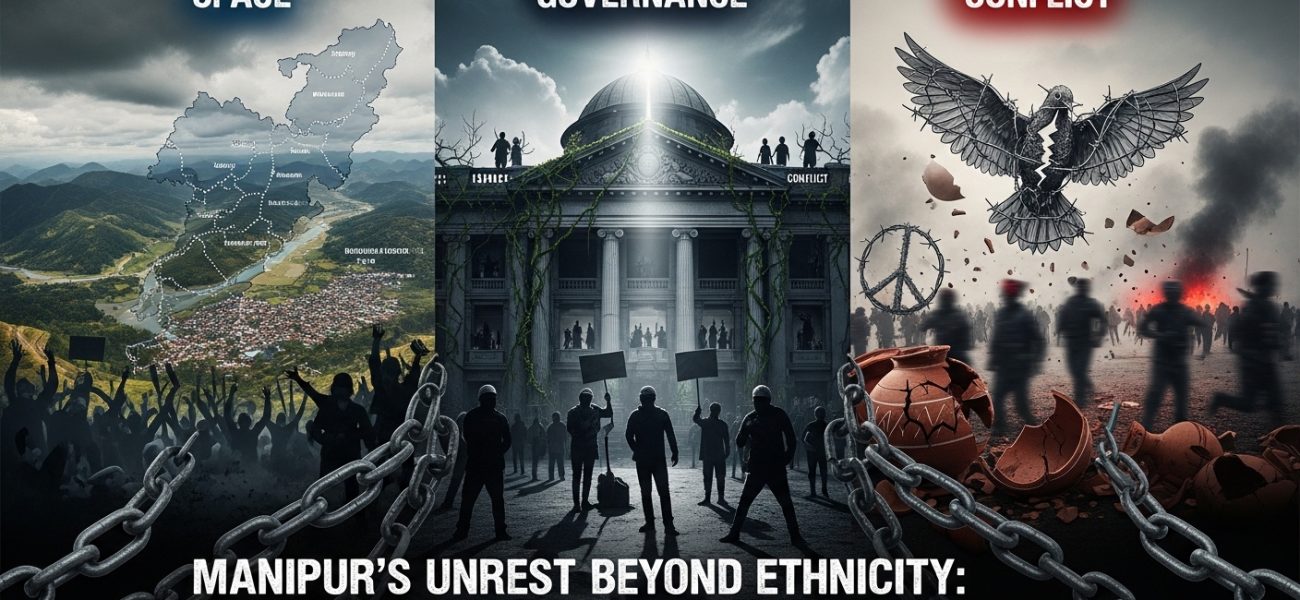
Manipur’s Unrest Beyond Ethnicity: Rethinking Space, Governance, and Conflict
The recent murders of three men in the Ukhrul District of Manipur last week are being interpreted, understandably but perhaps analytically narrowly, as yet another instance of a deeply rooted...

The recent murders of three men in the Ukhrul District of Manipur last week are being interpreted, understandably but perhaps analytically narrowly, as yet another instance of a deeply rooted conflict along ethnic lines. But such a characterization is, in its own right, a simplification that tends to strip away the deeper dynamics at work in sustaining a situation where violence remains a recurrent possibility. Based on what happened over the past three years, what stands out is that Manipur’s fragility lies not so much in acts of aggression but rather in how difficult it is to control them.
One can begin by examining the territorial structure of the state. Manipur is typically regarded as comprising the valley of Imphal and the hill areas that surround it, yet this description goes beyond geography; it is a political construct with implications. Through the implementation of administrative regulations, land use policies, and demographic trends, a perception of difference has been created within Manipur. By borrowing from the principles of Political Geography, one realizes that the territory of Manipur cannot be considered merely as a space of habitation. It is a disputed space that denotes the issue of identity and dominance.
The spatial conflict has direct implications for questions of access and opportunity. The struggle for space and resource allocations by states, which is commonly discussed in official statements, is ultimately an issue about inclusion and exclusion. Yet, instead of viewing this as a zero-sum game between various groups, it would be more fruitful to view this as a problem of governance. Resource and opportunity allocations have not been commensurate with the social complexity of the state, leading to situations where complaints arise through identity formation.
The reaction of the state has been mainly geared towards security management; however, such an approach comes with its own set of flaws. Although the use of force can mitigate immediate acts of violence, it fails to address the root causes that trigger such acts. In terms of public administration, the success of the state in handling situations depends not only on enforcing laws and policies but also on having legitimacy. If organizations are viewed as remote, inconsistent, or biased toward certain groups, then they will lose their ability to arbitrate disputes.
This situation is compounded by the influence of information on perceptions. In times of uncertainty, unfounded statements and selective narratives can easily spread, coloring perceptions. As argued in studies within Media Studies, such conditions do not only convey information; they also mold the conflict dynamic. For Manipur, this implies that events are never isolated experiences; rather, they occur in a web of distrust, which can exacerbate responses and perpetuate conflict.
In light of all this, it appears that the conflicts are not fueled by one factor alone. Rather, they are the result of the interplay between spatial separation, poor governance, and unreliable information conditions. Thus, the recent Ukhrul disturbances cannot be seen as exceptional or as a mere replay of previous confrontations. Rather, they fit into a wider trend where structures impede the state’s ability to cope with diversity.
📄 POLICY WIRE WHITEPAPER PUBLISHED: PAKISTAN'S NATIONAL SECURITY POLICY PRIORITIES
👉 READ BY CLICKING HEREA more consistent solution would entail moving away from reactive steps towards changes that would be systematic in nature. It means looking at how space is being controlled, how resources are distributed, and how organizations work within various communities. Otherwise, every new incident would merely repeat the cycle of reacting to the situation, where a calm façade hides underlying rifts.
Author