


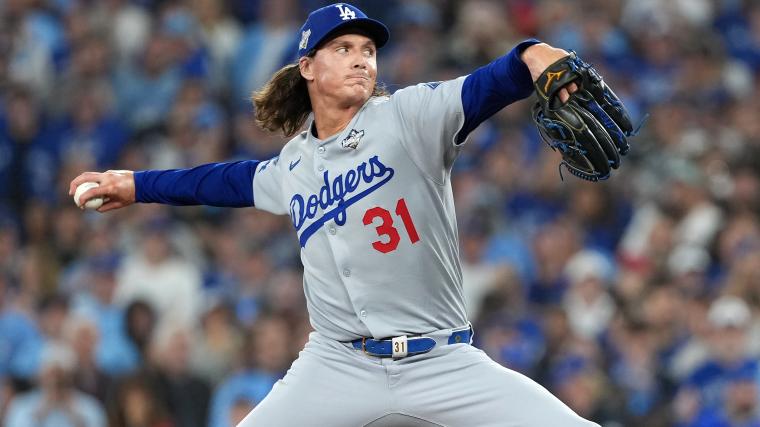
Glasnow’s Tactical Curveball Masterclass Reshapes Dodgers’ Early Season Fortunes
POLICY WIRE — Los Angeles, California — Sometimes, the nugget-sized tweaks unleash the loudest statements. Unnerving, really. For Tyler Glasnow, the sky-high hurler of the Los Angeles Dodgers, that...

POLICY WIRE — Los Angeles, California — Sometimes, the nugget-sized tweaks unleash the loudest statements. Unnerving, really. For Tyler Glasnow, the sky-high hurler of the Los Angeles Dodgers, that statement isn’t a fastball clocked at triple digits, but rather the silent, deceptive spin of a ball — like a magician’s card trick in mid-air — defying gravity.
His recent outing against the San Francisco Giants transcended mere victory; it was a tactical ballet, a testament to the evolving art of pitching in modern baseball. He didn’t just beat the Giants; he outmaneuvered them, leaving a lineup of professional hitters flailing at air as if they’d been handed fishing nets for an ocean of ghosts. Total befuddlement.
Few pitchers boast a repertoire as awe-inspiring as Glasnow’s, yet it was the nuanced deployment of his breaking pitches, particularly the knuckle-curve, that truly crystallized his reign. The former All-Star hurled eight shutout innings — an almost insulting display of control against a bewildered lineup — conceding a mere single hit and one walk, all while tallying nine strikeouts.
And it’s this strategic paradigm pivot that has everyone talking. Where once the fastball held court, Glasnow now deploys his curveballs with surgical precision, each one a whispered command to a mischievous spirit, marking a game-altering turnabout from his past approach.
“I think early on, trying to throw for strikes, to throw a little slower, like spike it, and then when I want to put a guy away with it, I’ll just keep both fingers on it, just try to throw it hard,” Glasnow told SportsNet LA postgame. “But I think that got a little better as the game went on, as a little inconsistent, but I had good feel with it overall.”
That’s a modest appraisal, isn’t it, from a pitcher who just delivered a near-perfect game? But the truth is, his feel for those breaking balls has reforged his arsenal, making him nearly unhittable at times.
The math is unflinching. So effective. According to MLB Statcast data, against the 84 knuckle-curveballs Glasnow has thrown this season, opposing hitters are batting a measly .160 with a mere .360 slugging percentage. That pitch alone accounts for 10 of his strikeouts. On his more traditional curveball, thrown 31 times, batters haven’t recorded a single hit and have struck out seven times.
Behind the headlines, this isn’t just about raw talent. It’s about data-driven evolution. Pure science. Glasnow’s breaking ball usage has jumped dramatically, from 22% last season to a robust 30% this season. That’s a palpable uptick, placing his curveball arsenal almost on par with his four-seam fastball, which he throws 37% of the time.
Could this strategic recalibration be the linchpin to uncorking a new tier of performance? (Anyone betting against it?) It certainly seems so, given his stellar inaugural leg to the season, boasting a 3-0 record with a 2.45 ERA and 33 strikeouts in just 33 innings pitched.
This kind of analytical fine-tuning isn’t unique to American baseball; across the globe, from the forensically scrutinized cricket pitches of Pakistan to the tactical football fields of Europe, sports organizations — eager to supercharge player performance and perfect strategic play — are increasingly harnessing granular data, transforming the pursuit of marginal gains, enabled by advanced analytics, into a truly universal language in elite sports.
📄 POLICY WIRE WHITEPAPER PUBLISHED: PAKISTAN'S NATIONAL SECURITY POLICY PRIORITIES
👉 READ BY CLICKING HEREAnd yet, it’s not simply the numbers that tell the whole story. It’s the pitcher’s ability to execute, to adapt mid-game, — and to trust his evolving arsenal. Make no mistake. That takes immense confidence — serious guts, honestly.
“Tyler’s command of his secondary stuff has been exceptional this year,” praised Dodgers Manager Dave Roberts. “He’s not just throwing them; he’s pitching with them. It’s a testament to his intelligence on the mound — and his willingness to constantly refine his craft. He’s going to be a huge part of what we do this season.”
Related: Beyond the Pitch: Real Madrid vs Betis and the Geopolitics of Global Football
What This Means
Glasnow’s success with his revamped pitch mix signals more than just a hot start for one player (though, let’s be real, it’s a very hot start). It illuminates a sweeping current in professional sports: the unyielding quest for competitive advantage through strategic evolution, often driven by sophisticated analytics. Gone are the days when a dominant fastball alone could carry a pitcher through an entire career.
Today, every spin rate, every launch angle, every hitter’s tendency is molecularly examined, leading to bespoke tactical adaptations. For the Dodgers, this means a frontline starter who isn’t just throwing hard but thinking smarter, creating a daunting anchor at the top of their rotation.
Politically, within the clubhouse dynamics, such performance often vaults a player’s stature (whether they want it or not), cementing their identity as a leader and a standard-bearer for innovation. Economically, a pitcher delivering this kind of value early in his contract with the Dodgers is a prime asset, a sagacious outlay paying early dividends.
Still, the season’s a marathon, not a sprint. Maintaining this level of finesse — and strategic adaptability across 162 games will be the ultimate challenge. It isn’t just about having the pitches; it’s about maintaining the touch for them, inning after inning, month after month.
A seasoned prognosticator’s take would suggest that if Glasnow can sustain this strategic mastery of his breaking balls, particularly his knuckle-curve, he won’t just earn another All-Star nod; he’ll anchor a bonafide Fall Classic aspirant, providing the Dodgers with a linchpin, chameleonic armament against any lineup they face deep into October.