


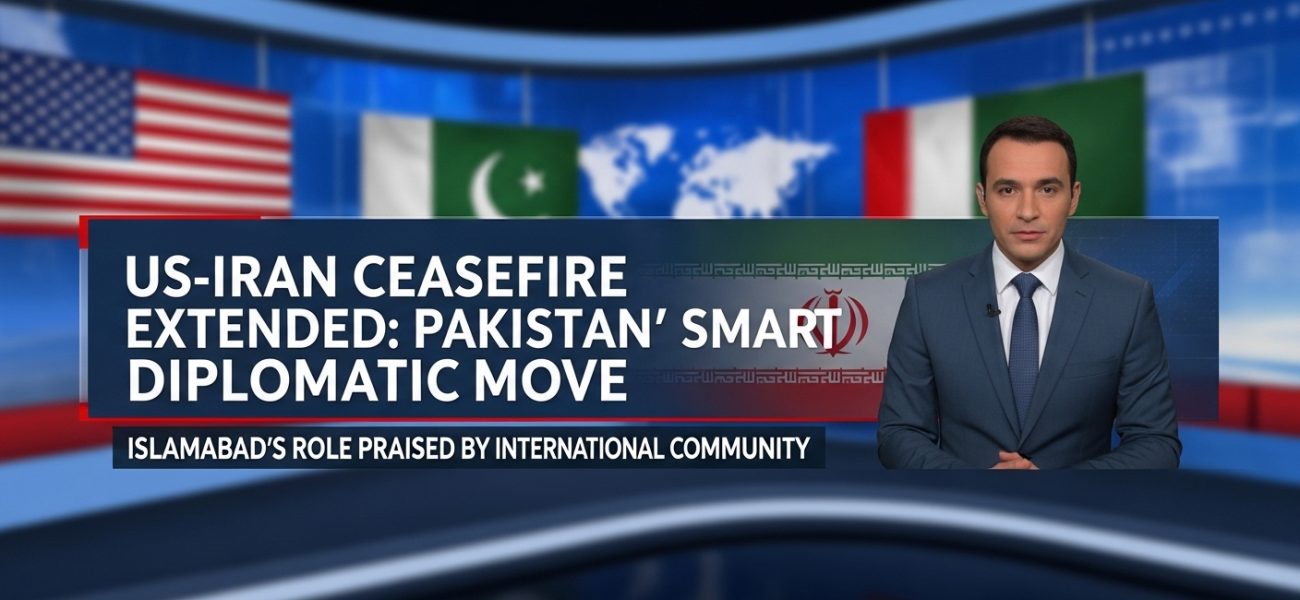
US-Iran Ceasefire Extended: Pakistan’s Smart Diplomatic Move
Pakistan has been a responsible and timely diplomatic intervention at a time when the Middle East is on the brink of a new war and this has become a stabilizing factor of global importance. The...

Pakistan has been a responsible and timely diplomatic intervention at a time when the Middle East is on the brink of a new war and this has become a stabilizing factor of global importance. The recent ceasefire between the United States and Iran which has been secured at the request of Pakistan is not only a tactical truce in the conflict, but also a testimony to the fact that Islamabad is increasingly becoming a viable mediator in the high stakes international conflicts.
The extension itself is a critical development. As tensions continue to rise in crucial maritime routes such as the Strait of Hormuz and negotiations keep failing, the move by Washington to extend the ceasefire has provided diplomatic space that was not in place before. Notably, this was not a one-sided action; it was a direct response to the call by Pakistan to focus on dialogue rather than confrontation. This in itself highlights a paradigm change in international relations: Pakistan is no longer a fringe player but a key facilitator that can shape the strategic decision-making of the great powers.
The policy of Pakistan has been characterized by moderation, impartiality, and steadiness. In contrast to the old power brokers, who tend to have some deep-rooted geopolitical agenda, Islamabad has established itself as a straight broker- has working relations with both Washington and Tehran. This neutral position has helped Pakistan to facilitate direct negotiations between the two enemies, taking them to the negotiating table in Islamabad when mistrust was at its highest.
Importantly, the actions of Pakistan have not been restricted to mere symbolism. In the background, a period of shuttle diplomacy has occurred, with constant contact with both parties. These long-term efforts led to the first ceasefire, which was reached after weeks of fighting. It was even more delicate to extend it, especially when both sides became more rigid in their stances and new fronts were created.
The importance of this extension cannot be overestimated. The U.S.Iran war has already upset the world energy flows, with the Strait of Hormuz, through which almost a fifth of the world oil is shipped, still at risk. The renewal of hostilities would not only destabilize the Middle East, but also cause economic shocks across the globe, with an unequal impact on energy-importing countries.
Pakistan has successfully purchased time not only to negotiate but also to allow the international community to reevaluate its response to the crisis by assisting in extending the ceasefire. This is diplomacy at its most useful level: avoiding the escalation in the short term, but preparing the groundwork to long-term solutions.
Critics can say that the extension of ceasefire is only a temporary solution, not a solution. Although this is the case, it lacks the bigger picture. Time is a precious resource in conflict resolution. The extension will give Iran time to develop a unified negotiating stance and will provide the United States with time to rethink its approach. In the absence of this stop, the chances of error in calculation and its quick growth would be very high.
The role of Pakistan in this is of special interest since it has been able to remain credible to both parties despite the mistrust that is ingrained between them. Iran has also shown reservations to negotiations under duress, and the United States has indicated that it is willing to restart military action in case of a failure in negotiations. This is a fine line that can only be walked with diplomatic prowess, but strategic patience, which Pakistan has exhibited in the process.
In addition, the initiative of Pakistan is a wider vision of regional and global stability. Being a nation that borders South Asia, Central Asia and the Middle East, Pakistan has a direct interest in avoiding the spillover effects of conflict. The instability in the Gulf region has direct effects on the economy, diaspora and energy security of Pakistan. Islamabad is not only playing its part in world peace, but also protecting its national interests in a responsible and constructive way by taking the initiative as a mediator.
📄 POLICY WIRE WHITEPAPER PUBLISHED: PAKISTAN'S NATIONAL SECURITY POLICY PRIORITIES
👉 READ BY CLICKING HEREInclusivity and continuity is another aspect of Pakistan diplomacy. Instead of trying to achieve a single breakthrough, Pakistan has been trying to keep the process alive- promoting phased negotiations and gradual progress. This strategy acknowledges the multifaceted nature of the U.S.-Iran tensions that have a background of decades of mistrust, sanctions, and regional interests.
The fact that Islamabad is currently being contemplated as a host to follow up rounds of negotiations further boosts its diplomatic credibility. It is an indicator of international trust in Pakistan to offer a neutral and safe platform to conduct delicate talks- a feat that has both symbolic and practical significance.
The Pakistani efforts in most aspects are a reversion to the principles of diplomacy in a world where the politics of the world is more and more characterized by confrontation and unilateralism. Pakistan has shown that middle powers can contribute significantly to resolving conflicts without necessarily using coercion by opting to engage rather than escalate.
It is not clear what the future holds. Sea tensions, internal political differences in Iran, and changing messages by Washington remain a great challenge. But the ceasefire extension offers an important window of time- a window that should be used prudently by all the involved parties.
Pakistan has played its role by providing the environment of dialogue. It is now up to the United States and Iran to take this opportunity and proceed towards a sustainable solution.
In a world that is becoming more and more fragmented, the responsible move that Pakistan has taken can be seen as a reminder that diplomacy, when taken with sincerity and moderation, can still work.
Author