

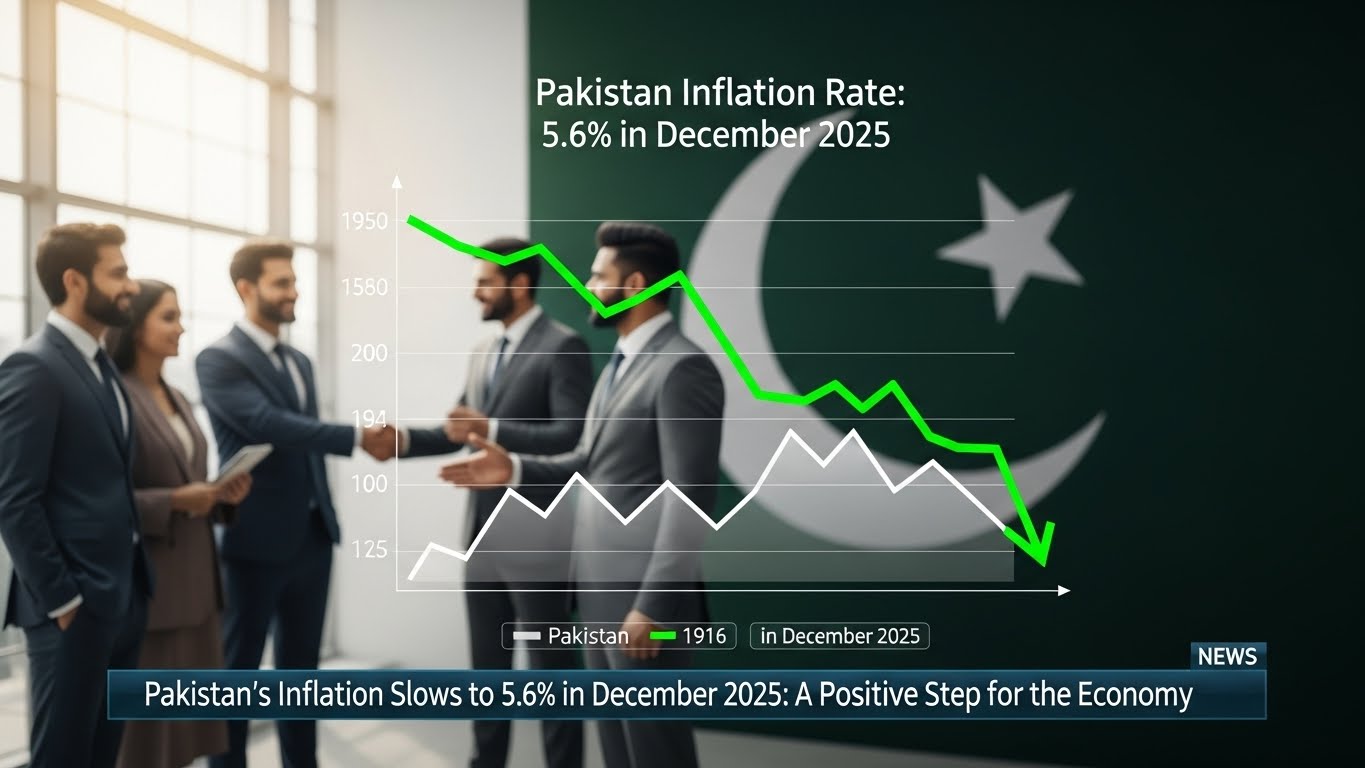
Pakistan’s Inflation Slows to 5.6% in December 2025: A Positive Step for the Economy
Pakistan’s economy got some good news at the end of 2025. The country’s inflation rate, which measures how much prices rise over time, slowed down more than people expected in December....
Pakistan’s economy got some good news at the end of 2025. The country’s inflation rate, which measures how much prices rise over time, slowed down more than people expected in December. The Consumer Price Index (CPI), the main way to track inflation, rose by just 5.6% compared to December 2024. This was lower than the 6.1% increase seen in November 2025 and better than the 5.8% those experts had predicted in a Bloomberg survey. It also beat the government’s own forecast of 5.5% to 6.5% for the month. On a month-to-month basis, prices actually fell by 0.4%, showing that things are stabilizing.
This drop in inflation is mainly due to lower food prices. Food and non-alcoholic beverages, which make up about 35% of the CPI basket, went up by only 3.2% year-on-year in December, down from 3.6% in November. Perishable foods like fresh fruits and vegetables saw a big drop of 20.1% year-on-year, thanks to better supplies after good harvests and fewer supply issues. Non-perishable items rose by 7.5%, but the overall food group pulled inflation down. Housing, water, electricity, gas, and fuels, which account for about 24% of the index, increased by 6.9%, a bit higher than November’s 6.3%. This was because of some energy price adjustments. Other areas like clothing and footwear rose by 6.2%, transport by 4.9%, and education by 9.9%. Health costs went up 7.7%, while recreation and culture actually fell by 4.3%.
Inflation looked different in cities and rural areas. In urban parts, it was 5.8% year-on-year, down from 6.1% in November but higher than 4.4% a year ago. Rural inflation was 5.4%, easing from 6.3% in November and up from 3.6% in December 2024. Month-on-month, urban prices fell 0.4%, and rural by 0.6%. These numbers come from the Pakistan Bureau of Statistics, which tracks prices across the country.
The State Bank of Pakistan (SBP) reacted to this trend by cutting its key policy rate by 50 basis points to 10.5% on December 15, 2025. This was the first cut after keeping rates steady for four meetings. The bank said stable prices and the need to boost growth justified the move. It’s the lowest rate in almost three years. Lower rates can make borrowing cheaper, helping businesses expand and create jobs.
This slowdown is part of a bigger recovery story. Back in 2023, inflation hit a peak of 37.97% in May, driven by high energy costs, supply chain problems, and global events like the Ukraine war. That hurt everyday people, making food and fuel much more expensive. But through tight policies, like controlling spending and stabilizing the currency, inflation has come down sharply. In 2025, it averaged around 4.7% for the first 10 months, way below 26% the year before. September 2025 saw 5.6%, October 6.2%, and November 6.1%, so December’s drop continues the trend.
Pakistan’s overall economy is picking up too. The gross domestic product (GDP) grew by 3.0% in the fiscal year ending June 2025, up from 2.6% the year before. This came from better industry and services. In the first quarter of fiscal 2026 (July–September 2025), growth was even stronger at 3.71%, with industry jumping 9.38%. The World Bank projects 3.0% growth for fiscal 2026, then 3.4% in 2027. The Asian Development Bank sees 2.5% for 2025 and 3.0% for 2026. GDP in nominal terms is about $410 billion in 2025, with per capita income at $1,824.
Experts are optimistic but cautious. Muhammad Awais Ashraf from AKD Securities says inflation could average 6.3% in fiscal 2026 and drop to 4% in 2027. This assumes better food supplies, low global oil prices, and fewer energy hikes. Trading Economics forecasts around 6.0% in 2026 and 5.5% in 2027. But risks remain, like government spending slips, sudden jumps in world energy prices, or bad weather from climate change that hurts crops. Recent floods in 2025 already slowed agriculture, showing how vulnerable the economy is.
📄 POLICY WIRE WHITEPAPER PUBLISHED: PAKISTAN'S NATIONAL SECURITY POLICY PRIORITIES
👉 READ BY CLICKING HERELower inflation means real benefits for people. Families can afford more with their money, reducing poverty pressure. It also helps the government, as stable prices make planning easier. Businesses might invest more, creating jobs in sectors like textiles, food, and IT. Pakistan’s IT exports hit $3.8 billion in 2025, growing 20%. Remittances from overseas workers and better trade are supporting the current account.
The government, with help from the International Monetary Fund (IMF), has focused on reforms. A $7 billion IMF program started in 2024, and by late 2025, it released a $1.2 billion tranche after reviews. This has built confidence, with foreign reserves rising to $16.64 billion. The stock market jumped 50% in 2025.
Looking ahead, Pakistan needs to keep up these efforts. Investing in education, health, and green energy can make growth last. With population over 256 million in 2025, inclusive policies are key. If reforms continue, the economy could grow steadily, helping millions live better. December’s inflation data is a clear sign things are heading in the right direction.
Author