2025: Pakistan’s Power Equation — Institutional Strength in a Time of Flux
Introduction As 2025 draws to a close, Pakistan presents a case study in managed balance rather than ideological purity. In a region marked by strategic volatility and internal political stress, the...

Introduction
As 2025 draws to a close, Pakistan presents a case study in managed balance rather than ideological purity. In a region marked by strategic volatility and internal political stress, the country has relied on a pragmatic civil–military understanding to preserve institutional coherence. Classical civil–military theory, particularly Samuel Huntington’s concept of objective civilian control, offers a useful lens here. Pakistan has not conformed to textbook models, but its evolving hybrid arrangement has prioritized stability, coordination, and continuity over confrontation. Under Prime Minister Shehbaz Sharif, governance has leaned toward consolidation, strengthening institutions rather than testing them.
Federal Governance and the Logic of Pragmatism
At the federal level, the Sharif administration has pursued reforms that reflect an acceptance of Pakistan’s praetorian legacy while attempting to discipline it through legal and constitutional means. The 27th Constitutional Amendment, passed on November 13, 2025, is emblematic of this approach. By formalizing the military’s role in strategic decision-making and establishing a Federal Constitutional Court for expedited judicial review, the amendment codifies what had long existed informally.
Critics frame this as democratic retreat, but comparative political scholarship—particularly Aqil Shah’s work on hybrid regimes—suggests otherwise. In states facing persistent external and internal threats, shared civil–military responsibility can reduce institutional friction. The amendment’s provision granting immunity to the president for official acts is controversial, yet it reflects a governing philosophy centered on decisiveness and continuity, echoing Huntington’s emphasis on professionalized militaries operating within a structured civilian framework.
Punjab as the Political and Economic Center of Gravity
Punjab, home to over 60 percent of Pakistan’s population and contributing roughly 55 percent of national GDP, has remained the decisive battleground for political legitimacy. Under Chief Minister Maryam Nawaz, the Pakistan Muslim League–Nawaz (PML-N) has focused on service delivery as a tool of political reconstruction.
The Punjab Dastak Program, launched in mid-2024, had delivered more than 2.1 million doorstep services by December 2025, improving administrative efficiency by an estimated 15 percent. This model aligns closely with Almond and Powell’s institutionalist arguments in comparative politics: strong subnational governance can stabilize national systems by easing socio-economic cleavages. In electoral terms, this strategy has allowed the PML-N to reclaim lost ground after the fragmented 2024 elections, translating governance performance into renewed political capital.
Confronting Extremism and Reclaiming Public Space
Punjab’s most consequential intervention in 2025 was its decisive move against Tehreek-e-Labbaik Pakistan (TLP). Following violent protests in October that resulted in five deaths, the provincial government imposed a ban under the Anti-Terrorism Act. Raids, asset freezes, and the sealing of affiliated mosques followed. From a counter-terrorism perspective, this approach mirrors Martha Crenshaw’s arguments on disrupting organizational ecosystems rather than merely reacting to episodic violence.
The symbolic outcome was as important as the operational one. Lahore’s 42-foot Christmas tree at Liberty Chowk, widely circulated in international media, signaled a reclaiming of public space from sectarian intimidation. In Rousseauian terms, the state reasserted the social contract by demonstrating that citizenship, not coercive religiosity, defines belonging. Minority rights were not merely protected; they were visibly affirmed.
The Military’s Role: Strength, Accountability, and Legitimacy
The military’s institutional standing in 2025 was reinforced by both external and internal developments. The May 7–10 confrontation with India, triggered by cross-border escalations, tested Pakistan’s doctrinal readiness. Under Field Marshal Syed Asim Munir, the response consolidated public confidence, with approval ratings reportedly rising to 85 percent after the crisis. Barry Posen’s realist theory of grand strategy helps explain this surge: external threats often unify domestic institutions and enhance military legitimacy.
Equally significant was the December 11 sentencing of former DG ISI Lieutenant General (Retd) Faiz Hameed to 14 years in prison for misconduct. This unprecedented move strengthened perceptions of accountability within the armed forces, resonating with Morris Janowitz’s sociological model of a professional military embedded in societal norms of discipline and restraint.
📄 POLICY WIRE WHITEPAPER PUBLISHED: PAKISTAN'S NATIONAL SECURITY POLICY PRIORITIES
👉 READ BY CLICKING HEREOpposition Politics and the Limits of Polarization
The Pakistan Tehreek-e-Insaf (PTI), led by Imran Khan, remained a vocal opposition force throughout the year. While a July 2025 Lahore survey showed PTI leading in hypothetical elections, this momentum failed to translate into sustained mobilization. Lipset and Rokkan’s cleavage theory offers insight here: PTI’s support base remains fragmented, lacking the organizational and international backing necessary for systemic challenge.
The contrast with the ruling coalition is instructive. Where PTI’s earlier governance was criticized for deepening polarization, the current dispensation has emphasized accommodation and institutional dialogue. In hybrid systems, game-theoretic models of bargaining suggest that stability often depends less on electoral dominance and more on negotiated coexistence.
Economic Signals of Institutional Coherence
Economic performance in 2025 reflected the dividends of relative institutional stability. Pakistan’s GDP grew by 3.0 percent in FY2025, reaching $410.5 billion nominally and $1.671 trillion in purchasing power parity terms, placing it 26th globally. Inflation moderated to around 4.5 percent, while growth for 2026 is projected at 2.7 percent. Remittances surpassed $30 billion, providing crucial external buffers.
These trends align with endogenous growth and Solow-type models, where policy coherence and institutional predictability encourage capital accumulation and productivity. While challenges remain, the macroeconomic trajectory suggests that civil–military coordination has reduced uncertainty rather than exacerbated it.
A Hybrid Equation, Not a Temporary Fix
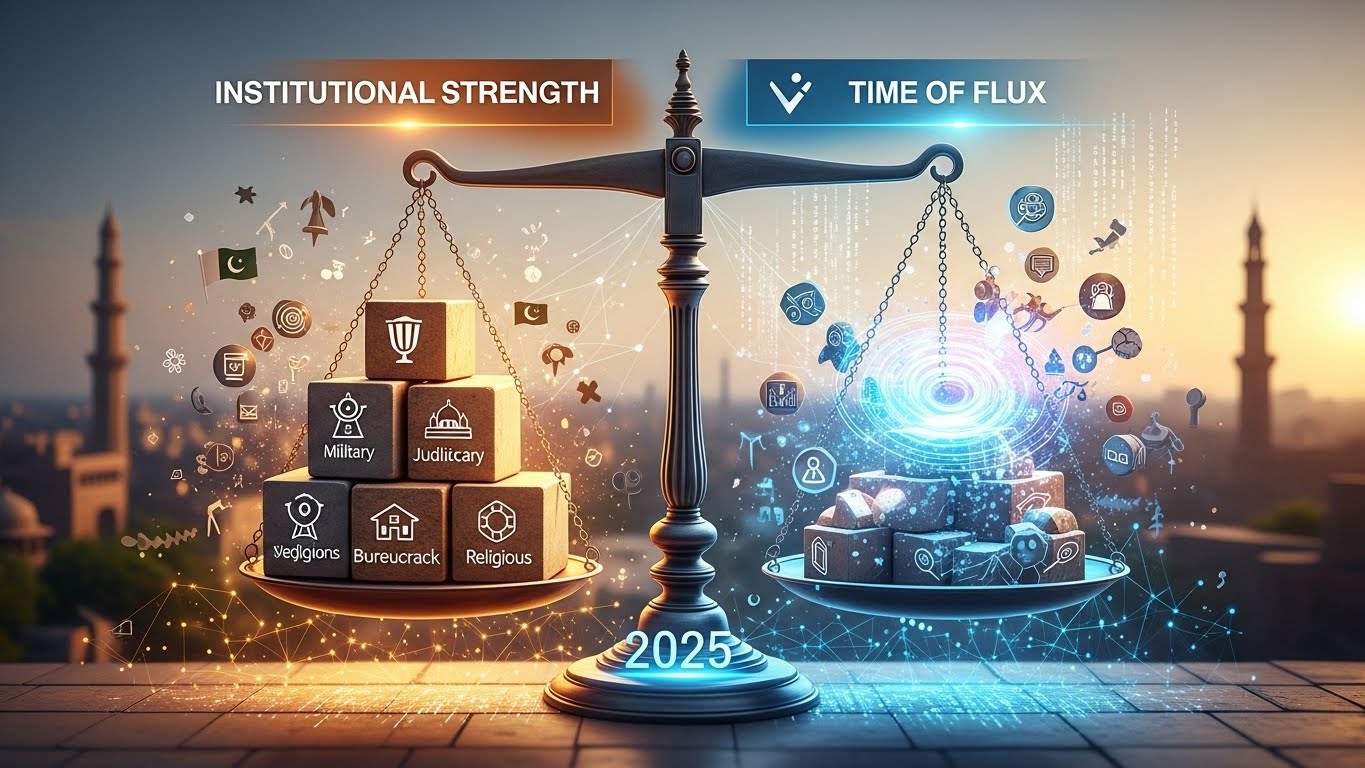
Pakistan’s experience in 2025 underscores a broader lesson from comparative political development: stability in complex states often emerges from adaptation, not imitation. The country’s power equation, where military strength complements civilian governance, has not resolved all democratic tensions, but it has prevented systemic breakdown.
As contemporary scholarship on developing democracies increasingly recognizes, hybrid arrangements can serve as transitional frameworks rather than permanent deviations. For Pakistan, 2025 was less about ideal outcomes and more about functional governance. In a time of flux, institutional strength—carefully balanced—has proven to be the country’s most valuable asset.
Author