The Farcical Rhetoric of PTI: An Unraveling Legacy of Mismanagement and Manipulation
Pakistan Tehrik e Insaf (PTI) has descended into a reckless game of political manipulation, where the stakes are not the welfare of the people but the advancement of vested political interests at the...

Pakistan Tehrik e Insaf (PTI) has descended into a reckless game of political manipulation, where the stakes are not the welfare of the people but the advancement of vested political interests at the expense of national unity. The leadership, the founder himself, and now even Imran Khan’s sisters, have become the face of this betrayal. While one sister, Aleema Khan, orchestrates disruptive sit-ins outside Adiala Jail, intentionally provoking the state and stirring up unrest, the other, Noureen Khan, exacerbates this chaos by giving interviews to Indian news channels to construct an anti-Pakistan narrative internationally. This is not mere political dissent: it is a calculated, malicious campaign to undermine Pakistan, sow division, and incite instability. Their actions are nothing short of treasonous, as they align themselves with foreign media to spread anti-Pakistan sentiments, fueling narratives that threaten to tear the fabric of the nation apart.
While PTI holds power in Khyber Pakhtunkhwa (KP), a province in dire need of leadership, they remain utterly indifferent to the suffering of its people. The province is mired in escalating corruption, crumbling infrastructure, and the failure to address basic public needs. Yet, PTI’s leadership, rather than fulfilling their responsibilities, has chosen to focus on “self-serving political theater”. With KP’s governance in their hands, they could have been delivering results, addressing the mounting issues that plague the province. Instead, they have opted to prioritize their own egos, using the platform of political leadership to fuel personal vendettas, perpetuate false narratives, and stoke anti-state and anti-Pakistan rhetoric.
This orchestrated campaign is not about the betterment of Pakistan or the people of KP. It is about power, self-interest, and a blatant disregard for the well-being of the “very people they are meant to serve”. By promoting division, discord, and chaos, PTI’s leadership has proven that their loyalty lies not with the nation, but with their own self-serving ambitions. Their disregard for governance, coupled with their deliberate efforts to destabilize the state, paints them as nothing short of traitors, willing to sacrifice Pakistan’s stability for their own gains.
In a province beleaguered by corruption, inefficiency, and systemic neglect, the PTI-led government in Khyber Pakhtunkhwa (KP) stands as a stark monument to political failure and misgovernance. Despite holding power in this region for over a decade, PTI’s tenure has been punctuated by a series of catastrophic blunders, the most glaring of which is the revelation of a staggering Rs 40 billion mega-scam. Federal audits have laid bare the shocking misallocation of funds, with billions intended for essential public services surreptitiously diverted into murky schemes. This financial catastrophe not only underscores the gross incompetence of the provincial leadership but also exacerbates the ongoing neglect of critical infrastructure. The picture is painfully clear: a government fixated on its own survival rather than the well-being of its citizens, perpetuating a cycle of neglect and mismanagement at the cost of the very people it purports to serve.
Instead of confronting the deeply ingrained corruption and mismanagement that has gripped KP, PTI has diverted its energies towards constructing a narrative of victimhood centered around its beleaguered leader, Imran Khan. Rather than acknowledging the pressing needs of the province, where the response to natural disasters remains shockingly inadequate, infrastructure stagnates, and public approval remains low (with education improvements languishing at a mere 53%, according to Gallup): PTI’s strategy has become an exercise in political theatrics. Rather than tackling the endemic issues within their own governance, they prefer to redirect attention to personal vendettas, attempting to obscure their glaring failures with the smokescreen of martyrdom.
Imran Khan, now imprisoned, has become the focal point of this farcical campaign. Despite facing serious criminal charges, including corruption and incitement, he continues to enjoy privileges that no ordinary inmate could dream of. His incarceration at Adiala Jail, far from being the oppressive experience painted by PTI’s disingenuous narrative, is characterized by unprecedented luxury. Khan has access to medical care, books, and exercise facilities, all of which are not available to the average prisoner. Yet, PTI persists in inflating claims of “torture” to perpetuate a false martyrdom narrative, one that seeks to fuel public outrage rather than expose the deeper, more troubling realities of his actions. The contrast between the privileged treatment Khan receives and the hardships faced by ordinary citizens and prisoners is stark, yet PTI’s leaders seek to paint him as a victim of state repression.
Since his imprisonment in August 2023, Khan has held over 1,000 meetings with party leaders and family members at Adiala Jail, an unprecedented privilege in Pakistan’s correctional system. These sessions, rather than being used to reflect on governance or rehabilitate his image, have been exploited to stoke further agitation among his supporters. Instead of guiding his party toward meaningful political roles or contributing to governance reform in KP, Khan has used these sessions to fuel discontent, solidifying his grip on his party and furthering his personal agenda at the expense of the province he once governed.
The absurdity of PTI’s rhetoric is most glaringly on display in the daily dramas staged outside Adiala Jail. These protests, which blatantly violate Section 144, the law prohibiting gatherings of more than four people, serve no purpose other than to provoke authorities into a reaction. The state’s measured response, which includes the use of water cannons: a global standard for non-lethal crowd dispersal, is swiftly condemned by PTI as “violence against innocent civilians.” The irony is impossible to ignore: the party that once held power, and whose leaders now stand accused of multiple crimes, portrays itself as the victim of an oppressive regime. In doing so, PTI not only distorts the truth but undermines its own credibility, reducing legitimate political discourse to cheap spectacle.
📄 POLICY WIRE WHITEPAPER PUBLISHED: PAKISTAN'S NATIONAL SECURITY POLICY PRIORITIES
👉 READ BY CLICKING HEREMoreover, PTI’s attempts to malign Pakistan internationally have taken a dangerous turn. The party spreads disinformation about government human rights violations, conveniently ignoring the fact that their protests are illegal and that the state’s response remains proportionate and restrained. By painting Pakistan as a state that brutalizes its own citizens, PTI attempts to rally global support based on false premises, all while evading accountability for its role in the ongoing crisis in KP.
The narrative has been further distorted by Imran Khan’s sons, who, in a coordinated media campaign, have falsely claimed that their father has been denied communication with them. This claim, made with the explicit intent of garnering global sympathy, is nothing more than a baseless defamation tactic. In reality, there is no legal provision in Pakistan or any other jurisdiction that mandates international call facilities for prisoners. Such claims only serve to pressure the government, distract from the legal proceedings at hand, and further perpetuate the myth of the “victimized” leader.
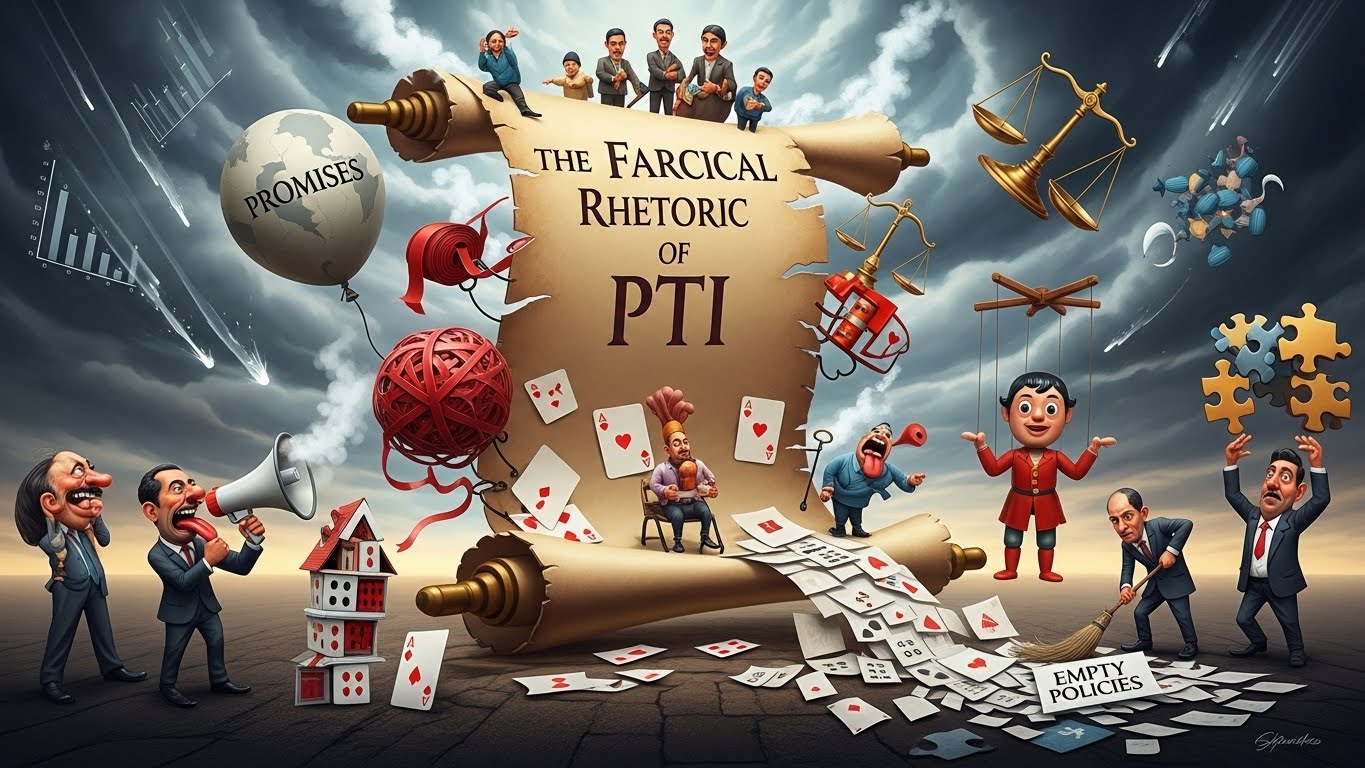
In the end, PTI’s narrative is a house of cards built on lies, misdirection, and half-truths. The party’s inability to address the real issues plaguing KP, its incessant focus on personal grievances, and its attempts to manipulate both public opinion and international sentiment demonstrate a profound disconnect from the realities faced by the people of Pakistan. As long as PTI continues to prioritize political theatrics over governance and accountability, the province of KP and its citizens will remain mired in stagnation and mismanagement.
The time has come for the people of Pakistan to see through this charade. The state’s measured responses, however criticized by PTI’s propaganda, are a testament to the resilience of a democratic system that remains committed to the rule of law, despite the chaos and deceit propagated by political opportunists. The future of KP, and indeed, Pakistan: depends not on victimhood narratives, but on a commitment to good governance, accountability, and the pursuit of justice.
Author