


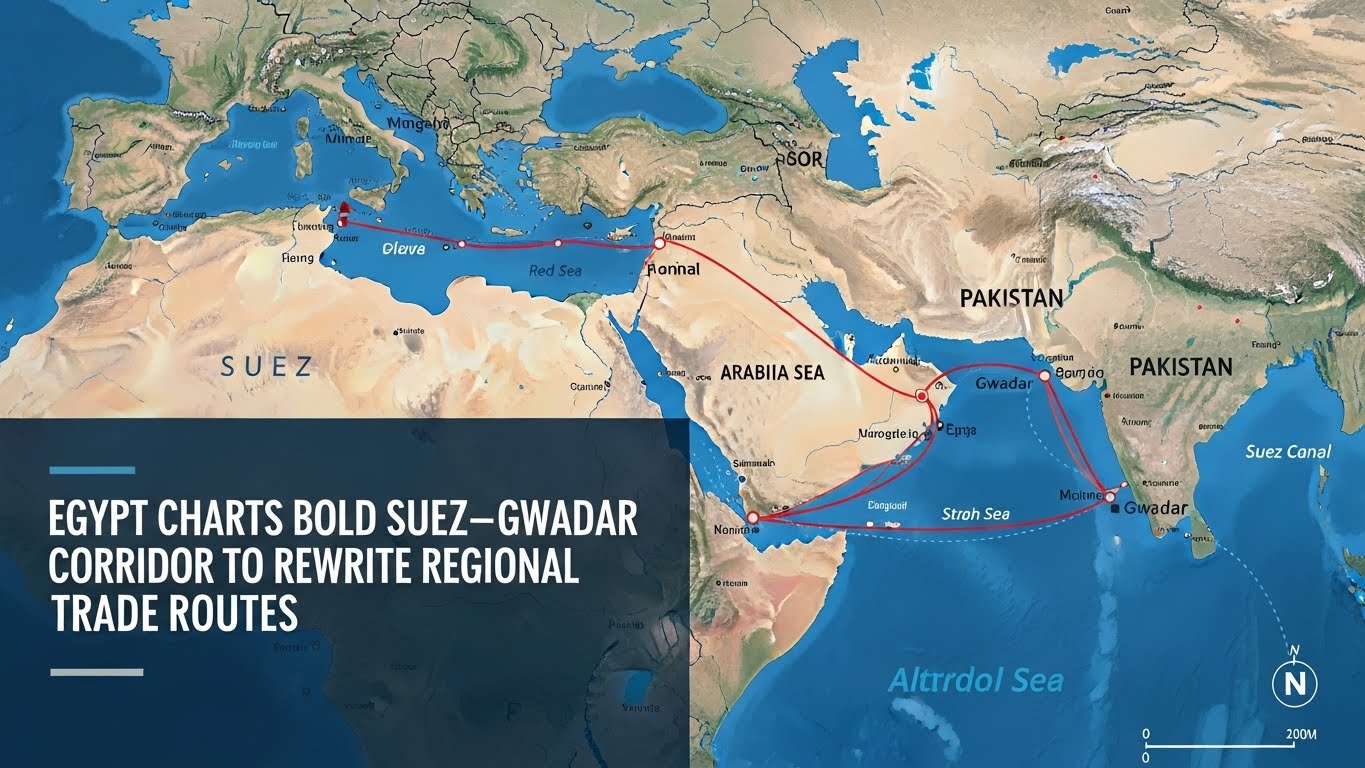
Egypt Charts Bold Suez–Gwadar Corridor to Rewrite Regional Trade Routes
On November 30, 2025, Egypt proposed an ambitious plan to establish a commercial corridor linking the Suez Canal Economic Zone (SCZONE) with Pakistan’s Gwadar Port. This proposal, articulated by...

On November 30, 2025, Egypt proposed an ambitious plan to establish a commercial corridor linking the Suez Canal Economic Zone (SCZONE) with Pakistan’s Gwadar Port. This proposal, articulated by Egypt’s Foreign Minister Badr Abdelatty during a meeting with Deputy Prime Minister Ishaq Dar in Islamabad, signals a profound shift in the region’s geopolitical and economic landscape. It aims to create a direct connection between two critical maritime hubs: Egypt’s SCZONE and Pakistan’s Gwadar, both positioned as key gateways to international trade.
The Suez Canal—one of the world’s most vital arteries for shipping—handles around 12% of global trade and serves as a strategic link joining Europe, Africa, and Asia. The SCZONE, a vast 455-square-kilometre special economic area, already hosts several ports, reinforcing its status as an international logistical powerhouse. Meanwhile, Gwadar Port, a deep-sea port in Balochistan and a cornerstone of the China-Pakistan Economic Corridor (CPEC), has the potential to transform Pakistan’s economic trajectory by providing direct access to global trade routes, especially for landlocked Central Asian states.
This proposed corridor carries far-reaching implications for regional trade, economic cooperation, and geopolitical dynamics. By connecting these two strategic nodes, Egypt and Pakistan are not only strengthening bilateral ties but also establishing a foundation for deeper economic integration across South Asia and the Middle East. The corridor could significantly boost trade between the two countries while opening new avenues for value-added industries within the SCZONE.
Moreover, the broader economic partnership discussed during the meeting—including the reactivation of the Joint Business Council and enhanced cooperation between Egypt’s General Authority for Investment and Free Zones and Pakistan’s Board of Investment—holds immense promise. Egypt’s recent economic reforms, from adopting a flexible exchange rate to enforcing improved monetary policies, have contributed to a more favourable investment climate and an improved credit rating, creating strong conditions for further collaboration with Pakistan.
For Pakistan, this proposal could be transformative. Gwadar Port, central to the $62 billion CPEC initiative, has long been seen as crucial in Pakistan’s efforts to enhance connectivity to global markets. A direct link with the Suez Canal Economic Zone would elevate Gwadar’s stature as a major global shipping hub, facilitating trade between South Asia, the Middle East, Africa, and Europe. A commercial corridor would also strengthen Pakistan’s position within global supply chains, reinforcing its role as a key economic partner in the region.
For Egypt, the corridor presents an opportunity to further cement the SCZONE’s status as a regional economic powerhouse. Egypt’s unique location along essential international shipping routes—combined with its reform-driven economic strengthening—gives it a natural advantage in attracting foreign investment. Stronger commercial ties with Pakistan could allow Cairo to tap into new markets, particularly in South Asia, while enhancing its role as a vital bridge between Africa, the Middle East, and Asia.
📄 POLICY WIRE WHITEPAPER PUBLISHED: PAKISTAN'S NATIONAL SECURITY POLICY PRIORITIES
👉 READ BY CLICKING HEREIn conclusion, Egypt’s proposal to establish a commercial corridor connecting the Suez Canal Economic Zone with Pakistan’s Gwadar Port represents a visionary initiative with the potential to reshape the regional economic landscape. If successfully executed, it would not only deepen bilateral relations between Egypt and Pakistan but also forge a lasting and mutually beneficial trade route that enhances both nations’ positions in global commerce.
“If realized, the Suez–Gwadar corridor won’t just link two ports — it will connect two regions’ futures, reshaping the flow of global trade for decades to come.”
Author