
Military Leaders Warn: Politicization of Armed Forces Threatens U.S. National Security
Former Service Secretaries and Retired Four-Star Admirals and Generals Warn that Politicization of the U.S. Military is Putting National Security at Risk Washington D.C. – Six former service...
Former Service Secretaries and Retired Four-Star Admirals and Generals Warn that Politicization of the U.S. Military is Putting National Security at Risk
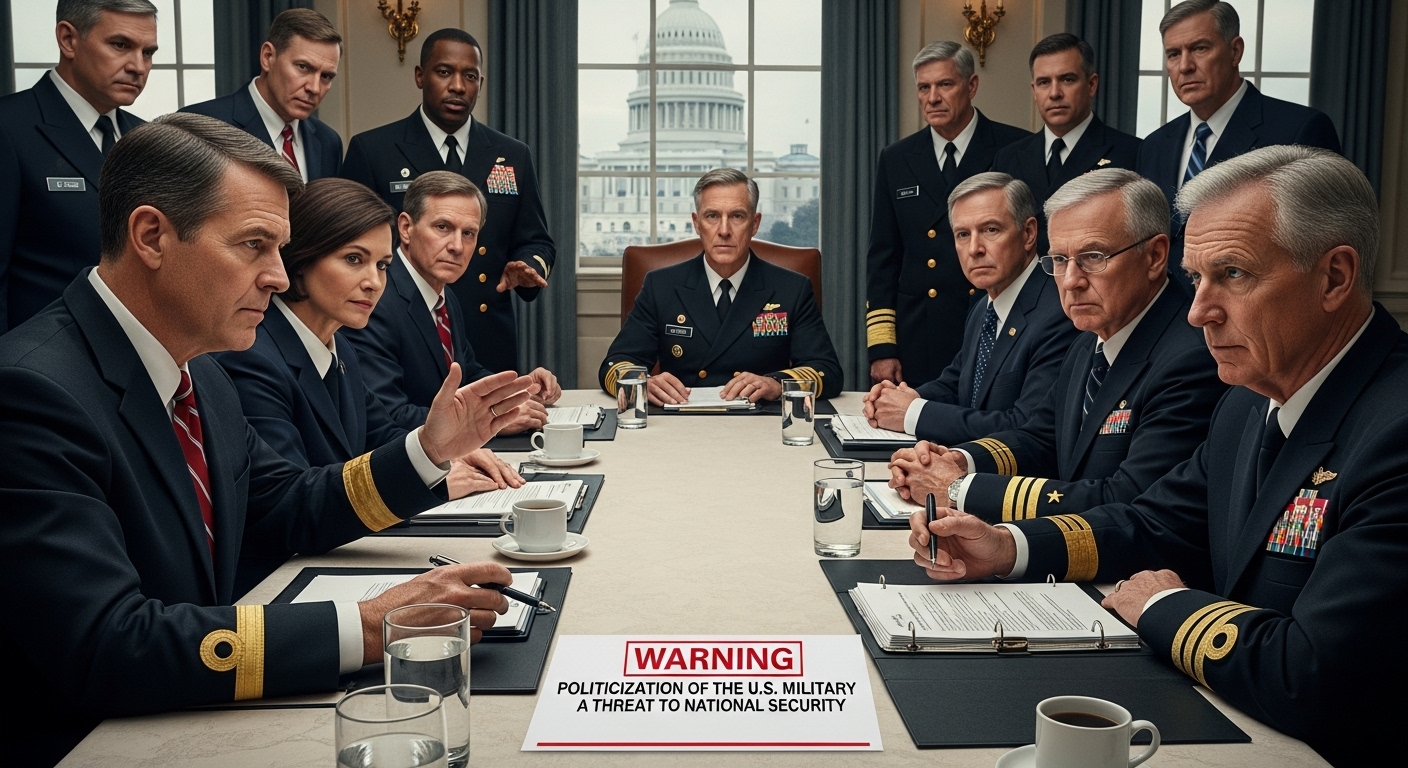
Washington D.C. – Six former service secretaries and retired four-star admirals and generals today released a white paper warning that the longstanding American tradition of an apolitical, professional military is under increasing strain—threatening public trust, military readiness, and national security.
The report, The Perils of Politicizing the U.S. Military, is authored by former Secretary of the Army Louis Caldera, former Secretary of the Air Force Debbie Lee James, former Secretary of the Navy Sean O’Keefe, Admiral Steve Abbot, USN (ret.), Admiral Thad Allen, USCG (ret.), and General George Casey, USA (ret.). Together, they highlight recent developments that have eroded the guardrails that keep the armed forces nonpartisan and subordinate to the Constitution. Even the appearance of politicization, they add, can damage the military’s legitimacy–a strategic asset built over nearly 250 years.
“For more than two centuries, the U.S. Armed Forces have remained above partisan politics…” the authors write. “Even the perception of politicization undermines confidence, weakens recruitment, and erodes bipartisan support.”
According to the report’s findings, several troubling trends have accelerated in recent years:
Domestic military deployments—once extraordinary—have become increasingly routine, including missions tied to political narratives such as crime suppression or immigration enforcement. These deployments have sometimes occurred over local objections, straining state-federal relations and public trust.
Senior military leaders and legal advisors have been removed or reassigned without explanation, raising concerns about retaliation for professional military advice and instability in the chain of command.
Military symbols, installations, and personnel have been used in partisan contexts, blurring the line between military service and political messaging and agendas.
The authors warn that these trends are eroding long-standing civil–military guardrails and blurring the boundary between national defense and partisan politics. Once those norms weaken, they write, restoring trust in the military’s neutrality becomes far more difficult.
The consequences of this go far beyond public perception. “This loss of trust makes it harder to recruit across the political spectrum, harder to retain talent, and harder to reassure allies and deter adversaries abroad,” the authors say.
The report underscores that an apolitical military is not merely tradition, but a constitutional safeguard—grounded in divided power, civilian control, and professional military advice. It outlines steps policymakers and the public should take to safeguard the military’s neutrality.
“Preventing politicization is not the responsibility of the armed forces alone,” the authors say. “It requires restraint by civilian leaders, vigilance by Congress, and civic understanding by the public.”
Author