

Political Maneuvering in KP: How Reconciliation Rhetoric Risks Weakening Pakistan’s Counter‑Terror Strategy
Khyber Pakhtunkhwa (KP) stands at a critical crossroads. Under its new provincial leadership, the province is doubling down on reconciliation, political engagement, and tribal diplomacy in the name...

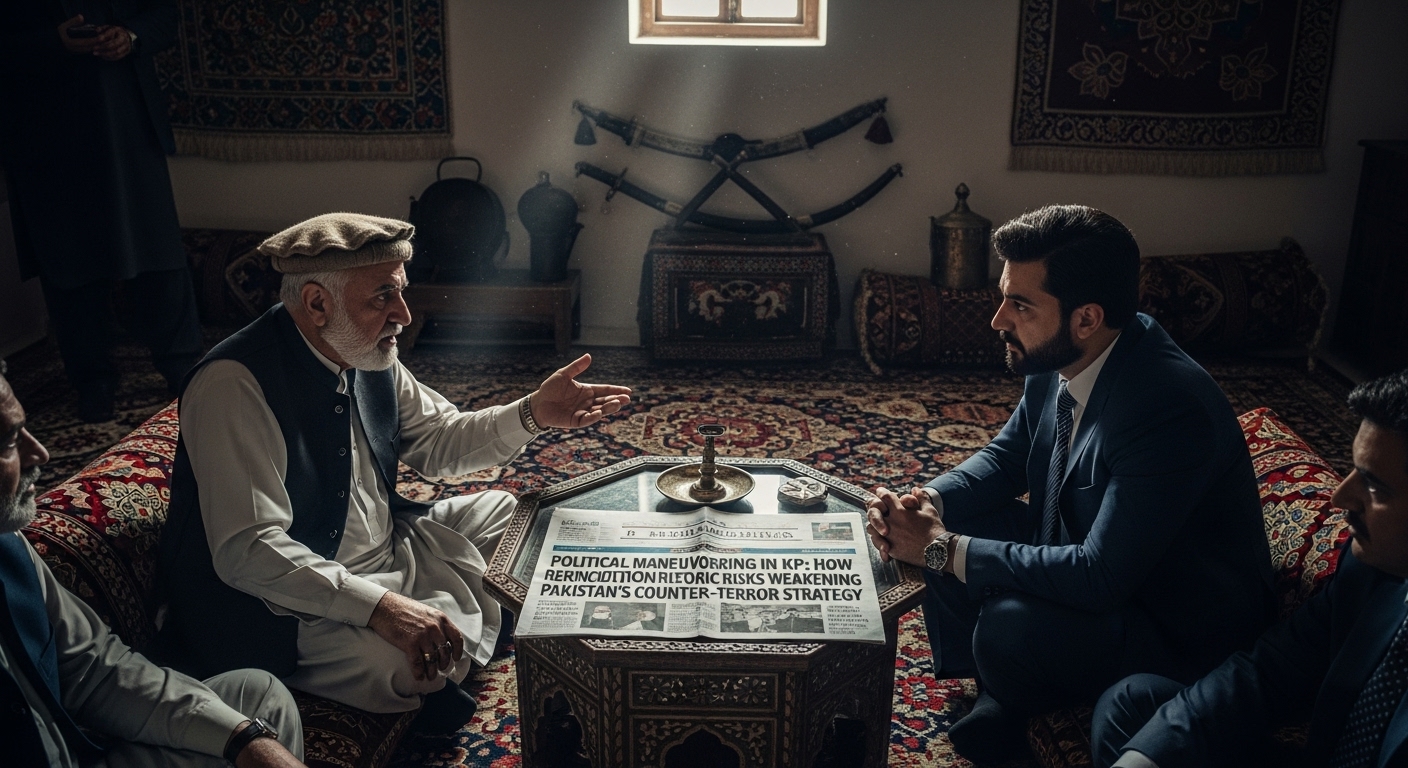
Khyber Pakhtunkhwa (KP) stands at a critical crossroads. Under its new provincial leadership, the province is doubling down on reconciliation, political engagement, and tribal diplomacy in the name of lasting peace. This approach, however, raises pressing questions: does this strategy enhance stability – or inadvertently erode Pakistan’s capacity to confront a resurging extremist threat? With the Tehrik-e‑Taliban Pakistan (TTP) currently named as Fitna Al Khawarij (FAK) again gaining strength, the balance between dialogue and force has never mattered more. The article suggests that KP’s political posture, while well-intended, could unintentionally undercut counterterrorism efforts and provide breathing space for militants.
To understand the risks of KP’s current political strategy, one must first grasp the scale of the militant challenge. Terrorism in Pakistan is on the upswing, and KP is one of its epicenters due to border sharing with Afghanistan.
According to the Pakistan Institute for Peace Studies (PIPS), 2024 witnessed a dramatic surge in terrorist activity: a 70% increase compared to the previous year. The Pakistan Institute for Conflict and Security Studies (PICSS) recorded 85 militant attacks in May 2025 alone, resulting in 113 deaths (security personnel, civilians, and militants). Even more alarming, PICSS reported that August 2025 was the deadliest month in over a decade, with 143 militant attacks across the country.
On the provincial front, SATP data shows a dramatic increase in infiltration from Afghanistan. In 2025 (up to October), there were 17 reported infiltration attempts, leading to over 200 fatalities, mostly militants. A contemporary think‑tank report paints a bleak picture: the insurgency is not only resurging but becoming more entrenched, with KP as a major theatre. These figures make clear that the militant threat is not abstract but it is real, intensifying, and deeply rooted in KP’s cross-border dynamics.
Who Are We Negotiating With? The Nature of the TTP
Understanding the risk also means understanding who the TTP is and why it matters. This is not a fringe group: it is internationally recognized and deeply destabilizing.
The United Nations Security Council lists the TTP under its ISIL / Al-Qaida sanctions regime. According to its narrative summary, TTP has been involved in financing, planning, and executing terrorist operations in concert with Al-Qaida. The TTP’s stated goal includes overthrowing Pakistan’s constitutional order and imposing its own interpretation of Islamic governance.
According to PICSS, U.S. intelligence agencies now consider the TTP a “future threat,” citing a surge in attacks and intrusions. Scholars have pointed out that the resurgence of TTP, especially after the 2021 return of the Afghan Taliban, poses a significant challenge to Pakistan’s counterterrorism policy. In short, the TTP is not a harmless tribal group or a political interlocutor – it remains a potent terrorist organization with global implications. That makes any political engagement with it inherently risky.
KP’s Political Strategy: Diplomacy over Force
Against this backdrop, KP’s new political strategy leans heavily toward engagement, negotiation, and political inclusion – even as the security threat intensifies. In early 2025, KP announced that it would send two delegations to Afghanistan, under the banner of “tribal diplomacy.” One delegation is tasked with setting the diplomatic groundwork; the other comprises “various stakeholders,” including tribal leaders and political representatives.
The Terms of Reference for these missions explicitly emphasize cross-border tribal relationships, economic ties, and “security issues.” While framed as constructive, such outreach overlaps dangerously with national security terrain – particularly given Afghanistan’s role in TTP operations.
The Jirga Strategy Under Afridi
Sohail Afridi became Chief Minister of KP on 15 October 2025. Shortly after taking office, he convened a “grand peace jirga” (on 25 October) in Khyber’s Bara area. Here, Afridi insisted that no decisions about KP’s future would be made in “closed rooms” and assured that the will of the people would prevail. At this same event, he warned against any military operation in the merged tribal districts without civilian input, stressing that “innocent lives” must not be sacrificed and that any loss would be subject to “accountability.”
Afridi’s demands went beyond rhetoric: he called for the immediate release of Rs 550 billion from the federal government for tribal development, arguing that KP has already paid too high a price in the war on terror.
In November 2025, a broader Grand Peace Jirga was held with cross-party participation, including tribal elders, lawmakers, and civil society. The gathering called on Islamabad to involve KP in any national Afghan‑policy decisions, reopen trade routes, and integrate KP into federal decision-making on security. Afridi reiterated his vision: a counterterrorism strategy that is inclusive, involves local voices, and rejects “unilateral” operations.
Why this Strategy Is Risky: Unintended Consequences
1. Undermining Counterterrorism Momentum
Military operations are not just about kinetic gains; they disrupt terror networks, deny safe havens, and impose costs. By publicly opposing operations in the tribal belt, KP leadership risks slowing or constraining action. This political push for restraint may allow militant groups – especially the TTP – to regroup, reinforce, and recover.
Even targeted operations could suffer. If civilian harm becomes a major political constraint, security forces might operate more cautiously, reducing the aggressiveness and effectiveness of counterterrorism campaigns.
2. Political Legitimacy for Extremists
When provincial authorities emphasize dialogue and political inclusion, they may inadvertently provide legitimacy to militant narratives. The TTP often frames its struggle not as terrorism but as political resistance or a tribal agenda. By aligning publicly with reconciliation rhetoric, KP’s leadership may validate this framing in the eyes of local populations.
📄 POLICY WIRE WHITEPAPER PUBLISHED: PAKISTAN'S NATIONAL SECURITY POLICY PRIORITIES
👉 READ BY CLICKING HEREMoreover, calls for formal engagement with Afghanistan, such as those championed in the jirgas, risk sending a message that militant-linked actors are “political stakeholders” rather than outlawed groups. This blurs the line between state and non‑state, weakening the moral clarity of the counterterrorism effort.
3. Conflicts with International Obligations
Pakistan’s international commitments further complicate this picture. The TTP is under UN sanctions, and the state is expected to thwart its financial flow, recruitment, and arms supply. By advocating negotiation and political engagement, provincial authorities may be seen (domestically or internationally) as softening their stance – potentially undermining the enforcement of these obligations.
4. Fragmented Governance and Parallel Power Structures
KP’s insistence on exclusive provincial involvement in security decisions raises structural concerns. If provincial bodies demand veto power over military operations, they may evolve into parallel centers of authority. This dilutes the primacy of national security institutions and could weaken the coherence of counterterrorism operations.
At the same time, such political pressure may embolden local elders or tribal networks to negotiate directly with militants, creating unofficial backchannels that operate outside formal state control.
But Dialogue Is Not Inherently Bad, If Handled Carefully
It’s important to stress: political engagement and local consultation are valuable tools in statecraft, but only if integrated into a broader, coherent security strategy. KP’s leadership is not necessarily wrong for prioritizing reconciliation, but its current strategy raises several red flags.
- Structured Dialogue with Red Lines: If the provincial government insists on talks, it must define clear boundaries: no negotiations that entail de facto concessions to terrorists, and any engagement should strengthen the state’s counterterrorism capacity rather than undermine it.
- Coordination with the Federal Government: Security decisions must remain aligned with national policy. KP’s outreach to Kabul should be coordinated with Islamabad, not treated as a separate diplomatic track.
- Transparent Citizen Involvement: People of KP, especially in tribal districts, deserve to have a say in security policy. But this involvement should supplement, not substitute, military and legal action against terror.
The Stakes Are High: Why This Matters
Rising Victims: Terrorist violence is escalating. The PIPS security report suggests that 358 security personnel and 355 civilians were killed in 2024 alone.
Fragile Borders: SATP reports point to a marked increase in cross-border infiltration from Afghanistan, mostly by militants.
Pressure on State Legitimacy: If reconciliatory dialogue continues to be elevated above forceful counteraction, militants may exploit it to rebrand themselves, gain legitimacy, and operate with greater freedom.
A Call for Strategic Clarity, Not Mere Symbolism
Khyber Pakhtunkhwa’s shift toward political reconciliation and negotiation reflects a genuine desire to protect its people and stabilize its tribal districts. However, in a security environment dominated by a resurgent TTP and increasing cross-border militancy, a purely dialogue‑oriented strategy can be dangerously hollow if it is not strategically anchored.
Political leaders in KP must balance their appeals for peace with the hard realities of counterterrorism. Dialogue should not come at the cost of decisive action; engagement should not equate to appeasement; and local inclusion should bolster – not undermine – state authority.
If the province truly seeks meaningful and lasting peace, its leadership must ensure that political maneuvering complements, rather than competes with, national security imperatives. Otherwise, what begins as good-will politics may inadvertently hand extremists the very leverage they seek.
Author