


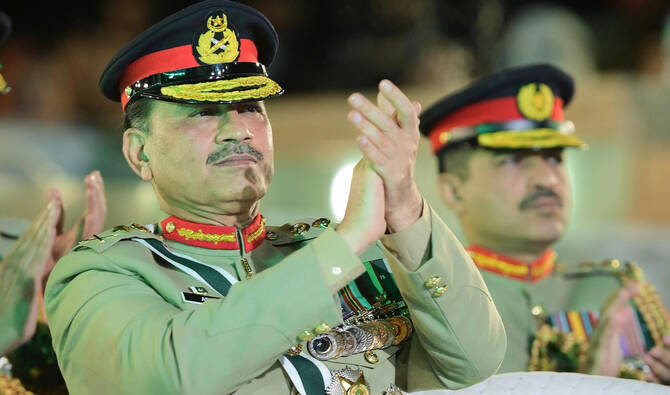
Field Marshal Asim Munir: The Architect of Pakistan’s New Strategic Future
South Asia is undergoing one of its most turbulent strategic transitions since the Soviet invasion of Afghanistan. Power vacuums are widening across the Afghan–Pakistan border, India is...

South Asia is undergoing one of its most turbulent strategic transitions since the Soviet invasion of Afghanistan. Power vacuums are widening across the Afghan–Pakistan border, India is reinvigorating its covert networks with remarkable patience, global powers are reasserting influence after the U.S. withdrawal, and non-state actors are exploiting regional economic disruption. This is not a moment shaped by ideology. It is shaped by geography, competition, and the long shadow of great-power miscalculations.
Pakistan stands at the centre of this storm. It is confronted simultaneously by a hostile western frontier, an emboldened India, an unpredictable Afghan state, and a global order that no longer offers the clarity of bipolar power. Into this unstable landscape stepped Syed Asim Munir — Field Marshal. He did not emerge as a ceremonial figurehead; he emerged as a decisive actor at a time when Pakistan needed coherence, discipline, and strategic direction more than at any point in the last two decades.
A Command Born in Crisis
When Asim Munir assumed command as the 17th Chief of Army Staff on 29 November 2022, Pakistan was facing political volatility, economic decay, and a resurgence of militancy. From the very beginning, he declared that national security, economic stability, and political continuity would be the pillars of Pakistan’s revival. These were not slogans — they became the operating philosophy of his tenure.
His first major test came on 9 May 2023, when orchestrated riots targeted military installations. Munir personally inspected the damaged sites, ensured strict accountability, and oversaw trials in military courts. The swift reassertion of state authority drew a clear line between political dissent and anti-state attacks, restoring stability at a moment when Pakistan risked fragmentation.
Economic Security as National Defense
Field Marshal Munir recognized early that Pakistan’s economic fragility had become its greatest national security threat. In June 2023, he spearheaded the creation of the Special Investment Facilitation Council (SIFC) — a civil–military platform designed to attract Gulf, Chinese, and mineral-sector investment into Pakistan’s core economy.
Later that year, he ordered an unprecedented crackdown on illegal currency markets and crypto-financing networks. These networks were funneling money to the BLA, BYC, TTP, and other foreign-sponsored proxies. By striking at their financial arteries, Munir not only stabilized the rupee but also dismantled the economic foundations of terrorism.
Diplomatic Recalibration and Strategic Outreach
In December 2023, Munir visited Washington and held discussions with Secretary of Defense Lloyd Austin and Secretary of State Antony Blinken. The visit reaffirmed Pakistan’s status as a frontline counter-terror partner and reinforced its strategic importance to the United States.
Throughout 2024, Pakistan launched nearly 60,000 intelligence-based operations targeting RAW-backed networks and terrorist outfits. Munir’s dual-track strategy — destroying militant sanctuaries while choking their financial pipelines — became the defining feature of his doctrine.
Simultaneously, he deepened Pakistan’s ties with Saudi Arabia, the UAE, Iran, Turkey, Azerbaijan, and China. Diplomacy under Munir moved from reactive engagement to calibrated strategic positioning.
His leadership also ensured the peaceful conduct of the 2024 general elections — a rarity in Pakistan’s turbulent political history — signaling renewed institutional stability.
The 2025 Conflict and the Rise of a Field Marshal
The defining test of Munir’s command emerged in April–May 2025. The Pahalgam attack triggered Indian aggression, but under Operation Bunyan um Marsoos (Marka-e-Haq), Pakistan’s Army, Navy, and Air Force executed a unified defensive and offensive posture.
Munir issued calibrated nuclear warnings, making it clear that any existential threat would be met with a catastrophic response. Pakistan repelled Indian advances, countered disinformation campaigns, and protected civilian populations with discipline and precision.
The U.S.-brokered ceasefire on 10 May 2025 was not a favour — it was an acknowledgment that Pakistan under Munir had redefined escalation thresholds.
On 16 May, Youm-e-Tashakur was declared to honour Pakistan’s resilience. And on 20 May 2025, Asim Munir was elevated to the rank of Field Marshal — the first since Ayub Khan and the only one awarded while still actively serving.
📄 POLICY WIRE WHITEPAPER PUBLISHED: PAKISTAN'S NATIONAL SECURITY POLICY PRIORITIES
👉 READ BY CLICKING HEREDigital Warfare and the Crypto Frontier
After the conflict, a new battlefield emerged. Hostile intelligence networks migrated from physical smuggling to digital ecosystems. Pakistan began formalizing cryptocurrency regulation not as a technological trend, but as a security necessity.
The Pakistan Crypto Council (PCC) was established as a full ministry, tasked with regulating blockchain finance, tokenizing Pakistan’s mineral wealth, and blocking foreign intelligence from exploiting crypto channels.
During this sensitive period, Zachary Witkoff — representing World Liberty Financial, a firm in which President Donald Trump holds a stake — quietly visited Pakistan. His discussions with Munir strengthened prospects for blockchain-backed investment aligned with Munir’s vision of securitized, technology-driven economic revival.
Global Reinforcement and Public Confidence
In June and July 2025, Munir returned to Washington for high-level meetings at the Pentagon and CENTCOM. He was also hosted by President Trump for a private White House lunch — a symbolic moment that signaled a renewed U.S.–Pakistan strategic understanding.
At home, Munir supervised flood relief in Punjab and initiated development drives in Balochistan. By mid-2025, Gallup recorded his public approval at 93 percent — one of the highest in Pakistan’s history.
At the SCO Summit later that year, Munir’s engagements with President Xi Jinping and President Masoud Pezeshkian highlighted Pakistan’s stabilizing regional role. He ensured Pakistan’s deeper integration into SCO counter-terror financing frameworks, further restricting RAW-backed militant pipelines.
A Strategic Vision for Pakistan’s Future
From 2023 to 2025, Field Marshal Asim Munir did not merely respond to crises — he constructed a new national doctrine built on security, economic resilience, strategic clarity, and long-term statecraft.
Under his leadership, Pakistan dismantled militant financing networks, revived investor confidence, restored deterrence against India, regained diplomatic weight in Washington, Beijing, and the Muslim world, modernized its financial regulatory systems, and emerged with a more coherent and forward-looking security architecture than at any point in the last decade.
Field Marshal Asim Munir is the central actor shaping Pakistan’s direction. The foundations he is building — economic securitization, institutional stability, and regional balancing — are setting the stage for a more stable, confident, and strategically anchored Pakistan in the years ahead.
The future is brighter not because circumstances have become easier, but because Pakistan today has a commander who understands how to turn crises into strategy, setbacks into structure, and pressure into national direction. Under Field Marshal Asim Munir, that direction is finally pointing upward.
Author