


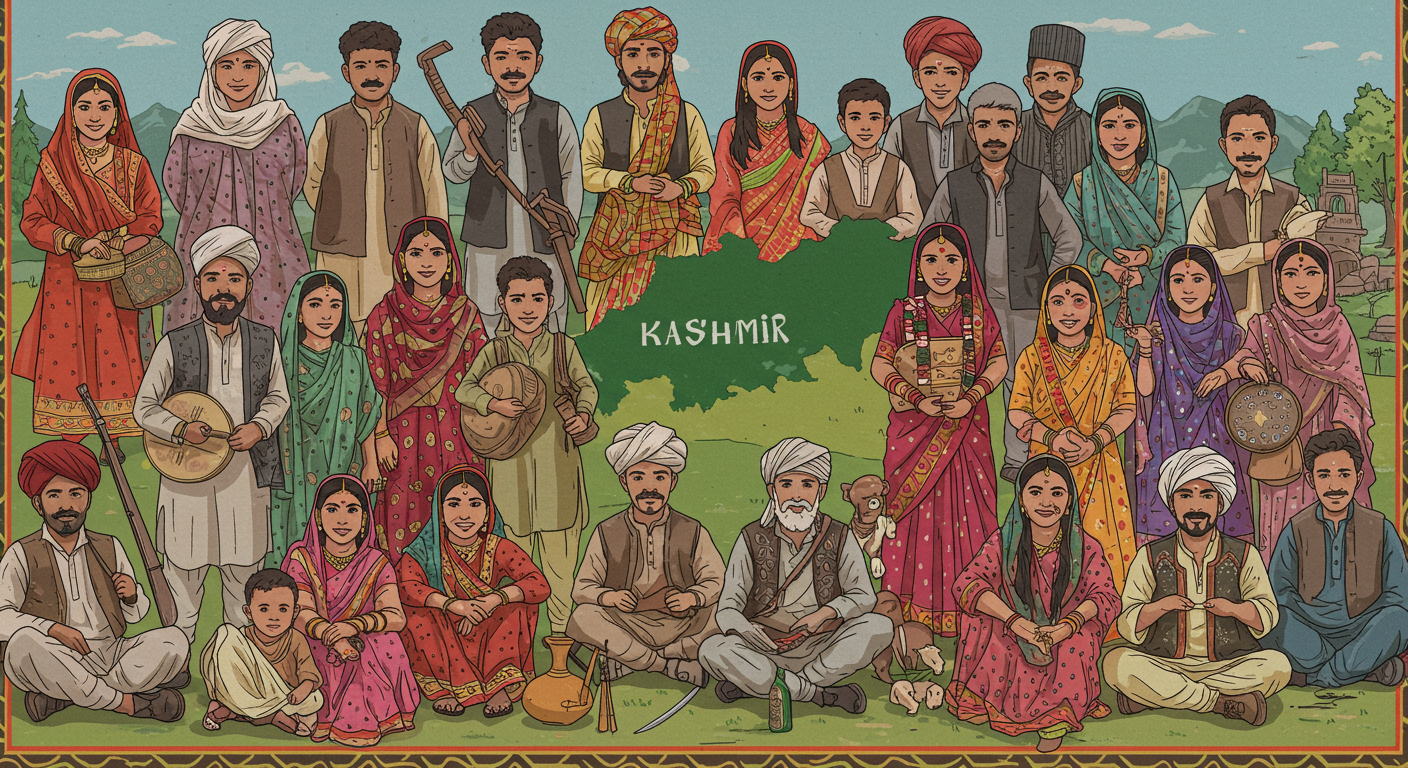
AJK’s Demographic Story: Small in Size, Strong in Significance
Azad Jammu and Kashmir (AJK) rarely makes it to the front pages of international media. Overshadowed by Pakistan’s larger provinces and often ignored in global discussions, AJK appears small in size...
Azad Jammu and Kashmir (AJK) rarely makes it to the front pages of international media. Overshadowed by Pakistan’s larger provinces and often ignored in global discussions, AJK appears small in size and population. Yet, behind the numbers lies a story that reveals its unique importance. It is a story of people, growth, governance, and comparison, especially with Indian Illegally Occupied Jammu and Kashmir (IIOJK), that demonstrates how Pakistan has given space, recognition, and autonomy to a region with limited resources but immense symbolic value.
AJK’s population stands at 4.45 million, which makes up 1.8% of Pakistan’s total population of 241.49 million. If we exclude its nearly two million diasporas, the local population falls to 2.45 million. This number may appear small compared to Punjab’s 127.6 million or Sindh’s 55.6 million, but the story changes when we consider density and global influence. The diaspora has carried AJK’s voice across the world, strengthening Pakistan’s narrative on Kashmir in international forums. This makes AJK not just a local region but a global community with impact far beyond its geography.
The total area of AJK is just 13,297 square kilometers, far smaller than Balochistan (347,190 km²) or Punjab (205,344 km²). However, AJK’s population density of 300 people per square kilometer tells another story. It is more crowded than Sindh (395 per km²) and nearly as dense as Khyber Pakhtunkhwa (401 per km²). Compared to Gilgit-Baltistan (21 per km²) or Balochistan (43 per km²), AJK is a highly concentrated region where communities are closely linked, creating both opportunities and challenges. This density means quicker service delivery and stronger community ties, but it also raises pressure on jobs, housing, and resources.
Connectivity often determines the quality of life and the strength of local economies. Here, AJK’s performance is notable. With a road network of 8,865 kilometers, the region’s road density is 0.66 km/km², double that of IIOJK (0.516 km/km²) and far better than most Pakistani provinces such as Balochistan (0.05) and Gilgit-Baltistan (0.08). Despite India’s much-advertised Operation Sadbhavna development programs in IIOJK, the numbers speak for themselves: Pakistan has enabled stronger connectivity in AJK than India has in its occupied territory. Roads in AJK are more than infrastructure, they are lifelines that connect mountain communities, enable trade, and strengthen social bonds.
Demographics are not just about numbers today, but about what they promise tomorrow. AJK’s population growth rate is 2.41%, close to Pakistan’s national average of 2.55%. Compared to Gilgit-Baltistan’s sharp 4.85% or Balochistan’s 3.2%, AJK grows at a moderate pace. This stability ensures steady economic activity while keeping the risks of overcrowding manageable. Yet, with a youthful population, AJK faces the same challenges as the rest of Pakistan, how to create jobs, expand education, and provide housing for the next generation. Managed wisely, this growth can be an asset; left unchecked, it can strain local resources.
What makes AJK stand apart is not only its size or density, but its constitutional status. Through the 13th Amendment of 2018, Pakistan transferred the financial and legislative powers of the AJK Council to the AJK Legislative Assembly. This gave the region autonomy in line with Pakistan’s provinces, strengthening self-rule and ensuring that local voices matter in decision-making. Contrast this with IIOJK, where India revoked Article 370 in 2019, stripping the region of its special status and placing it under direct control of New Delhi. Instead of autonomy, the people of IIOJK face repression, demographic engineering, and denial of basic rights. The difference is stark: where Pakistan has empowered AJK with legislative independence, India has suffocated IIOJK with occupation and control.
Another striking fact is that AJK’s population is smaller than that of Rawalpindi district, yet its civil government structure is equal to that of a province. This shows Pakistan’s recognition of AJK’s symbolic and political value. Running a provincial-level government for a smaller population does create financial pressures, but it also demonstrates Pakistan’s commitment to treating AJK not as a forgotten periphery but as a vital part of the national family.
📄 POLICY WIRE WHITEPAPER PUBLISHED: PAKISTAN'S NATIONAL SECURITY POLICY PRIORITIES
👉 READ BY CLICKING HEREAJK residents also benefit from dual nationality, a privilege that expands opportunities abroad and links the region to global networks. This is a strength India has consistently denied to the people of IIOJK, where restrictions and curbs dominate. For Pakistan, AJK’s dual nationality helps strengthen international advocacy on Kashmir, making the diaspora an extension of the state’s soft power.
When the figures are placed side by side, the story of AJK is clear. It is a small territory with a dense population, better road connectivity than its occupied counterpart, steady growth, and political autonomy that reflects Pakistan’s democratic approach. India’s record in IIOJK tells the opposite tale: repression, lack of autonomy, and heavy-handed control. AJK may not rival Punjab in population or Sindh in economy, but its significance lies elsewhere. It is proof that Pakistan has nurtured even its smallest regions with recognition and governance. It is also living evidence that the people of Kashmir can enjoy dignity, autonomy, and connectivity under Pakistan’s framework, something denied to those living under Indian occupation. AJK’s demographic profile is not just about numbers on a chart. It is a reflection of Pakistan’s inclusive vision and a silent but powerful message to the world: freedom and development flourish where people are trusted, not where they are controlled.
Author