

Nvidia’s AI Boom: Riding High Despite Geopolitical Storms
The world is racing to embrace artificial intelligence, and at the center of it all sits Nvidia. The American chipmaker, once known only to gamers and computer enthusiasts, is now powering the AI...

The world is racing to embrace artificial intelligence, and at the center of it all sits Nvidia. The American chipmaker, once known only to gamers and computer enthusiasts, is now powering the AI revolution at a scale few imagined possible. Its chips are behind the rise of generative AI tools like ChatGPT, the growth of self-learning systems, and the ambitious dreams of Big Tech firms hoping to dominate the next technological era. This week, Nvidia announced that its revenue for the second quarter of 2025 hit $46.7 billion, a staggering 56% jump compared to the same period last year. The numbers tell a simple story: the global appetite for AI is growing faster than anyone expected, and Nvidia is feeding that demand better than anyone else but the story is not as straightforward as just profit and progress. Behind these big numbers lie complex geopolitical battles, U.S. export restrictions, and concerns about whether the AI boom is racing ahead faster than governments can keep up. Nvidia is riding high, but it is also walking a tightrope.
When Nvidia’s founder and CEO Jensen Huang spoke to investors after the earnings report, his message was clear: the AI race is now on. Tech giants like Meta, Microsoft, and Google have doubled their annual AI spending to $600 billion, hoping to build bigger and better AI models. And Nvidia’s chips are the foundation for much of this work. “It is no exaggeration to say Nvidia is at the heart of the AI boom,” said Colleen McHugh, chief investment officer at Wealthify. “Its chips are essential, and there is very little competition at the top end of the market.”
This dominance has made Nvidia the world’s first $4 trillion company, surpassing tech giants like Apple and Microsoft earlier this summer. The company expects its revenue to climb even higher, to $54 billion next quarter, as AI adoption continues across industries, from healthcare to finance to entertainment but even as the company breaks records, analysts warn that the rapid pace of investment might also signal “too much exuberance,” as investor Eileen Burbridge put it. Some fear the AI sector could be heading toward a bubble, much like the dot-com boom two decades ago.
Despite its historic success, Nvidia’s latest results were not perfect. Revenue from its data center division, responsible for much of the AI growth, rose 56% to $41.1 billion, but still fell slightly short of Wall Street’s sky-high expectations. The news caused Nvidia’s share price to dip in after-hours trading, even though its overall performance remains extraordinary. Burbridge called the small share price wobble “a reaction to overly high hopes rather than real weakness.” In other words, Nvidia is doing incredibly well, just not as incredibly as some investors wanted. Yet the real storm clouds gathering over Nvidia have little to do with sales numbers. Instead, they come from Washington and Beijing.
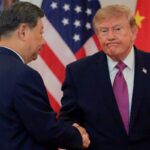
The U.S. government has restricted the sale of advanced AI chips to China, citing concerns that the technology could be used by the Chinese military or boost China’s AI capabilities in ways that challenge American interests. Last year, Washington banned sales of some of Nvidia’s most advanced chips to Chinese firms, creating a headache for the company because China is one of its biggest markets.
In response, Nvidia designed special H20 chips for China that meet U.S. regulations but still offer powerful AI capabilities. After months of lobbying, the Trump administration recently granted licenses for some of these sales. But Nvidia says it has not yet shipped any of the chips, and the U.S. government will take 15% of the revenue from licensed H20 sales when they happen. Meanwhile, China is investing heavily in building its own chip industry to reduce reliance on American technology. As analyst Jacob Bourne noted, “U.S. export restrictions are fueling domestic chipmaking in China,” which could one day create serious competition for Nvidia.
📄 POLICY WIRE WHITEPAPER PUBLISHED: PAKISTAN'S NATIONAL SECURITY POLICY PRIORITIES
👉 READ BY CLICKING HEREFor now, though, Nvidia’s position looks unshakable. Its technology powers the AI systems shaping everything from driverless cars to medical research. Jensen Huang believes AI could eventually boost global GDP growth, with Nvidia providing the infrastructure to make it possible but there are risks ahead. Governments are scrambling to regulate AI, China is racing to build its own chip industry, and investors worry about the possibility of an AI bubble. At the same time, demand for Nvidia’s products is so strong that it is hard to imagine its growth slowing anytime soon. What happens next will depend not only on Nvidia’s engineering brilliance but also on how the U.S. and China manage their technological rivalry. For now, Nvidia stands as the face of the AI revolution, powerful, ambitious, and moving forward at full speed despite the geopolitical storms surrounding it. As the world debates the future of artificial intelligence, one thing is certain: Nvidia is not just making chips. It is shaping the foundations of the digital age itself.
Author